nondiscrimination

“My right hand does a lot of things–it creates calligraphy and writes poems. Nearly all my poems have been written with my right hand because I don’t use a typewriter. There was only one time when I wrote a poem on a typewriter. When inspiration came to me, I did not have a pen at hand so I just put an envelope into the typewriter, and at that time my left hand participated. All the rest of my poems were written with my right hand alone, yet my right hand never says to the left hand, ‘You, you are good for nothing! You don’t do calligraphy, you don’t write poems. I do all the work, you never do anything!’

whitewaterraftingweb

“The body never discriminates in this way. Don’t think that this is because our bodies do not possess any inherent intelligence. While trying to hang a picture on the wall, I held the nail in my left hand and hammered with the right. But instead of hitting the nail I hit a finger on my left hand. That happens from time to time, especially if you are high up on a ladder. Immediately the right hand put down the hammer and reached over to take care of the left hand, very naturally. The feet began to move to look for a bandage. Everything worked together very smoothly. Later the right hand did not say, “Hay left hand, remember how I helped you? Next time I need something you have to come and help me.’ Our innately wise bodies do not act in that way. So the wisdom of nondiscrimination is present in us as a living bodily reality. We have to train our minds to see in this way.

whitewaterraftingbweb

We form one reality. We exist in interbeing with all of life. When we understand this fundamental truth, our acts of giving will be made in the spirit of nondiscrimination. …we can offer a smile or a loving compassionate gaze. We can give the gift of calm, concentrated presence to help someone who is fearful or anxious. We can make an offering of our time and energy and work with the homeless, or with those who are prisoners or who are addicted to different substances, or to work on helping the environment. We have plenty of gifts to offer; we are far wealthier than we may imagine. We can help secure the happiness of many people even if we don’t have a single penny in our pocket.”

~Thich Nhat Hanh, Opening the Heart of the Cosmos

Solitude…

solitude

Today’s edition of Aeon offered an amazing piece, Before you can be with others, first learn to be alone, written by Jennifer Stitt.  Hope you find this discussion about solitude as enlightening as I do.

“In 1840, Edgar Allan Poe described the ‘mad energy’ of an ageing man who roved the streets of London from dusk till dawn. His excruciating despair could be temporarily relieved only by immersing himself in a tumultuous throng of city-dwellers. ‘He refuses to be alone,’ Poe wrote. He ‘is the type and the genius of deep crime … He is the man of the crowd.’

Like many poets and philosophers through the ages, Poe stressed the significance of solitude. It was ‘such a great misfortune’, he thought, to lose the capacity to be alone with oneself, to get caught up in the crowd, to surrender one’s singularity to mind-numbing conformity. Two decades later, the idea of solitude captured Ralph Waldo Emerson’s imagination in a slightly different way: quoting Pythagoras, he wrote: ‘In the morning, – solitude; … that nature may speak to the imagination, as she does never in company.’ Emerson encouraged the wisest teachers to press upon their pupils the importance of ‘periods and habits of solitude’, habits that made ‘serious and abstracted thought’ possible.

In the 20th century, the idea of solitude formed the centre of Hannah Arendt’s thought. A German-Jewish émigré who fled Nazism and found refuge in the United States, Arendt spent much of her life studying the relationship between the individual and the polis. For her, freedom was tethered to both the private sphere – the vita contemplativa – and the public, political sphere – the vita activa. She understood that freedom entailed more than the human capacity to act spontaneously and creatively in public. It also entailed the capacity to think and to judge in private, where solitude empowers the individual to contemplate her actions and develop her conscience, to escape the cacophony of the crowd – to finally hear herself think.

In 1961, The New Yorker commissioned Arendt to cover the trial of Adolf Eichmann, a Nazi SS officer who helped to orchestrate the Holocaust. How could anyone, she wanted to know, perpetrate such evil? Surely only a wicked sociopath could participate in the Shoah. But Arendt was surprised by Eichmann’s lack of imagination, his consummate conventionality. She argued that while Eichmann’s actions were evil, Eichmann himself – the person – ‘was quite ordinary, commonplace, and neither demonic nor monstrous. There was no sign in him of firm ideological convictions.’ She attributed his immorality – his capacity, even his eagerness, to commit crimes – to his ‘thoughtlessness’. It was his inability to stop and think that permitted Eichmann to participate in mass murder.

Just as Poe suspected that something sinister lurked deep within the man of the crowd, Arendt recognised that: ‘A person who does not know that silent intercourse (in which we examine what we say and what we do) will not mind contradicting himself, and this means he will never be either able or willing to account for what he says or does; nor will he mind committing any crime, since he can count on its being forgotten the next moment.’ Eichmann had shunned Socratic self-reflection. He had failed to return home to himself, to a state of solitude. He had discarded the vita contemplativa, and thus he had failed to embark upon the essential question-and-answering process that would have allowed him to examine the meaning of things, to distinguish between fact and fiction, truth and falsehood, good and evil.

‘It is better to suffer wrong than to do wrong,’ Arendt wrote, ‘because you can remain the friend of the sufferer; who would want to be the friend of and have to live together with a murderer? Not even another murderer.’ It is not that unthinking men are monsters, that the sad sleepwalkers of the world would sooner commit murder than face themselves in solitude. What Eichmann showed Arendt was that society could function freely and democratically only if it were made up of individuals engaged in the thinking activity – an activity that required solitude. Arendt believed that ‘living together with others begins with living together with oneself’.

But what if, we might ask, we become lonely in our solitude? Isn’t there some danger that we will become isolated individuals, cut off from the pleasures of friendship? Philosophers have long made a careful, and important, distinction between solitude and loneliness. In The Republic (c380 BCE), Plato proffered a parable in which Socrates celebrates the solitary philosopher. In the allegory of the cave, the philosopher escapes from the darkness of an underground den – and from the company of other humans – into the sunlight of contemplative thought. Alone but not lonely, the philosopher becomes attuned to her inner self and the world. In solitude, the soundless dialogue ‘which the soul holds with herself’ finally becomes audible.

Echoing Plato, Arendt observed: ‘Thinking, existentially speaking, is a solitary but not a lonely business; solitude is that human situation in which I keep myself company. Loneliness comes about … when I am one and without company’ but desire it and cannot find it. In solitude, Arendt never longed for companionship or craved camaraderie because she was never truly alone. Her inner self was a friend with whom she could carry on a conversation, that silent voice who posed the vital Socratic question: ‘What do you mean when you say …?’ The self, Arendt declared, ‘is the only one from whom you can never get away – except by ceasing to think.’

Arendt’s warning is well worth remembering in our own time. In our hyper-connected world, a world in which we can communicate constantly and instantly over the internet, we rarely remember to carve out spaces for solitary contemplation. We check our email hundreds of times per day; we shoot off thousands of text messages per month; we obsessively thumb through Twitter, Facebook and Instagram, aching to connect at all hours with close and casual acquaintances alike. We search for friends of friends, ex-lovers, people we barely know, people we have no business knowing. We crave constant companionship.

But, Arendt reminds us, if we lose our capacity for solitude, our ability to be alone with ourselves, then we lose our very ability to think. We risk getting caught up in the crowd. We risk being ‘swept away’, as she put it, ‘by what everybody else does and believes in’ – no longer able, in the cage of thoughtless conformity, to distinguish ‘right from wrong, beautiful from ugly’. Solitude is not only a state of mind essential to the development of an individual’s consciousness – and conscience – but also a practice that prepares one for participation in social and political life. Before we can keep company with others, we must learn to keep company with ourselves.”Aeon counter – do not remove

Jennifer Stitt

This article was originally published at Aeon and has been republished under Creative Commons.

try

tryWhen you are in touch with the suffering in the world, it is so easy for despair to overwhelm you. …Throughout the war in Vietnam young people easily became the victims of despair because the war went on for so long and it seemed it would never end. It is the same with the situation in the Middle East. young Israelis and Palestinians feel the heavy atmosphere of war will never end.



Animals, plants, and minerals also suffer because of the greed of human beings. The earth, the water and air are suffering because we have polluted them. The trees suffer because we destroy the forest for our own profit. Some species have become extinct because of the destruction of the natural environment. Humans also destroy and exploit one another. How can we stop ourselves from collapsing in despair?

The bodhisattva of wonderful sound, Gadgadashvara, can use music, writings and sound to awaken people.  If you are a poet, a writer or a composer you can be that bodhisattva. Your artistic creations are not just to help people forget their pain momentarily but to water the seeds of awakened understanding and compassion in others.  Among us are so many writers, poets and composers who are using the wonderful ocean of sound to serve the way of understanding and love…(excerpts from Thich Nhat Hanh’s No Death, No Fear)

nature’s lace


nature'slace

“Life can certainly have meaning without books, but books cannot have meaning without life. Most of us probably share a belief that life is greatly enriched by them: life goes into books and books go back into life. But the relationship is not equal or symmetrical. Nonetheless what is in them not only adds to life, but genuinely goes back into life and transforms it, so that life as we live it in a world full of books is created partly by books themselves.”

~I McGilchrist, The Master and his Emissary

illumination

Protecting oneself, one protects others; protecting others, one protects oneself . . . And how does one, in protecting oneself, protect others? By the repeated and frequent practice of meditation.
And how does one, in protecting others, protect oneself? By patience and forbearance, by a non-violent and harmless life, by loving kindness and compassion. But self-protection is not selfish protection. It is self-control, ethical and spiritual self-development.
~ The Buddha

tulipshadesofbnw

an uncertain weekend

Angry in the ultimate dimension

I close my eyes and look deeply

Three hundred years from now

Where will you be and where shall I be?

~Thich Nhat Hanh*

abnwstudy

While Thich Nhat Hanh’s words are of anger, I believe they also apply to today’s uncertainty in that “…we are living in the most fear mongering time in human history. And the main reason for this is that there’s a lot of power and money available to individuals and organizations who can perpetrate these fears.”

…where fear is about danger that seems certain; anxiety is…”an experience of uncertainty.”

If there is a crack in human psychology into which demagogues wriggle, it is by offering psychological relief for the anxiety created by uncertainty…this is where a good scapegoat comes in; for example, There’ us — real Americans – then there are…”**

May equanimity fill the minds and hearts of all this holiday season and end this dangerous game of brinkmanship.

*cited: No Death, No Fear, Thich Nhat Hanh

**cited: Why We’re Living in the Age of Fear, Rolling Stone

life…manifesting again and again

do you also miss

your mother?

cicada ~Issa*

mom

Tulip

In Thich Nhat Hanh”s book, No Death No Fear,  he shares a personal experience associated with the passing away of his mother.

“The day my mother died, I wrote in my journal, ‘A  serious misfortune of my life has arrived.’  I suffered for more than one year after the passing away of my mother. But one night, in the highlands of Vietnam … I dreamed of my mother. …When I woke up…I felt very strongly that I had never lost my mother. The impression that my mother was still with me was very clear. I understood then that the idea of having lost my mother was just an idea. It was obvious in that moment that my mother is always alive in me.

I opened the door and went outside. …Walking slowly in the moonlight through the rows of tea plants, I noticed my mother was still with me. She was the moonlight caressing me as she had done so often, very tender, very sweet…wonderful! Each time my feet touched the earth I knew my mother was there with me. I knew this body was not mine alone but a living continuation of my mother and my father and my grandparents and great-grandparents. Of all my ancestors. These feet that I saw as ‘my’ feet were actually ‘our’ feet. Together my mother and I were leaving footprints in the damp soil.

From that moment on, the idea that I had lost my mother no longer existed. All I had to do was look at the palm of my hand, feel the breeze on my face or the earth under my feet to remember that my mother is always with me, available at any time.

When you lose a loved one, you suffer. But if you know how to look deeply, you have a chance to realize that his or her nature is truly the nature of no birth, no death. There is a manifestation and there is the cessation of manifestation in order to have another manifestation.

…If you can stop and look deeply, you will be able to recognize your beloved one manifesting again and again in many forms. You will again embrace the joy of life.” (pp. 4-5)

In remembrance of my mother’s birthday…who passed away April 19, 2016.

*cited: http://www.haikuguy

real or imaginary

when i awake

i wonder

if the color i saw

in my dream

was real 

or imaginary

winterbckofford-abstract20154dsc_2139jan-27-2017was it red?

i turn back

towards the word red

but the color is gone

what i thought was 

being alive 

is only various colors

reflected and

scattered

in my mind

sun setting

turned the windowpane orange

shower spray

was a diamond color

so i thought

now only the memory 

of color remains

the window 

and the shower spray

have vanished.

~Yoshihara Sachiko

I found this video, The Pattern behind Self-deception, at Ted.com by Michael Shermer interesting as well as entertaining.  Hope you find your self smiling.

anxiety’s blindness

Every day my anxiety grew deeper,

until it enveloped me so thickly

that I could see nothing.

Alone in an illimitable desert

I wept hopelessly, as if in a nightmare in dawn

where the open mouth blue sky wept with me.

~Nakamura Chio*

beauty

my gift to you today…awakening seeds of calmness… right diligence

*cited:

Women Poets of Japan

K Rexroth &  I Atsumi

we need truth…or do we need a truth that validates our personal viewpoints?

…facts alone hardly put an end to [political] arguments. People embrace the facts they want to hear.

‘We don’t behave at all like the ideal picture of engaged citizens neutrally and dispassionately analyzing the evidence before casting their ballot…It’s not how people work.’

…the ‘backfire effect’ [is when] people with deeply held political beliefs double down on those beliefs when presented with facts that contradict them.

Human beings, it seems, have a tendency to engage in ‘directionally motivated reasoning’ – roughly, to draw conclusions based on the evidence that supports the conclusions they want to draw. And in politics those conclusions…seem to be rooted in allegiances as expressions of identity. Your desire to believe, despite the overwhelming evidence to the contracting…isn’t about what’s true. It’s about who you are.*

weneedtruth

*cited:
2016 Could Be Fact-Checking’s Finest Year – If Anyone Listens, 9/13/16
http://www.wired.com

seeing differently: 4th of 15

Jung describes synchronicity as a meaningful coincidence of two or more events, where something other than the probability of chance is involved. …The critical factor is the meaning, the subjective experience that comes to the person: events are connected in a meaningful way, that is, events of the inner and outer world, the invisible and the tangible, the mind and the physical universe. This coming together at the right moment can happen only without the conscious intervention of the ego. …it is as though the psyche had its own secret design…

~The Essence of Jung Psychology and Tibetan Buddhism, Radmila Moacanin

windowwindow6

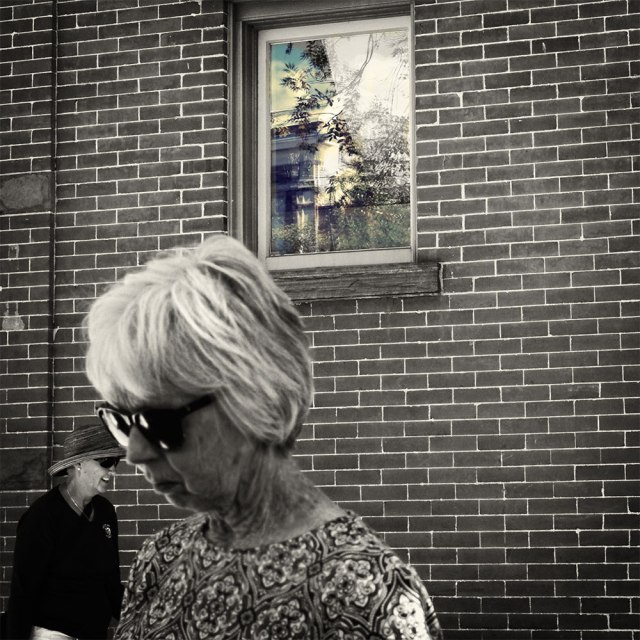
I find myself drawn to photograph people who seemingly are within their own worlds as they wander, interact, mingle within the public realm.  Yet, sometimes the eye is drawn towards the amazing abstract paintings light creates within the window canvas.

Seeing Differently is an October challenge proposed by Robyn.

reflections

…instead of a coherent personality that stretches back in an unbroken line to a first memory and looks forward to an indefinite future, we discover a self ridden with gaps and ambiguities.  Who “I am” appears coherent only because of the monologue we keep repeating, editing, censoring, and embellishing in our heads.

windows