early morning readings II

In this world, time is like a flow of water, occasionally displaced by a bit of debris, a passing breeze.  Now and then, some cosmic disturbance will cause a rivulet of time to turn away from the mainstream, to make connection back stream. When this happens, birds, soil, people caught in the branching tributary find themselves suddenly carried to the past.   ~A Lightman, Einstein’s Dreams

Reality in itself is a stream of life, always moving.  ~Thich Nhat Hanh, The Sun My Heart

Cartier-Bresson’s photograph of children playing in the rubble of war…may become a metaphor or symbol of hope. The image over my desk of a grieving mother and child after an earthquake in Armenia, made by my photographer friend Mark Beach, symbolized for me the sorrow and tragedy that is part of life.  An image I once made of the source of the mighty Susquehanna River–a spring flowing into a bathtub in a field that serves as a water tank for cows, then spilling over to begin a stream–reminds me that the restorative juice “river,” with which I am associated, has many small sources.  ~H Zehr, The Little Book of Contemplative Photography
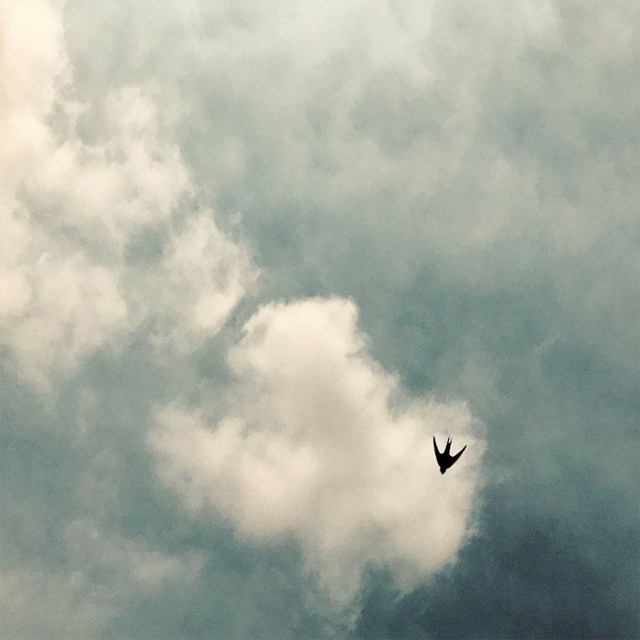
a photo study: contemplative photography II

Beyond the clouds
My gaze goes on and on;
The endless sea:
What lies beyond is unknown
As my gloomy thoughts…

~Lord Suetsune (cited: http://www.wakapoetry.net)

solitarybirdweb

sparrow…    Apple iPad   f/1.8  1/12000s   20 ISO

This week’s photo study was inspired by Howard Zehr, (Contemplative Photography seeing with wonder, respect, and humility).  He invites us to consider,

“… how we might use the medium of photography to stimulate our imaginations, to develop our intuitive and aesthetic sensibilities, to gain new insights. …to stop and look and be refreshed. In order to do this, [he] asks us to ‘re-image’ how we envision and carry out photography.

“Rarely do we spend enough time with an image to ‘mine’ all of its visual, emotional, and spiritual potential. Rarely are we aware of its impact on the emotional as well as the intellectual level. Too often our tendencies to judge and evaluate get in the way of appreciating what we see.”

Photo Assignment:
Discipline yourself to make at least one photograph each day.
Once a week, spend at least 10 minutes with one of the photographs.
As you do, consider three topics in this order:
I see — describe each object, each detail, the light, etc., Then associate: what are you reminded of by the shapes, juxtapositions, etc.
I feel — What do you feel as you look at the image?
I think — Interpret and analyze.
Keep a journal about this and any insights you gain.

“The practice of contemplative photography does not end when you finish shooting… The first thing you should do after [photographing] is spend some time with each of your images.  Try to see which ones work and which do not. Don’t be in a hurry to delete the ones you don’t like, but try to learn from them. See if you can remember what was going on in your state of mind when you [pressed the shutter].”  ~ A Karr & M Wood (The Practice of Contemplative Photography)

I am looking forward to seeing your image that was inspired by Howard Zehr’s photo assignment.  Let’s tag with #aphotostudy.

Photo Friday: “Candid Shot”

photofricandid

When we photograph, we do not actually reach out and take anything.  A camera is basically a dark box with a receptor (film or digital sensor) on one side and a small opening on the other.  Light reflected from the subject is projected through the opening by the lens onto the receptor opposite it.  When we do photography, we receive an image that is reflected from the subject. Instead of photography as taking, then, we can envision it as receiving.  Instead of a trophy that is hunted, an image is a gift.

~Howard Zehr*

*cited in:  The Little Book of Contemplative Photography