lie without waking…

…In infinite succession light and darkness shift,

And years vanish like the morning dew.

Man’s life is like a sojourning,

His longevity lacks the firmness of stone and metal.

For ever it has been that mourners in their turn were mourned,

Saint and Sage,—all alike are trapped.

Seeking by food to obtain Immortality

Many have been the dupe of strange drugs.

Better far to drink good wine

And clothe our bodies in robes of satin and silk. …

The above 12th poem is from a series known as the Nineteen Pieces of Old Poetry. Some have been attributed to Mei Shēng (first century b.c.), and one to Fu I (first century a.d.). They are manifestly not all by the same hand nor of the same date. Internal evidence shows that No. 3 at least was written after the date of Mei Shēng’s death. These poems had an enormous influence on all subsequent poetry, and many of the habitual clichés of Chinese verse are taken from them.

cited: Trans: Arthur Waley, A hundred and Seventy Chinese Poems. Project Gutenberg. This ebook is made available at no cost and with almost no restrictions whatsoever. You may copy it, give it away or re-use it under the terms of the Project Gutenberg of Australia License which may be viewed online at http://gutenberg.net.au/license.html.

66th day of self isolation 

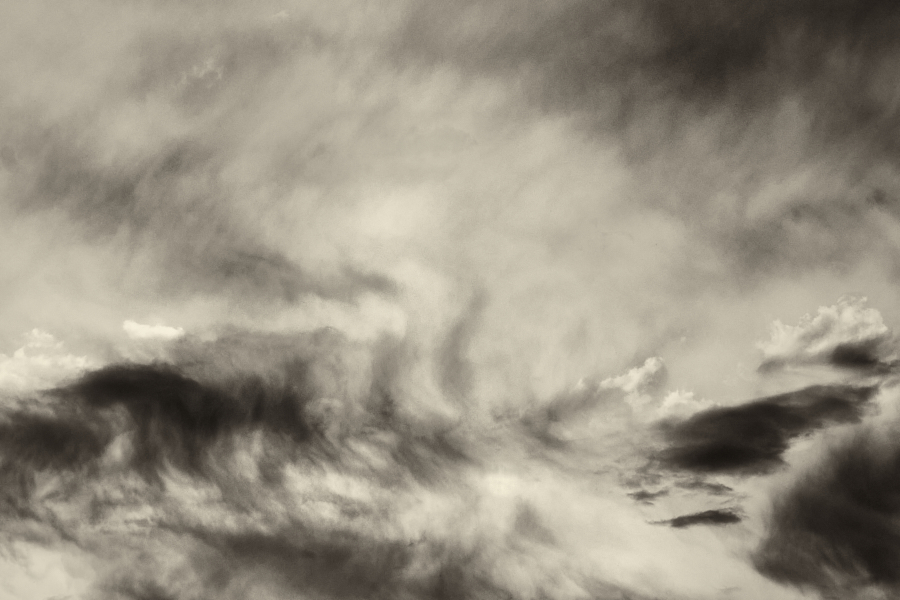
Skyscape photograph Nikon D750 f/8 1/25s 32 mm 400 ISO edited: Capture One 20 and Photoshop

the man who dreamed of fairies*

There was once a man who dreamt he went to Heaven:

His dream-body soared aloft through space.

He rode on the back of a white-plumed crane,

And was led on his flight by two crimson banners.

Whirring of wings and flapping of coat tails!

Jade bells suddenly all a-tinkle!

Half way to Heaven, he looked down beneath him,

Down on the dark turmoil of the World.

Gradually he lost the place of his native town…

~Po Chü

cited: Trans: Arthur Waley, A hundred and Seventy Chinese Poems. Project Gutenberg. This ebook is made available at no cost and with almost no restrictions whatsoever. You may copy it, give it away or re-use it under the terms of the Project Gutenberg of Australia License which may be viewed online at http://gutenberg.net.au/license.html.

65th day of self isolation 

Skyscape photograph Nikon D750 f/8 1/80s 92 mm 400 ISO edited: Capture One 20

*Po Chü’s (AD 772-846) poem is an attack on the Emperor Hsien-tsung, a.d. 806-820, who “was devoted to magic.” A Taoist wizard told him that herbs of longevity grew near the city of T’ai-chou. The Emperor at once appointed him prefect of the place, “pour lui permettre d’herboriser plus à son aise” (Wieger, Textes III, 1723). When the censors protested, the Emperor replied: “The ruin of a single district would be a small price to pay, if it could procure longevity for the Lord of Men.”

day’s end

sunset–
tears shine in a frog’s eyes
too

~Issa (cited: www.haikuguy.com)

David G. Lanoue writes

The most important word in this haiku is “too” (mo). The frog’s eyes look shiny, as if filled with tears. The “too” suggests someone else in the scene, and that someone else has to be Issa. Why are there tears in the poet’s eyes? He doesn’t say. Instead, he shows us, simply, a sunset and a frog. The day is over. Is the frog sad about this? Regretful? And what if the whole scene is symbolic, sunset suggesting death and the day that is almost gone, a lifetime? Then, the frog’s and Issa’s tears become even more significant and poignant. Together they weep for what has been and will never be again. 

64th day of self isolation

Skyscape photograph Nikon D750 f/8 1/100s 190 mm 400 ISO edited: Capture One 20 & Photoshop

the distant parting

the distant parting

III. 1. The Distant Parting

“Long ago there were two queens* called Huang and Ying. And they stood on the shores of the Hsiao-hsiang, to the south of Lake Tung-t’ing. Their sorrow was deep as the waters of the Lake that go straight down a thousand miles. Dark clouds blackened the sun. Shōjō** howled in the mist and ghosts whistled in the rain. The queens said, ‘Though we speak of it we cannot mend it. High Heaven is secretly afraid to shine on our loyalty. But the thunder crashes and bellows its anger, that while Yao and Shun are here they should also be crowning Yü. When a prince loses his servants, the dragon turns into a minnow. When power goes to slaves, mice change to tigers.

“’Some say that Yao is shackled and hidden away, and that Shun has died in the fields.

“’But the Nine Hills of Deceit stand there in a row, each like each; and which of them covers the lonely bones of the Double-eyed One, our Master?’

“So the royal ladies wept, standing amid yellow clouds. Their tears followed the winds and waves, that never return. And while they wept, they looked out into the distance and saw the deep mountain of Tsang-wu.

“’The mountain of Tsang-wu shall fall and the waters of the Hsiang shall cease, sooner than the marks of our tears shall fade from these bamboo-leaves.’”

Cited:

The Project Gutenberg EBook of The Poet Li Po, by Arthur Waley and Bai Li This eBook is for the use of anyone anywhere at no cost and with almost no restrictions whatsoever. You may copy it, give it away or re-use it under the terms of the Project Gutenberg License included with this eBook or online at http://www.gutenberg.org

Notes:

*These queens were the daughters of the Emperor Yao, who gave them in marriage to Shun, and abdicated in his favour. Shun’s ministers conspired against him and set “the Great Yü” on the throne. A legend says that the spots on the bamboo-leaves which grow on the Hsiang River were caused by the tears of these two queens

**A kind of demon-monkey

Skyscape photography at sunset on 62nd day of self isolation – Nikon D750 f/8 1/640 90mm 400 ISO edited Capture One 20