life’s passages … 65

brendakofford_dandelionproject9118b-webThe ocean of suffering is immense, but if you turn around, you can see the land. The seed of suffering in you may be strong, but don’t wait until you have no more suffering before allowing yourself to be happy. When one tree in the garden is sick, you have to care for it. But don’t overlook all the healthy trees. Even while you have pain in your heart, you can enjoy the many wonders of life — the beautiful sunset, the smile of a child, the many flowers and trees. To suffer is not enough. Please don’t be imprisoned by your suffering. … When you have suffered, you know how to appreciate the elements of paradise that are present. If you dwell only in your suffering, you will miss paradise. Don’t ignore your suffering, but don’t forget to enjoy the wonders of life. For your sake and the benefit of many beings.

When I was young, I wrote this poem. I penetrated the heart of the Buddha with a heart that was deeply wounded.

My youth
an unripe plum.
Your teeth have left their marks on it.
The tooth marks still vibrate.
I remember always,
remember always

Since I learned how to love you,
the door of my soul has been left wide open
in the winds of the four directions.
Reality calls for change.
The fruit of awareness is already ripe,
and the door can never be closed again.

Fire consumes this century,
and mountains and forest bear its mark.
The wind howls across my ears,
while the whole sky shakes violently in the snowstorm.

Winter’s wounds lie still,
Missing the frozen blade,
Restless, tossing and turning
in agony all night.

I grew up in a time of war…Once the door of awareness has been opened, you cannot close it. The wounds of war in me are still not all healed. … Embrace your suffering, and let it reveal to you the way to peace.

~Thich Nhat Hanh (The Heart of the Buddha’s Teaching, pp. 3-5)

Life’s passage … 57

The storm at the window

has escalated its roaring,

the sounds of children

muffled in the dim,

tells us night is far from gone ~ Unknown

I have found myself slipping and sliding along a fragile thread of feelings, anger at one end and at the opposite…oddly enough…moments of joy. Within anger, the sensations of this unpleasant state of being, finds itself standing at a crevice throwing curses into the wind. Curses that rise from the politicans’ and medias’ detached words of intimate stories of war and victims of war, hunger, homeless, negation of human rights, grief and loss. The reported justification of words and actions my head cannot get around.

Standing there looking into this great void of leadership, compassion, and truth tellers brings forth a powerlessness that forms an expanding curse that repeats again and again — resisting a call to return to the flow of the in-breath and out-breath, blocking an invitation to return to the present. It screams, louder and louder, despite the knowing that no one hears,

“As the night settles within your home, may the nightmares begin with a silence, a silence that only the dead know, that invites eyes – pair of eyes … eyes empty of life and filled with despair, fear, betrayal, anger, confusion intermixed with increasing variations of the voices, the human beings (mothers, fathers, children, grandparents, aunts, uncles, cousins, nieces, nephews) filling your inescapable nights with the depths of their grief and loss. And may it come to be that these nightmares sit upon the graves of all that come after you.”

Mindful of the flow of the in-breath and out-breath…the duration of the breath’s movement…like the movement of ocean waves…absorbing and releasing. Mother Earth, our true healer, absorbing these physically unpleasant feelings I’ve identified as anger and releasing me from anger’s tension and pain. Tears…tears…silent tears that emerge from my soul…my own acquaintance with grief, powerlessness, despair, confusion, loss of trust.

Yes, loss of trust. Yearning for those days of innocence…of ignorance of the shadow within humans…of faith in those of position of trust. Crumbling, fragmented trust…as I hear the unspoken dispassionate words, “Let the market rule.”

Returning to the breath…to the present…to the belief that my empowerment comes from the choice to seek solitude, to connect with family/friends, to welcome the morning sun, to appreciate the beauty of the seasons in their transition, to find expression through the arts, to silence this horrid reality as I escape inhumanity, to have deep gratification for all first responders who witness human anguish, to smile with the joy that arises when I hear from family and friends, to express gratitude to the many unknown subers whose translations open the door to escape through foreign dramas, to open myself to the wisdom of Thich Nhat Hanh as I find refuge within the teachings of the dharma and the sharing and listening to the hearts within sangha.

Joy…the positive sensations of joy.

Anger…joy. One unpleasant, one pleasant, connected together by a thread of life. I do hope that my shadow…the hidden aspect of me finds comfort with the flow of my in-breath and out-breath and is embraced by the warmth of human compassion, loving-kindness, and inclusiveness.

May this curse find solace and fade…fade…fade.

May the thread connecting, suffering and joy, two diverse sensations never be severed.

May I continue to find peace and joy within the movements of the in-breath and out-breath.

May the trust I place within compassion and loving-kindness guide me through these uncertain times.

May you know peace and joy.

May you be embraced by the warmth of trust and peace

May you find inclusiveness within these times of solitude.

life’s passages … 34

we tell stories
of the far mountains
’round the brazier
~Issa*

contemplativephoto-reflectionweb9719
Baring the Soul…Nikon D750   f/4.5   1/1,250   85m   100 ISO

Stories, myths, and parables acknowledge and respect the unique individuality of each of us. Myths give voice, through their use of symbols, to what is hidden, unknown, or evasive. Stories that share the dynamics of human interactions silently plant a seed of personal truth in the dark component of each of us, waiting for the appropriate time to bloom and to nourish. They also illustrate the universal theme of suffering and its resolution. Parables, with their multiple levels of meaning, honor the unique perspective and understanding of both listener and speaker.  These multiple layers of meaning touch what is salient to the reader and thus gift all readers with an invitation to define for self their own understanding, interpretation, and application.**  

*cited: haikuguy.com

**Excerpts from B Koeford, A Meditative Journey with Saldage

seeking peace

Do not go upon what has been acquired by repeated hearing, nor upon tradition, nor upon rumor, nor upon scripture, nor upon surmise, nor upon axiom, nor upon specious reasoning, nor upon bias towards a notion pondered over, nor upon another’s seeming ability, nor upon the consideration ‘The monk is our teacher.’

When you yourselves know: ‘These things are bad, blamable, censured by the wise; undertaken and observed, these things lead to harm and ill,’ abandon them.

When you yourselves know: ‘These things are good, blameless, praised by the wise; undertaken and observed, these things lead to benefit and happiness,’ enter on and abide in them.   ~ The Buddha (Kalama Sutta)

contemplativephoto-peace

The Kalama Sutta tells us that the Buddha wanted our truths to be known, not through the words of others, but through personal experiences as well as introspection and intuition.  His words suggest that the way in which we comprehend and make sense of this vast and mysterious thing called life brings forth beliefs that have the power to either ease our discontent or intensify our suffering. Yet, to undertake, for one self, the challenge to analyze the mental ground one stands upon is to encounter a time of uncertainty.   This uncertainty is like quicksand: its power to imprison will intensify in association with the struggle to escape the entanglements of concepts that formulate the foundation of one’s life, family, culture.

Therefore, to observe, question, and analyze suffering through Buddhist psychology requires an acknowledgment that this endeavor will be influenced by the myths, beliefs, and expectations within my family of origin, how I understood doctrines within my religious upbringing, and the experience and training I have had as a psychotherapist.

Freud noted that suffering comes from three directions: the feebleness of our bodies, the superior power of nature, and more painful to us than that of any other, our relations with others. He also wrote, “In the last analysis, all suffering is nothing else than sensation; it only exists in so far as we feel it, and we feel it in consequence of certain ways in which our organism is regulated.” The few who possess the ability to experience pleasure through special dispositions and gifts do not have “an impenetrable amour against the arrows of future.”

Those who are most likely to have intimate knowledge of what it means to be fettered to suffering are those who present with a history of chemical use, either personal, that of a significant other, or both.  The dynamics within dependency resemble the autumn leaves traveling upon the surface of a stream; they are overt manifestations of the undercurrent that demonstrates how each of us seeks pleasure and will, in the long run, endure suffering if there is a thread of hope, no matter how short lived, of experiencing remembered pleasure.  As Freud wrote: “The most interesting methods of averting suffering are those which seek to influence our own organism . . . The crudest, but also the most effective method people use to ease their suffering is through “intoxication [to] alter the conditions governing our sensibility so that we become incapable of receiving unpleasureable impulses . . . The service rendered by intoxicating media in the struggle for happiness and in keeping misery at a distance is so highly prized. .  . We owe to such media not merely the immediate yield of pleasure, but also a greatly desired degree of independence from the external world.”

This yield of pleasure and degree of independence that Freud identified creates its own attachment, which is compounded by an aversion to both the impermanence of intoxication and a re-engagement with life’s discontent.  Suffering intensifies as cravings and intrusive thoughts feed a desire to escape discontent.  Therefore, a relentless ruminating and obsessing mind has the power to create as much suffering as physical dependence.

Excerpts from B Koeford, A Meditative Journey with Saldage

myths of suffering

contemplativephoto-reflectionweb9719

Baring the Soul…Nikon D750   f/4.5   1/1,250   85m   100 ISO

Stories, myths, and parables acknowledge and respect the unique individuality of each of us. Myths give voice, through their use of symbols, to what is hidden, unknown, or evasive. Stories that share the dynamics of human interactions silently plant a seed of personal truth in the dark component of each of us, waiting for the appropriate time to bloom and to nourish. They also illustrate the universal theme of suffering and its resolution. Parables, with their multiple levels of meaning, honor the unique perspective and understanding of both listener and speaker.  These multiple layers of meaning touch what is salient to the reader and thus gift all readers with an invitation to define for self their own understanding, interpretation, and application.  

The story of the Veranda provides an example . . .

once upon a time in a peaceful village people would gather during the lunch hour to rest, eat their afternoon meals, and exchange village news and gossip.  In the village square, some people chose to sit on the grass, others rested in the shade of a large tree, while some chose to sit underneath a century-old veranda. One afternoon without warning tragedy came to the village.  Five people died and two were seriously injured when the veranda broke loose and fell to the ground. 

Before the end of the day, rumors, myths, and suppositions began to formulate from questions such as why that particular veranda? Why that particular day? Why that particular time? Why those particular people and not others?  Does the heavens hear the cries of so many suffering souls?  Why does the heavens remain silent as weeping and yearnings fill the universe?  What needs to happen for one to be comforted by heaven’s truth of life and death?  

These universal questions which have failed to ease suffering have given birth to myths of old.

Excerpts from B Koeford, A Meditative Journey with Saldage

a heart that was deeply wounded

brendakofford_dandelionproject9118b-webThe ocean of suffering is immense, but if you turn around, you can see the land. The seed of suffering in you may be strong, but don’t wait until you have no more suffering before allowing yourself to be happy. When one tree in the garden is sick, you have to care for it. But don’t overlook all the healthy trees. Even while you have pain in your heart, you can enjoy the many wonders of life — the beautiful sunset, the smile of a child, the many flowers and trees. To suffer is not enough. Please don’t be imprisoned by your suffering. … When you have suffered, you know how to appreciate the elements of paradise that are present. If you dwell only in your suffering, you will miss paradise. Don’t ignore your suffering, but don’t forget to enjoy the wonders of life. For your sake and the benefit of many beings.


When I was young, I wrote this poem. I penetrated the heart of the Buddha with a heart that was deeply wounded.

My youth
an unripe plum.
Your teeth have left their marks on it.
The tooth marks still vibrate.
I remember always,
remember always

Since I learned how to love you,
the door of my soul has been left wide open
in the winds of the four directions.
Reality calls for change.
The fruit of awareness is already ripe,
and the door can never be closed again.

Fire consumes this century,
and mountains and forest bear its mark.
The wind howls across my ears,
while the whole sky shakes violently in the snowstorm.

Winter’s wounds lie still,
Missing the frozen blade,
Restless, tossing and turning
in agony all night.

I grew up in a time of war…Once the door of awareness has been opened, you cannot close it. The wounds of war in me are still not all healed. … Embrace your suffering, and let it reveal to you the way to peace.

~Thich Nhat Hanh (The Heart of the Buddha’s Teaching, pp. 3-5)

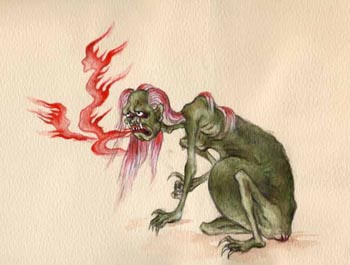
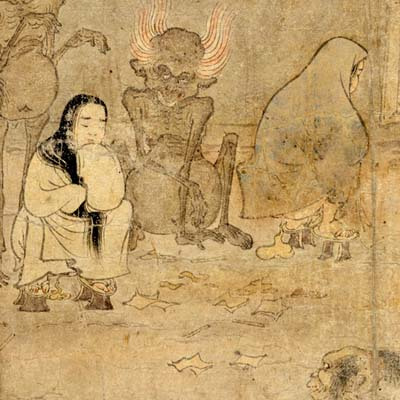
hungry ghosts

hungry-ghost

“,,,when we offer food to the hungry ghost, the ceremony always begins with a dharani for the hungry ghost to help increase the size of their throats so that they can receive our offerings. In classical Buddhist literature, hungry ghosts are described as having a big belly but a very tiny throat–so even though they are always very hungry they are never able to take in enough nourishment. There are many kinds of hungry ghosts that need our help to transform their suffering. They are hungry for love and understanding but because they are so suspicious, because their hearts are not open enough, they cannot receive our love and compassion.

“All the hungry ghost bear great injustices in themselves and that is why they have become hungry ghosts. Many of us are victims of injustice, and if there is no compassion and understanding there is no way we can undo the knot of injustice within ourselves and become free. We still continue to suffer if no one can help us undo the knot of injustice in our heart.
art-eater_asuras_wrath_pretas_hungry_ghosts_05
“There are so many hungry ghosts in the world. Many of them are caught in their situation and have no opportunity to experience the kind of safe, calm, stable space that will allow them to get in touch with what is nourishing and healing…they will be hungry ghosts all their lives, wandering aimlessly in suffering, destroying themselves physically and mentally.

“Hungry ghosts are drive by the habit energy in themselves. They may want to tear up the new roots, they may not be able to feel peace, they may not be capable of establishing themselves in the here and now. …it is important for us to become aware of the habit energy in ourselves. It is always pushing us to tear up our roots, to play the role of a wandering soul, a hungry ghost. We can become so used to being a hungry ghost that staying in one place becomes very difficult.  So we practice mindful breathing and recognize that the habit energy of being a hungry ghost is still very strong in us.

aaa_gakizoshi_1-0

“All of us who are the friends of the Earth-Store Bodhisattva must pool our ideas and energies to help the many hungry ghosts in our family, community, and society…

~Thich Nhat Hanh, Opening the Heart of the Cosmos

The images within this posting were drawn from the internet and reflect historical representations of hungry ghosts.