everything in the cosmos…

branchweb

For a table to exist, we need wood, a carpenter, time, skillfulness, and many other causes. And each of these causes needs other causes to exist. The wood needs the forest, the sunshine, the rain, and so on. The carpenter needs his parents, breakfast, fresh air, and so on. And each of these things, in turn, has to be brought about by other conditions. If we look in this way, we’ll see that nothing has been left out. Everything in the cosmos has come together to bring us this table. Looking deeply at the sunshine, the leaves on the tree, and the clouds, we can see the table. The one can be seen in the all, and the all can be seen in the one.

Thich Nhat Hanh, The Heart of the Buddha’s Teaching

tuesday photo challenge: signs

signs (1)

…a sign means something – stop, go, walk, etc. The sign thinks for you. It commands you. A symbol, on the other hand, represents an idea, a process, or a physical entity. But the important word here is represents. The symbol represents something else, something beyond what you are looking at–whereas the sign means only this… Where the sign thinks for you, the symbol asks you to do the thinking–abstract versus the literal.

~Junichiro Tanizaki

A sign painted on a building commanding the passerby to “stop” and “drink…”  Submitted in response to  Dutch goes the Photo’s challenge.

everyman’s artist…consciousness

dandelionproject_tearsbnwweb

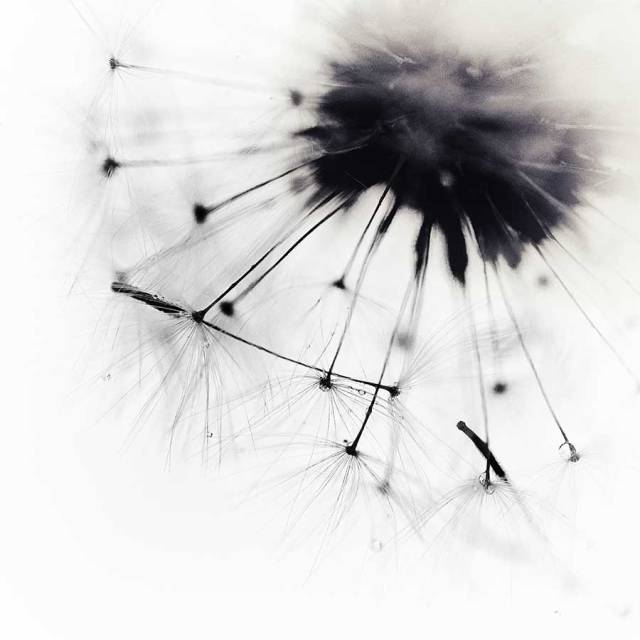
He saw that his own mind was present in every phenomenon in the universe. …Our own mind is the source of all phenomena. Form, sound, smell, taste, and tactile perception such as hot and cold, hard and soft – these are all creations of our mind. They do not exist as we usually think they do.  Our consciousness is like an artist, painting every phenomenon into being.

Thich Nhat Hanh, Old Path White Clouds

dandelionproject_tearscolorweb

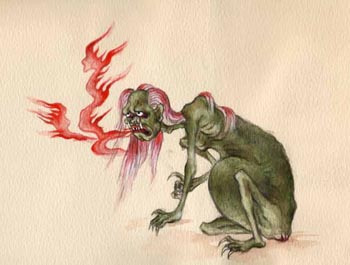
hungry ghosts

hungry-ghost

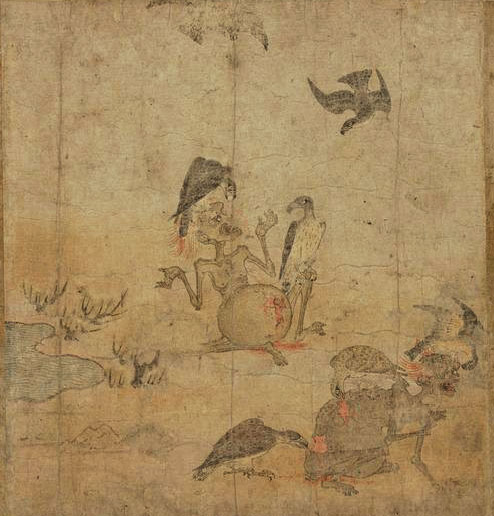
“,,,when we offer food to the hungry ghost, the ceremony always begins with a dharani for the hungry ghost to help increase the size of their throats so that they can receive our offerings. In classical Buddhist literature, hungry ghosts are described as having a big belly but a very tiny throat–so even though they are always very hungry they are never able to take in enough nourishment. There are many kinds of hungry ghosts that need our help to transform their suffering. They are hungry for love and understanding but because they are so suspicious, because their hearts are not open enough, they cannot receive our love and compassion.

“All the hungry ghost bear great injustices in themselves and that is why they have become hungry ghosts. Many of us are victims of injustice, and if there is no compassion and understanding there is no way we can undo the knot of injustice within ourselves and become free. We still continue to suffer if no one can help us undo the knot of injustice in our heart.
art-eater_asuras_wrath_pretas_hungry_ghosts_05
“There are so many hungry ghosts in the world. Many of them are caught in their situation and have no opportunity to experience the kind of safe, calm, stable space that will allow them to get in touch with what is nourishing and healing…they will be hungry ghosts all their lives, wandering aimlessly in suffering, destroying themselves physically and mentally.

“Hungry ghosts are drive by the habit energy in themselves. They may want to tear up the new roots, they may not be able to feel peace, they may not be capable of establishing themselves in the here and now. …it is important for us to become aware of the habit energy in ourselves. It is always pushing us to tear up our roots, to play the role of a wandering soul, a hungry ghost. We can become so used to being a hungry ghost that staying in one place becomes very difficult.  So we practice mindful breathing and recognize that the habit energy of being a hungry ghost is still very strong in us.

aaa_gakizoshi_1-0

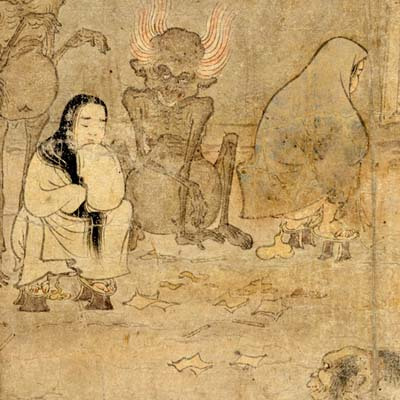
“All of us who are the friends of the Earth-Store Bodhisattva must pool our ideas and energies to help the many hungry ghosts in our family, community, and society…

~Thich Nhat Hanh, Opening the Heart of the Cosmos

The images within this posting were drawn from the internet and reflect historical representations of hungry ghosts.

discrimination…

“Further, O Mahamasti, the five categories are: Appearance, Name, Discrimination, Suchness, and Right Knowledge.

“O Mahamati, what is Appearance? Appearance is what is seen in colors, forms, figures, which are distinctive and not alike, –this is what is called Appearance.

summeriii

“O Mahamati, depending upon this appearing of things, there arises Discrimination, saying that ‘this is a jar’, ‘this is a horse, a cow, a sheep, etc.,’ that ‘this is such and such’, ‘this is no other things’ –this, O Mahamati, is called Name.

“O Mahamati, depending upon these objects thus named, their characteristics are distinguished and made manifest, whereby such various names are set up as cow, sheep, horse, etc. This is called the Discriminating of mind and objects belonging to mind.

“O Mahamaati, when one surveys names and appearances even down to atoms, one never sees a single reality, all things are unreal; for they are due to the Discrimination stirred up in one’s deceiving mind.

“O Mahamati, when is known as Suchness is non-emptiness, exactness, ultimate end, self nature, self-substance, right seeing, –these are the characteristics of Suchness.

“By myself and the Bodhisattvas and [other] Buddhas who are Tathagatas, Arhats, and All-knonwing Ones, it is said that though names differ the sense is one.”

An English translation of an excerpt of Bodhiruci’s translation cited in, Daisetz Teitaro Suzuki, Studies in the Lankavatara Sutra, pp 26-28.

https://youtu.be/QpIPgQPfQp8?t=6s 

objectification

gaze

 My eye for me is a certain power of making contact with things, and not a screen on which they are projected … The other’s gaze transforms me into an object, and mine, him, only if both of us withdraw into the core of our thinking nature [left hemisphere], if we both make ourselves into an inhuman gaze, if each of us feels his actions to be not taken up as understood, but observed as if they were an insect’s. This is what happens, for instance, when I fall under the eyes of a stranger. But even then the objectification of each by the other’s gaze is felt as unbearable only because it takes the place of a possible communication.

~Maurice Merleau-Pontry (cited: Iain McGilchrist, The Master and his Emmissary, p.166)

dandelion project

dandelionproject730bweb

All phenomena of being, since time memorial, are independent of concepts and words. Concepts and words cannot transform them or separate them from their true nature.

~The Awakening of Faith in the Mahayana  (cited: Thich Nhat Hanh, Zen Keys, pg. 81)

awakening

awakening“Suppose I invite you to join me for a cup of tea. You receive your cup, taste the tea, and then drink a little more…

“Now suppose I ask you to describe the tea. You use your memory, your concepts, and your vocabulary to describe the sensations. …concepts and words describe your direct experience of the tea, they are not the experience itself. Indeed, in the direct experience of the tea, you do not make the distinction that you are the subject of the experience and that the tea is its object, you do not think that the tea is the best, or the worst…There is no concept or word that can frame this pure sensation resulting from experience. You can offer as many descriptions as you like, but only you have had a direct experience of the tea. …And you yourself, when you are describing the experience, are no longer in it.  In the experience you were one with the tea. There was no distinction between subject and object, no evaluation, and no discrimination. That pure sensation is an example of non-discriminative wisdom, which introduces us to the heart of reality.

“To reach truth is not to accumulate knowledge, but to awaken to the heart of reality. Reality reveals itself complete and whole at the moment of awakening. In the light of awakening, nothing is added and nothing is lost. …The moment of awakening may be marked by an outburst of laughter, but this is not the laughter of someone who has won the lottery or some kind of victory. It is the laughter of one who, after searching for something for a long time, suddenly finds it in the pocket of his coat.”

~Thich Nhat Hanh ( Zen Keys, pp.43-44)

Solitude…

solitude

Today’s edition of Aeon offered an amazing piece, Before you can be with others, first learn to be alone, written by Jennifer Stitt.  Hope you find this discussion about solitude as enlightening as I do.

“In 1840, Edgar Allan Poe described the ‘mad energy’ of an ageing man who roved the streets of London from dusk till dawn. His excruciating despair could be temporarily relieved only by immersing himself in a tumultuous throng of city-dwellers. ‘He refuses to be alone,’ Poe wrote. He ‘is the type and the genius of deep crime … He is the man of the crowd.’

Like many poets and philosophers through the ages, Poe stressed the significance of solitude. It was ‘such a great misfortune’, he thought, to lose the capacity to be alone with oneself, to get caught up in the crowd, to surrender one’s singularity to mind-numbing conformity. Two decades later, the idea of solitude captured Ralph Waldo Emerson’s imagination in a slightly different way: quoting Pythagoras, he wrote: ‘In the morning, – solitude; … that nature may speak to the imagination, as she does never in company.’ Emerson encouraged the wisest teachers to press upon their pupils the importance of ‘periods and habits of solitude’, habits that made ‘serious and abstracted thought’ possible.

In the 20th century, the idea of solitude formed the centre of Hannah Arendt’s thought. A German-Jewish émigré who fled Nazism and found refuge in the United States, Arendt spent much of her life studying the relationship between the individual and the polis. For her, freedom was tethered to both the private sphere – the vita contemplativa – and the public, political sphere – the vita activa. She understood that freedom entailed more than the human capacity to act spontaneously and creatively in public. It also entailed the capacity to think and to judge in private, where solitude empowers the individual to contemplate her actions and develop her conscience, to escape the cacophony of the crowd – to finally hear herself think.

In 1961, The New Yorker commissioned Arendt to cover the trial of Adolf Eichmann, a Nazi SS officer who helped to orchestrate the Holocaust. How could anyone, she wanted to know, perpetrate such evil? Surely only a wicked sociopath could participate in the Shoah. But Arendt was surprised by Eichmann’s lack of imagination, his consummate conventionality. She argued that while Eichmann’s actions were evil, Eichmann himself – the person – ‘was quite ordinary, commonplace, and neither demonic nor monstrous. There was no sign in him of firm ideological convictions.’ She attributed his immorality – his capacity, even his eagerness, to commit crimes – to his ‘thoughtlessness’. It was his inability to stop and think that permitted Eichmann to participate in mass murder.

Just as Poe suspected that something sinister lurked deep within the man of the crowd, Arendt recognised that: ‘A person who does not know that silent intercourse (in which we examine what we say and what we do) will not mind contradicting himself, and this means he will never be either able or willing to account for what he says or does; nor will he mind committing any crime, since he can count on its being forgotten the next moment.’ Eichmann had shunned Socratic self-reflection. He had failed to return home to himself, to a state of solitude. He had discarded the vita contemplativa, and thus he had failed to embark upon the essential question-and-answering process that would have allowed him to examine the meaning of things, to distinguish between fact and fiction, truth and falsehood, good and evil.

‘It is better to suffer wrong than to do wrong,’ Arendt wrote, ‘because you can remain the friend of the sufferer; who would want to be the friend of and have to live together with a murderer? Not even another murderer.’ It is not that unthinking men are monsters, that the sad sleepwalkers of the world would sooner commit murder than face themselves in solitude. What Eichmann showed Arendt was that society could function freely and democratically only if it were made up of individuals engaged in the thinking activity – an activity that required solitude. Arendt believed that ‘living together with others begins with living together with oneself’.

But what if, we might ask, we become lonely in our solitude? Isn’t there some danger that we will become isolated individuals, cut off from the pleasures of friendship? Philosophers have long made a careful, and important, distinction between solitude and loneliness. In The Republic (c380 BCE), Plato proffered a parable in which Socrates celebrates the solitary philosopher. In the allegory of the cave, the philosopher escapes from the darkness of an underground den – and from the company of other humans – into the sunlight of contemplative thought. Alone but not lonely, the philosopher becomes attuned to her inner self and the world. In solitude, the soundless dialogue ‘which the soul holds with herself’ finally becomes audible.

Echoing Plato, Arendt observed: ‘Thinking, existentially speaking, is a solitary but not a lonely business; solitude is that human situation in which I keep myself company. Loneliness comes about … when I am one and without company’ but desire it and cannot find it. In solitude, Arendt never longed for companionship or craved camaraderie because she was never truly alone. Her inner self was a friend with whom she could carry on a conversation, that silent voice who posed the vital Socratic question: ‘What do you mean when you say …?’ The self, Arendt declared, ‘is the only one from whom you can never get away – except by ceasing to think.’

Arendt’s warning is well worth remembering in our own time. In our hyper-connected world, a world in which we can communicate constantly and instantly over the internet, we rarely remember to carve out spaces for solitary contemplation. We check our email hundreds of times per day; we shoot off thousands of text messages per month; we obsessively thumb through Twitter, Facebook and Instagram, aching to connect at all hours with close and casual acquaintances alike. We search for friends of friends, ex-lovers, people we barely know, people we have no business knowing. We crave constant companionship.

But, Arendt reminds us, if we lose our capacity for solitude, our ability to be alone with ourselves, then we lose our very ability to think. We risk getting caught up in the crowd. We risk being ‘swept away’, as she put it, ‘by what everybody else does and believes in’ – no longer able, in the cage of thoughtless conformity, to distinguish ‘right from wrong, beautiful from ugly’. Solitude is not only a state of mind essential to the development of an individual’s consciousness – and conscience – but also a practice that prepares one for participation in social and political life. Before we can keep company with others, we must learn to keep company with ourselves.”Aeon counter – do not remove

Jennifer Stitt

This article was originally published at Aeon and has been republished under Creative Commons.

thursday’s special: vision

Vision:  Unable to see things clearly unless they are relatively close to the eyes, owing to the focusing of rays of light by the eye at a point in front of the retina; myopic

visionwebvisionbwebvisoncweb

The Six Blind Men & the Elephant, a famous Hindu fable that tells the story of six blind sojourners that come across different parts of an elephant. In turn, each blind man creates his own version of reality from that limited experience and perspective. The video below is a illustrated version sharing an aged truth about our human condition and the relation between relative and absolute truth.

Jump on over to Lost in Translation to join this week’s Thursday’s Special.