to be elsewhere…

…and for other Quest
initially posted on 9/23/2016
“I’ve waited for you
for a long time” – for your song,
my mountain cuckoo ~Issa*

This week, show us a photo of whatever you’d like, but make sure it’s saturated. It can be black and white, a single color, a few hues, or a complete rainbow riot; just make sure it’s rich and powerful. Let’s turn the comments into an instant mood-booster!
Visit WordPress’ weekly photo challenge to view additional images created specifically for the concept of saturated
Initially posted on September 27, 2013
*cited in:
The Spring of my Life
Trans: Sam Hamill
In all things, the Way does not want to be obstructed, for if there is obstruction, there is choking; if the choking does not cease, there is disorder, and disorder harms the life of all creatures ~Chuang-Tzu*

When I chisel a wheel, if the blows of the mallet are too gentle, the chisel slides and won’t take hold. But if they’re too hard, it bites in and won’t budge. Not too gentle, not too hard–you can get it in your hand and feel it in your mind. You can’t put it into words, and yet, there’s a knack to it somehow. I can’t teach it to my son, and he can’t learn it from me. ~Wheelwright P’ien*
*cited in:
Tao of Photography Seeing Beyond Seeing
Philippe L. Gross & S.I. Shapiro
initially posted on September 21, 2013
Hum…let’s go with:
Estival, relating to or typical of summer
How cool it is!
In summer, beneath trees
as if in flower.
~Takayama Sōzei (cited: SD Carter, Haiku Before Haiku)



The four calendar-based seasons (with their adjectives) are generally recognized: “spring” (“vernal”), “summer” (“estival“), “autumn” (“autumnal”) and “winter” (“hibernal”)
cited: dictionary.cambridge.org
Paula is back! This Thursday’s Pick a Word challenge: estival, cuisine, rift, instructive, span.

merging lines with light and shadow

peace lily
the eye that is penetrating sees clearly,
the ear that is penetrating hears clearly,
the nose that is penetrating distinguishes odors,
the mouth that is penetrating distinguishes flavors,
the mind that is penetrating has understanding,
and the understanding that is penetrating has virtue. ~ CHUANG-TZU
initially posted in August, 2012
In the courtyard there grows a strange tree,
Its green leaves ooze with a fragrant moisture.

Holding the branch I cut a flower from the tree,
Meaning to send it away to the person I love.

Its sweet smell fills my sleeves and lap.
The road is long, how shall I get it there?

Such a thing is not fine enough to send:
But it may remind him of the time that has past since he left

cited: Trans: Arthur Waley. A Hundred and Seventy Chinese Poems, Project Gutenberg

Note: The poem above is one of a series known as the Nineteen Pieces of Old Poetry. Some have been attributed to Mei Shēng (first century b.c.), and one to Fu I (first century a.d.).
This week’s lens-artists challenge (spring) is hosted by Tina
Each night as I watch the sunset, I am surprised to see the the western sky’s limitless wardrobe of clouds.




I have found that taking the time to sit on the veranda to watch the sunset and photograph the impermanence of clouds offers me moments of peace during this time of uncertainty. Thank you Leya for this week’s photo challenge: surprise.


Hop on over to join Travel with Intent’s Saturday’s Six Word Challenge
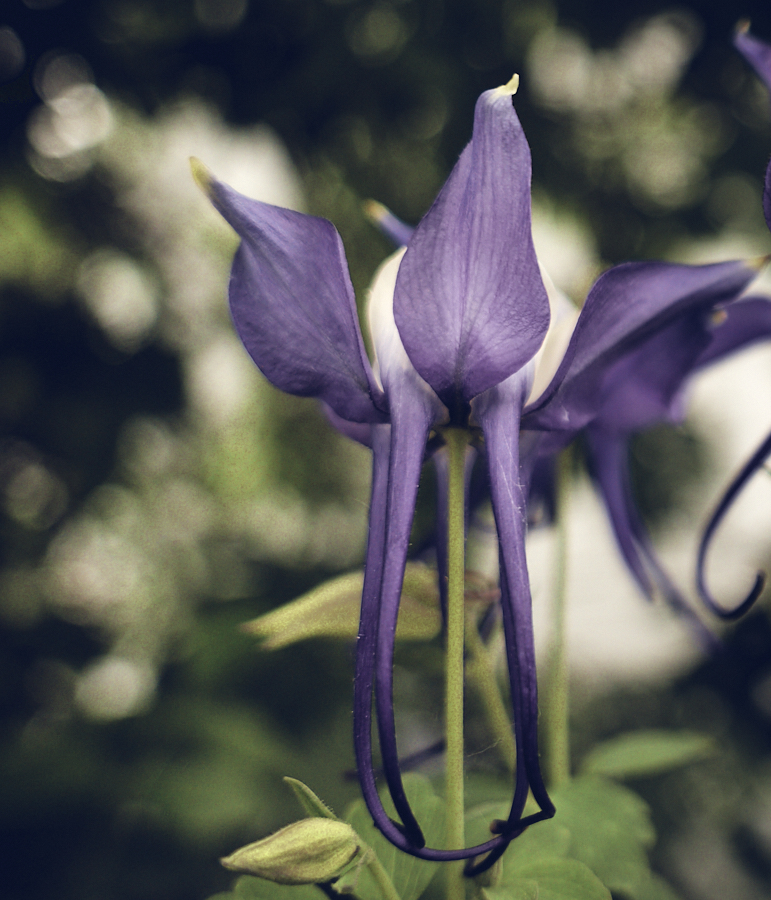
image submitted in response to Cee’s lens-artists’ photo challenge: one single flower

Generally my editing begins with cropping an image with a “focus” on the points of interest using a crop tool set for either a golden ratio, rectangular, or fibonacci spiral grid. The times when there is a pesky “thing” poking in from the edge(s) which somehow was either ignored or not seen in the camera lens, I will either crop or use a software program to removed the unwanted object.

I like the composition of the first image so kept the image at the original aspect ratio and cropped with a fibonacci spiral grid.

The above image was cropped with a ratio of 6×7 which seemed to invite me to move from a stilled contemplative mood to a sense of an ocean’s dynamic energy.
The monochrome cloud images were created with a Nikon D750 (f/8 1/500s 190mm 400 ISO ) and edited in Silver Efex Pro 2.
This week’s Lens-Artists photo challenge is offered by Patti who discussed the photo editing technique and benefits of cropping the shot followed by, “Show us how cropping helped to improve an image and create a desired effect. Include the shot ‘before’ and ‘after’ so we can see the difference.
Stay at Home Order … day 17 plus 14 seclusion retreat days

Nikon D750 f/1.8 1/250 35m 200 ISO
Hop on over to Travel with Intent to participate in the Word Saturday photo challenge
Across concealed blue skies – drifting signs
Imaginary birds and dragons – aimless shifting stories
Gathering and dispersing – water droplets and star dust
In flight – clouds empty of clouds

Nikon D750 f/1.8 1/800 35mm 200 ISO
This week Patti (P.A. Moed) invites us to “get back to the basics” and to share how we understand simplicity.
As I was re-reading the basic rules for the board game Go, I came to understand that while the game builds upon 6 simple rules it is an incredibly complex game with more possible configurations for pieces than atoms in the observable universe.
The true origin of Go is unknown. One of the legends tells us that it first emerge in China during the reign of the legendary Emperor Yao (2356 BC- 2255 BC) who created the game for one of his children.
Kano Yoshinori (Graded Go Problems for Beginners) outlines the 6 general rules as:
1) Go is played by two people (I enjoy playing alone as it feels more strategic than competitive) taking turns playing their moves, one stone at a time.
2) One side plays with black stones, the other white.
3) A move consisted of placing a stone on an intersection of the board. Stones can also be placed on the borders of the grid.
4) Once a stone is placed on an intersection, it cannot be moved to another point.
5) When one player has more knowledge and skill, the “weaker” player places more stones on the board to compensate for the difference in strength.
6) In an even game, the side holding the black stone always goes first. In a handicap game, it is the white who plays first.

Nikon D750 f/1.8 1/3200 35mm 200 ISO
At first glance, nature appears simple. The seasons flow from one into another. Clouds move across the sky creating amazing characters and awakening imaginary stories. Yet, when one become more intimate with Mother Earth’s dynamics there are multiple configurations that are beyond my imagination.
Please be safe…
 a meditative journey
You must be logged in to post a comment.