hungry ghosts

hungry-ghost

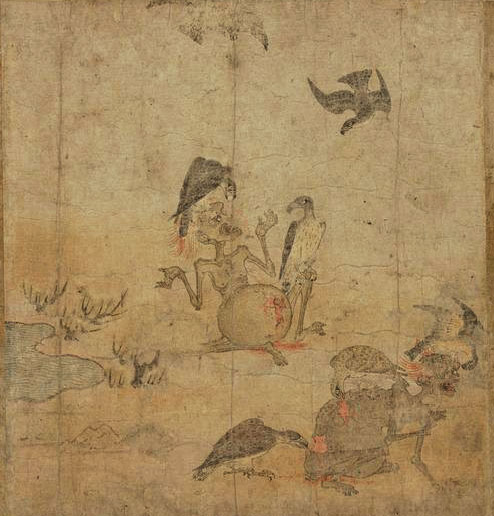
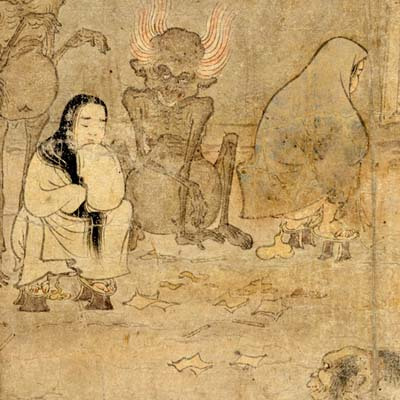
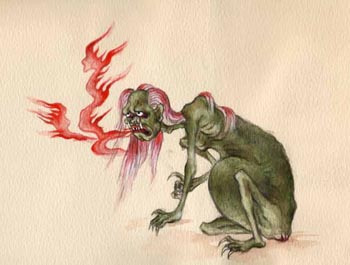
“,,,when we offer food to the hungry ghost, the ceremony always begins with a dharani for the hungry ghost to help increase the size of their throats so that they can receive our offerings. In classical Buddhist literature, hungry ghosts are described as having a big belly but a very tiny throat–so even though they are always very hungry they are never able to take in enough nourishment. There are many kinds of hungry ghosts that need our help to transform their suffering. They are hungry for love and understanding but because they are so suspicious, because their hearts are not open enough, they cannot receive our love and compassion.

“All the hungry ghost bear great injustices in themselves and that is why they have become hungry ghosts. Many of us are victims of injustice, and if there is no compassion and understanding there is no way we can undo the knot of injustice within ourselves and become free. We still continue to suffer if no one can help us undo the knot of injustice in our heart.
art-eater_asuras_wrath_pretas_hungry_ghosts_05
“There are so many hungry ghosts in the world. Many of them are caught in their situation and have no opportunity to experience the kind of safe, calm, stable space that will allow them to get in touch with what is nourishing and healing…they will be hungry ghosts all their lives, wandering aimlessly in suffering, destroying themselves physically and mentally.

“Hungry ghosts are drive by the habit energy in themselves. They may want to tear up the new roots, they may not be able to feel peace, they may not be capable of establishing themselves in the here and now. …it is important for us to become aware of the habit energy in ourselves. It is always pushing us to tear up our roots, to play the role of a wandering soul, a hungry ghost. We can become so used to being a hungry ghost that staying in one place becomes very difficult.  So we practice mindful breathing and recognize that the habit energy of being a hungry ghost is still very strong in us.

aaa_gakizoshi_1-0

“All of us who are the friends of the Earth-Store Bodhisattva must pool our ideas and energies to help the many hungry ghosts in our family, community, and society…

~Thich Nhat Hanh, Opening the Heart of the Cosmos

The images within this posting were drawn from the internet and reflect historical representations of hungry ghosts.

Solitude…

solitude

Today’s edition of Aeon offered an amazing piece, Before you can be with others, first learn to be alone, written by Jennifer Stitt.  Hope you find this discussion about solitude as enlightening as I do.

“In 1840, Edgar Allan Poe described the ‘mad energy’ of an ageing man who roved the streets of London from dusk till dawn. His excruciating despair could be temporarily relieved only by immersing himself in a tumultuous throng of city-dwellers. ‘He refuses to be alone,’ Poe wrote. He ‘is the type and the genius of deep crime … He is the man of the crowd.’

Like many poets and philosophers through the ages, Poe stressed the significance of solitude. It was ‘such a great misfortune’, he thought, to lose the capacity to be alone with oneself, to get caught up in the crowd, to surrender one’s singularity to mind-numbing conformity. Two decades later, the idea of solitude captured Ralph Waldo Emerson’s imagination in a slightly different way: quoting Pythagoras, he wrote: ‘In the morning, – solitude; … that nature may speak to the imagination, as she does never in company.’ Emerson encouraged the wisest teachers to press upon their pupils the importance of ‘periods and habits of solitude’, habits that made ‘serious and abstracted thought’ possible.

In the 20th century, the idea of solitude formed the centre of Hannah Arendt’s thought. A German-Jewish émigré who fled Nazism and found refuge in the United States, Arendt spent much of her life studying the relationship between the individual and the polis. For her, freedom was tethered to both the private sphere – the vita contemplativa – and the public, political sphere – the vita activa. She understood that freedom entailed more than the human capacity to act spontaneously and creatively in public. It also entailed the capacity to think and to judge in private, where solitude empowers the individual to contemplate her actions and develop her conscience, to escape the cacophony of the crowd – to finally hear herself think.

In 1961, The New Yorker commissioned Arendt to cover the trial of Adolf Eichmann, a Nazi SS officer who helped to orchestrate the Holocaust. How could anyone, she wanted to know, perpetrate such evil? Surely only a wicked sociopath could participate in the Shoah. But Arendt was surprised by Eichmann’s lack of imagination, his consummate conventionality. She argued that while Eichmann’s actions were evil, Eichmann himself – the person – ‘was quite ordinary, commonplace, and neither demonic nor monstrous. There was no sign in him of firm ideological convictions.’ She attributed his immorality – his capacity, even his eagerness, to commit crimes – to his ‘thoughtlessness’. It was his inability to stop and think that permitted Eichmann to participate in mass murder.

Just as Poe suspected that something sinister lurked deep within the man of the crowd, Arendt recognised that: ‘A person who does not know that silent intercourse (in which we examine what we say and what we do) will not mind contradicting himself, and this means he will never be either able or willing to account for what he says or does; nor will he mind committing any crime, since he can count on its being forgotten the next moment.’ Eichmann had shunned Socratic self-reflection. He had failed to return home to himself, to a state of solitude. He had discarded the vita contemplativa, and thus he had failed to embark upon the essential question-and-answering process that would have allowed him to examine the meaning of things, to distinguish between fact and fiction, truth and falsehood, good and evil.

‘It is better to suffer wrong than to do wrong,’ Arendt wrote, ‘because you can remain the friend of the sufferer; who would want to be the friend of and have to live together with a murderer? Not even another murderer.’ It is not that unthinking men are monsters, that the sad sleepwalkers of the world would sooner commit murder than face themselves in solitude. What Eichmann showed Arendt was that society could function freely and democratically only if it were made up of individuals engaged in the thinking activity – an activity that required solitude. Arendt believed that ‘living together with others begins with living together with oneself’.

But what if, we might ask, we become lonely in our solitude? Isn’t there some danger that we will become isolated individuals, cut off from the pleasures of friendship? Philosophers have long made a careful, and important, distinction between solitude and loneliness. In The Republic (c380 BCE), Plato proffered a parable in which Socrates celebrates the solitary philosopher. In the allegory of the cave, the philosopher escapes from the darkness of an underground den – and from the company of other humans – into the sunlight of contemplative thought. Alone but not lonely, the philosopher becomes attuned to her inner self and the world. In solitude, the soundless dialogue ‘which the soul holds with herself’ finally becomes audible.

Echoing Plato, Arendt observed: ‘Thinking, existentially speaking, is a solitary but not a lonely business; solitude is that human situation in which I keep myself company. Loneliness comes about … when I am one and without company’ but desire it and cannot find it. In solitude, Arendt never longed for companionship or craved camaraderie because she was never truly alone. Her inner self was a friend with whom she could carry on a conversation, that silent voice who posed the vital Socratic question: ‘What do you mean when you say …?’ The self, Arendt declared, ‘is the only one from whom you can never get away – except by ceasing to think.’

Arendt’s warning is well worth remembering in our own time. In our hyper-connected world, a world in which we can communicate constantly and instantly over the internet, we rarely remember to carve out spaces for solitary contemplation. We check our email hundreds of times per day; we shoot off thousands of text messages per month; we obsessively thumb through Twitter, Facebook and Instagram, aching to connect at all hours with close and casual acquaintances alike. We search for friends of friends, ex-lovers, people we barely know, people we have no business knowing. We crave constant companionship.

But, Arendt reminds us, if we lose our capacity for solitude, our ability to be alone with ourselves, then we lose our very ability to think. We risk getting caught up in the crowd. We risk being ‘swept away’, as she put it, ‘by what everybody else does and believes in’ – no longer able, in the cage of thoughtless conformity, to distinguish ‘right from wrong, beautiful from ugly’. Solitude is not only a state of mind essential to the development of an individual’s consciousness – and conscience – but also a practice that prepares one for participation in social and political life. Before we can keep company with others, we must learn to keep company with ourselves.”Aeon counter – do not remove

Jennifer Stitt

This article was originally published at Aeon and has been republished under Creative Commons.
people with nothing…give

peoplewithnothing

emerging compassion

Kevin Sieff, a writer for The Washington Post (May 31, 2017), identified how people within Nigeria, Somalia, and South Sudan have taken it upon themselves to offer assistance to others even though they themselves struggle to survive the hardships within poverty.

Elijah Karma, who over the past three years has (in addition to providing shelter to 20 members of his own family) been offering his home to 50 people at a time who were displaced by the Boko Haram conflict.

The families of the South Sudanese town of Ganyiel offered portions of their own  food, gave their beds to the elderly, and shared space within cramped huts to some of the thousands of displaced families who had escaped the fighting and possible starvation in nearby villages.

The people of Baidoa “gave and gave, food, clothes, shelter” to Mohamed Iman, a farmer, who now finds himself living as a beggar.

In Maiduguri, “the vast majority of the displaced aren’t living in U.N. camps.”  The residents within this community have opened their doors to the newly homeless – “the poor housing the poorer.”

Sieff notes that these examples of compassion are emerging from “sites of the three largest hunger crises in sub-Saharan Africa. In each country, overstretched humanitarian organizations have failed to raise sufficient funds to feed and house all of these in need. An untold number of people, most of them children, have died of malnutrition and preventable diseases.”


thursday’s special: pick a word

Continual…frequently recurring…a service disrupted by continual breakdowns.

Within the shadows of today’s political discord and emotional-driven social media postings, there is a continual theme I have encountered in the past several weeks…a grass-root movement providing a basic need…food.  No, not $1,000,000-3,000,000 weekend golfing trips or $50,000 jackets…food, simple, over-the-counter food.

The first time was the poster in my doctor’s office which informed patients, “we have food if you need.”  The second was an alteration to the random small wooden book exchanges that invite neighbors to share books; that is, the Lutheran Trinity Church offers…a mini food pantry.

signofthetime

Jump on over to Lost in Translation to participate.


the untruth…the greatest truth

anovelistMilosz

“…the power of attraction exerted by totalitarian thinking, whether of the left or of the right, does not belong to the past…

When a writer strives to present reality most faithfully he becomes convinced that the untruth is at times the greatest truth. The world is so rich and so complex that the more one tries not to omit any part of the truth, the more one uncovers wonders that elude the pen.

Eyes that have seen should not be shut; hands that have touched should not forget when they take up the pen.”

~Czeslaw, Milosz: The Captive Mind


an uncertain weekend

Angry in the ultimate dimension

I close my eyes and look deeply

Three hundred years from now

Where will you be and where shall I be?

~Thich Nhat Hanh*

abnwstudy

While Thich Nhat Hanh’s words are of anger, I believe they also apply to today’s uncertainty in that “…we are living in the most fear mongering time in human history. And the main reason for this is that there’s a lot of power and money available to individuals and organizations who can perpetrate these fears.”

…where fear is about danger that seems certain; anxiety is…”an experience of uncertainty.”

If there is a crack in human psychology into which demagogues wriggle, it is by offering psychological relief for the anxiety created by uncertainty…this is where a good scapegoat comes in; for example, There’ us — real Americans – then there are…”**

May equanimity fill the minds and hearts of all this holiday season and end this dangerous game of brinkmanship.

*cited: No Death, No Fear, Thich Nhat Hanh

**cited: Why We’re Living in the Age of Fear, Rolling Stone

black and white sunday: traces of the past

Generally speaking, Heaven and Earth endow the generality of men with the same mediocre qualities, so that one is hardly distinguishable from the other.  Not so, however, in the rare instances of the Exceptionally Good and the Exceptionally Evil that flash through the pages of history. The first embodies the Perfect Norm of Heaven and Earth; the second, its Horrid Deviations. The first comes into the world when Harmony is to prevail; the second, when Catastrophe impends. The first ushers in peace and order; the second brings war and strife. Examples of the first are the Emperors Yao, Shun, Yu, and T’ang, the Kings Wen and Wu, the sages Confucius and Mencius, and such philosophers as the Ch’eng brothers and Chu Hsi; examples of the second are the tyrants Ch’ih Yu and Kung Kung, Chieh and Chou and the First Emperor, and such usurpers and traitors as Wang Mang, Huan Wen, and Ch’in K’uai.

window

Today, under our divine Sovereign, peace and prosperity reign…which manifest itself in the form of sweet dew and gentle breeze.  …there is no place under the clear sky and the bright sun for the Deviations from the Norm; these had to hide their ugly heads in the abysmal chasms in the bowels of the earth, where they lie inert and powerless. But occasionally, pressed upon by the clouds or wafted by the winds, traces of these evil elements find their way into the upper air and clash with the traces of the Norm, causing violence storms and thunder and lighting. (Trans: Chi-Chun Wang: Tsao Huueh-Chin, Dream of the Red Chamber, pp. 22-23)

I began the day with the intention to nourish myself by avoiding the Twitter Wars by engaging in literature; that is, Dream of the Red Chamber which was written sometime around 1742.  Yet, as my eyes fell upon page 22 I stumbled out of historical China and into the present time, this time of Horrid Deviations.

This passage and image are  submitted in response to the”traces of the past” challenge posed by Lost in Translation.

day without immigrants

I have chosen to remain home today, the 16th of February, to participate in the day without immigrants protest.  Why?

My family history includes incidents in which they encountered resentment, hate, and violence as they sought a new life on this American soil.

In the 19th century, my father’s paternal family heeded a call to “gather to Zion” and thus immigrated to the United States from Denmark as newly converts to the Church of Jesus Christ of Latter Day Saints  (LDS).  His maternal family left Ireland to settle in Virginia before relocating to the west coast in the 1860s.

My mother’s maternal and paternal families left England in the 18th century and settled in the northeast part of the United States.  Their relationships with Joseph Smith resulted in their relocation to Nauvoo, Illinois before seeking refuge in Salt Lake City, Utah.

Exif_JPEG_PICTURE

Have you chosen to give voice to this issue?  I would enjoy hearing your thoughts about the events of today.

history repeats

Photojournalist Edward Crawford is the Edge of Humanity Magazine contributor of this social documentary photography. From his project ‘Au revoir la Jungle‘. To see Edward’s portfolio and stories click on any image. In September 2016 Francoise Hollande on his first visit to Calais as the French president made a statement many had been anticipating. […]

via The Evacuation And Dismantling Of The Calais Jungle — Edge of Humanity Magazine

weekly photo challenge: path

I believe that in order to move forward, to identify one’s own path and not another’s, requires time to contemplate where one has been, one’s regrets and celebrations; as well as a review of one’s beliefs, values, and guiding principles.

The state of the world today leaves me unsettled in that my own grounding principles seem to be shadowed by the ramifications of war, negation of principles, righteous anger, and divisiveness.  All of this leaves a world formulated less and less by rational thinking and more and more by emotional reactivity.  Therefore, I find that my path is not an earthly one, but one drawn from the words of Buddha:

path
Path

Do not go upon what has been acquired by repeated hearing, nor upon tradition, nor upon rumor, nor upon scripture, nor upon surmise, nor upon axiom, nor upon specious reasoning, nor upon bias towards a notion pondered over, nor upon another’s seeming ability, nor upon the consideration ‘The monk is our teacher.’
When you yourselves know: ‘These things are bad, blamable, censured by the wise; undertaken and observed, these things lead to harm and ill,’ abandon them.

When you yourselves know: ‘These things are good, blameless, praised by the wise; undertaken and observed, these things lead to benefit and happiness,’ enter on and abide in them.
                                                                                                                                                          

This ain’t right!

The church of my childhood and of my mother, her mother, and my grandmother’s mother taught me that the body, the family, and the church were sacred and thus any choice I made in my life was to be drawn upon that guiding principle.

My choice to participate in this past election came after hearing how Trump used social media to shame women…and now to hear that the Mormon Tabernacle Choir will be performing at Trump’s inauguration brings my soul into a deeper disbelief that began on the darkest of dark nights…election night.

So…I have given my voice to “this isn’t right.” I may have to find some kind of resolution for the next four years, but I will not accept the church’s celebration of human negation and shame.  If your beliefs are similar to mine, please sign the petition at change.org.

https://www.change.org/p/the-church-of-jesus-christ-of-latter-day-saints-mormon-tabernacle-choir-should-not-perform-at-trump-inauguration?recruiter=20691342&utm_source=share_petition&utm_medium=copylink

Thank you.  My daughter, granddaughter, and soon to be great granddaughter also thank you for validating the right of all human beings to be respected and honored.