enlightenment?

An agenda designed to use cruelty against humanity as a means to win an election?  “No!” I silently scream, “how would anyone want to politically benefit from this cloud of torment moving across the United States?”

This question has plagued me since I listened to Rachel Maddow’s coverage, http://www.msnbc.com/rachel-maddow/watch/trump-cruel-to-migrant-kids-to-drive-immigration-political-wedge-1259660867952

Is this an example of how the crumbling of the pillars of society–moral shame and moral fear–gives way to a Stephen Miller’s delight at the public outrage and anger of migrant families being torn apart?

In The Atlantic, McKay Coppins writes that Stephen Miller

“… made it clear to me that he sees immigration as a winning political issue for his boss.

‘The American people were warned—let me [be] sarcastic when I remark on that—[they] were quote-unquote warned by Hillary Clinton that if they elected Donald Trump, he would enforce an extremely tough immigration policy, crack down on illegal immigration, deport people who were here illegally, improve our vetting and screening, and all these other things,’ Miller told me. ‘And many people replied to that by voting for Donald Trump.’

“Skeptics will note that most Americans did not, in fact, vote for Donald Trump, and that polls continue to show widespread disapproval of some of his signature immigration positions. But it doesn’t matter. In Miller’s view of the electoral landscape, the president is winning anytime the country is focused on immigration—polls and bad headlines be damned. (This explains why Miller is, according to Politico, leading an effort within the administration to plan additional crackdowns on immigrants in the months leading up to the midterm elections.)

“Speaking to The New York Times, Miller framed his theory this way: ‘You have one party that’s in favor of open borders, and you have one party that wants to secure the border. And all day long the American people are going to side with the party that wants to secure the border. And not by a little bit. Not 55–45. 60–40. 70–30. 80–20. I’m talking 90–10 on that.’

“Of course, if the goal were simply to draw voters’ attention to the border, there are plenty of ways to do it that are less controversial (not to mention, less cruel) than ripping young children from the arms of asylum seekers and sticking them in dystopian-looking detention centers. But for Miller, the public outrage and anger elicited by policies like forced family separation are a feature, not a bug.

“A seasoned conservative troll, Miller told me during our interview that he has often found value in generating what he calls ‘constructive controversy—with the purpose of enlightenment.‘ This belief traces back to the snowflake-melting and lib-triggering of his youth. As a conservative teen growing up in Santa Monica, he wrote op-eds comparing his liberal classmates to terrorists and musing that Osama bin Laden would fit in at his high school. In college, he coordinated an ‘Islamo-Fascism Awareness Week.’ These efforts were not calibrated for persuasion; they were designed to agitate. And now that he’s in the White House, he is deploying similar tactics.”

Instead of using children as a step ladder, let’s be inspired by the resilience of children, like Amanda Mena, and not succumb to the evil within these bullies.

as I read the news today…

As I read the news from multiple sources about children being taken away from family and placed in detention, I find myself stunned at the denial of harm, the justification of inhumanity, and the rationalization of the negation of compassion, all under the banner of Christian compliance with law.  Whose law?  The law of man?  The law of God?  The law of nature?

street-1web

The laws and procedures in place today…are man made.  And thus are to be questioned by all of humanity.  Would you blindly comply with the laws regarding children in 18th century England?

If a child was not sold into employment he or she would inevitably end up homeless and living on the streets, in all manner of weather amongst the raw sewage, rotting animal and vegetable waste, rats, disease, and bad water. Many slum children had to endure filthy conditions as they fought a daily battle for survival.

Age 11: 14 days gaol + 5 years Reformatory for Stealing a Coat
Age 12: 14 days gaol + 5 years Reformatory for Stealing Boots
Age 11: 1 day gaol and whipped, for Stealing Pigeons
Age 9: 1 day gaol and whipped, for Stealing Pigeons [three boys]
Age 13: Trial at the Assizes, accused of Murder
Age 12: 21 days gaol + 5 years Reformatory, for Stealing Money
Age 13: 14 days gaol, for Stealing an Umbrella.

Source: Old Police Cells Museum

street-8-web

John Greening, age 11 charged with stealing a quarter of gooseberries  (growing). Punishment:  one calendar month of hard labor and five years reformatory.

John Hillesley, age 15 charged with stealing a coat.  Punishment: transportation to a penal colony in a different country.

Joseph Lewis, age 11 charged with simple larceny for stealing 28 pounds of iron.  Punishment:  one calendar month of hard labor.

Source:  The national Archives

Just for a moment image the fear that would have you leave home, family, friends and run to the unknown?  And then…imagine for another moment having your child removed from your arms and not knowing where she is or if you will ever be reunited.

Why are we not guided by the laws of compassion, loving kindness, equanimity…or even empathy?

geography doesn’t create justice….

My mother once described a job interview for a dietary postion within a small community hospital in which she was asked if she could cook. She described how she  directed the woman’s gaze to the various pictures of her children that were placed about her living room and invited the woman into her kitchen to show her that she, indeed, as a mother did and could cook.

This question, was experienced by my mother as an example of discrimination…a prejudice of deafness.  As I listened to my mother’s story, I understood the question as appropriate to the job. What I interpreted to be discrimination came from the environment in which the interview occurred…not at the hospital, but within the privacy of her own home.

How many job interviews take place within a job applicant’s home?

Being a child of my mother’s and a female, I believed I came to understand discrimination, oppression, and  marginalization, both personally and through my mother’s life stories.   As a child, she was required by state law to attend a deaf school and initially attended a school that was close enough to the family home to allow for weekends with the family.  Yet, because the school was located out of state, she had to enroll in a state school much further away,  Consequently, she was then only able to be with family during specific holidays. This is of a time when letters were her only course of connection with her family.

Also, the school she attended had a policy prohibiting communication through the use of sign language as a means to assist the students to fit in with the “hearing world.”  I smile today, remembering her pride as she described the opposition to this policy.  She and her classmates would gather together in an attic, at night, to teach one another how to speak in sign.

The events of today have invited me to reflect upon my own behaviors — and even my reaction to my mother’s job interview experience —  and to see them as being influenced by discrimination, marginalization, and oppression especially in light of my understanding of “microaggression.”

Microaggressions are the everyday verbal, nonverbal, and environmental slights, snubs, or insults, whether intentional or unintentional, which communicate hostile, derogatory, or negative messages to target persons based solely upon their marginalized group membership. In many cases, these hidden messages may invalidate the group identity or experiential reality of target persons, demean them on a personal or group level, communicate they are lesser human beings, suggest they do not belong with the majority group, threaten and intimidate, or relegate them to inferior status and treatment.

…microaggressions are active manifestations and/or a reflection of our worldviews of inclusion/exclusion, superiority/inferiority, normality/abnormality, and desirability/undesirability. Microaggressions reflect the active manifestation of oppressive worldviews that create, foster, and enforce marginalization. Because most of us consciously experience ourselves as good, moral and decent human beings, the realization that we hold a biased worldview is very disturbing; thus we prefer to deny, diminish or avoid looking at ourselves honestly. Yet, research suggests that none of us are immune from inheriting the racial, gender, and sexual orientation biases of our society. We have been socialized into racist, sexist and heterosexist attitudes, beliefs and behaviors. Much of this is outside the level of conscious awareness, thus we engage in actions that unintentionally oppress and discriminate against others.

~ https://www.psychologytoday.com/blog/microaggressions-in-everyday-life/201011/microaggressions-more-just-race

 I have come to realize that to there are no benign questions…and that a small section of my indignities towards another arise, in part, from my own denial and ignorance.  Awakening to the suffering of others and to the unintentional harm I have caused others brings tears to my eyes as well as leaves me floundering in how to apologize.

It is my hope this sharing of Br Phap Man’s video, “Inclusivity and Justice”, is a small step  that brings about a healing awakening that overcomes walls of various shapes, formations, and sizes.

expanding market share…the hidden agenda

studyofrhythumtone1. “I will be strongly pushing Comprehensive Background Checks.” That sounds like a worthwhile reform, though it would be a rather dramatic reversal for Trump, who, as Rachel noted on last night’s show, has weakened the background check system.

Indeed, the L.A. Times  reported this week, Trump administration officials “have quietly chipped away at the National Instant Criminal Background Check System, the federal system that stores consult to make sure buyers are eligible to purchase guns.” The piece added, “In his recently released budget for the coming fiscal year, Trump proposed slashing millions of dollars from the budget for the background check system.”

2. “…with an emphasis on Mental Health.” Again, Trump is the one who, shortly after taking office, took steps to make it easier for the mentally impaired to buy guns. What’s more, as the Washington Post’s Catherine Rampell explained last week, Trump’s proposed budget calls for significant cuts that, if implemented, would limit access to mental-health services for many Americans.

3. “Raise age to 21.” There seems to be a growing number of Republicans who can’t answer questions about why a young adult can buy an assault rifle, but not a beer. The NRA, however, has not yet signed off on the change.

4. “…end sale of Bump Stocks.” If Trump is serious about this, he could endorse the pending legislation banning bump-stock modifications. So far, he hasn’t

Cited: http://www.msnbc.com/rachel-maddow-show/guns-pay-attention-what-trump-does-not-what-he-says

I am finding myself wondering if those who support guns in schools, churches, malls, etc. have they ever, personally, been in a war zone.   A quote from a very close friend:

Before I went to Vietnam, I went through six months of extensive weapons training, and then SERE (survival, escape, resistance, and evasion) training. Even so, I’m not embarrassed to admit, I still pissed my pants in my first firefight with the VC. Yeah, I came home, but some did not. Are we now expected to train our educators to the same standard? Why on earth would I want my daughter [an university instructor] subjected to the same terror? Would you? I do not.

Then I am beginning to wonder if the focus upon Second Constitutional is more about a distraction that comes from stirring up emotive distance while the gun industry is silently expanding their market shares.  The easing of the federal background checks, removal of criminal records, budget cuts, opening up gun ownership to “mentally impaired” individuals, easing interstate carry of weapons, and now arming school teachers…all in all has the hidden benefit of expanding the market share.  Did the NRA begin lobbying politicians as the gun industry saw potential loss of revenue due to market saturation?

Before I labeled myself as an independent or progressive, I am foremost a parent, a grandparent, and more recently a great-grandparent. My youngest grandchild will graduate from high school this spring. I worry, as do most conscientious parents, grandparents and great grandparents, about the availability of these weapons falling into the hands of an irresponsible person and using it against helpless teachers and students.

My world of friends and family is rather small…yet, my life history includes the loss of a childhood friend after being shot by his brother, two teen suicides, and the deaths of three young sons by their father.  I also have a dear, dear friend whose childhood family was taken hostage by her stepfather that ended when the police chose to use…not weapons, but tear gas.  No one was seriously injured throughout this ordeal; yet, I wonder would the ending to this trauma be even more intense for her and her family if there had been a gun in the home…


they found their man…

911multiexposureweb

Disillusionment is an important part of the spiritual path. It is a powerful and fiery gate, one of the purest teachers of awakening, independence, and letting go that we will ever encounter. To be disillusioned is to be stripped of our hopes, imaginings, and experiences. But while it opens our eyes, the resulting pain all too often closes our hearts. The great challenge of disillusionment is to keep our eyes open and still remain connected with the great heart of compassion. Whether our heart is torn open in the dark night of our inner practice or the dark night of system difficulties, we can use this experience to learn a deeper consciousness and wiser love.

~unknown

I am…

Civil rights community doesn’t need to look Farr for racism in Trump.

Excerpt from The Hill, 12.22.2017

Our decision to protest President Trump’s visit to the opening of the Mississippi Civil Rights Museum wasn’t simply about the insult of his presence to the legacy of civil rights, it was also about his ongoing war to recreate the barriers and protections so many gave their lives to tear down.

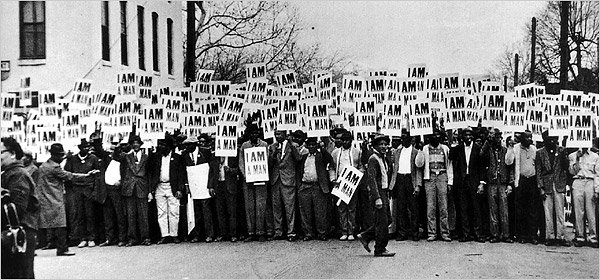
ernest withers, civilrightsphoto

Sanitation workers’ protest in Memphis, TN in 1968
Ernest Withers, Civil Rights Photographer


Through his refusal to condemn white supremacy and his policies to dilute the voting strength and political power of the poor, the middle class and communities of color, Trump has frightened civil rights communities in ways they have not felt in a long time.  It is with this same fear and dread that we look upon his current nominations to the federal courts.

civilrights

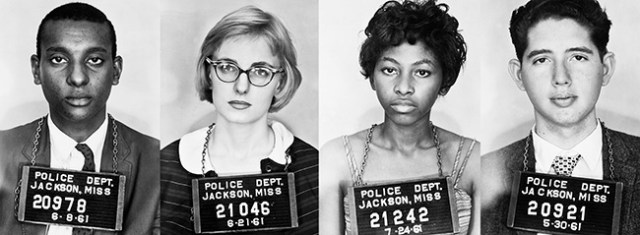
Students’ Arrest in Jackson, MS 1961 

…we stand on the verge of a watershed moment that could impede progressive issues for decades. [Thomas] Farr’s nomination represents the tip of the iceberg in what many consider our president’s attempt to remake America’s ideology in his own image. Trump’s judicial nominees, like those elsewhere in his government, are more than 90 percent white and overwhelmingly male. In fact, white males make up 81 percent of the nearly 60 nominees (14 confirmed), including at least four who were determined to be “unqualified” by the American Bar Association.

images

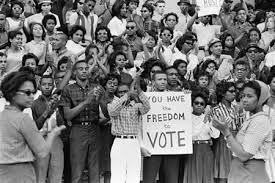
Protest against racial integration in schools, at the Arkansas State Capitol in Little Rock, August 20, 1959. U.S. News and World Report photograph. Public domain

If ever there was a time to guard the federal judiciary, this is it. These nominees share dreadful records on civil rights and are simply unfit to serve. Unlike policy or legislation, these judges are lifetime appointees with the ability to influence all aspects of jurisprudence for decades to come.

~ Derrick Johnson, President and CEO of the National Association for the Advancement of Colored People (NAACP).

truth & strength…together

geesetwo-3web

…we were determined to speak the truth. Now I understand that truth and virtue must be joined by strength. When I first read the French author La Fontaine many years ago, I was disturbed by this statement: ‘The argument of the strongest party is always the best.’ …life has taught me more than once that his statement is at least partly true. Truth without strength cannot stand firm. Strength does not have to mean tyranny or violence, but one must be strong. Without strength, how could those with no more than a pen challenge powerful authorities? 

~Thich Nhat Hanh (Fragrant Palm Leaves)


in the shadow…homelessness

This abandoned house

shining

in the mountain village–

how many nights

has the autumn moon spent here?

~Ono no Komachi (J Hirshfield & M Aratani, The Ink Dark Moon)

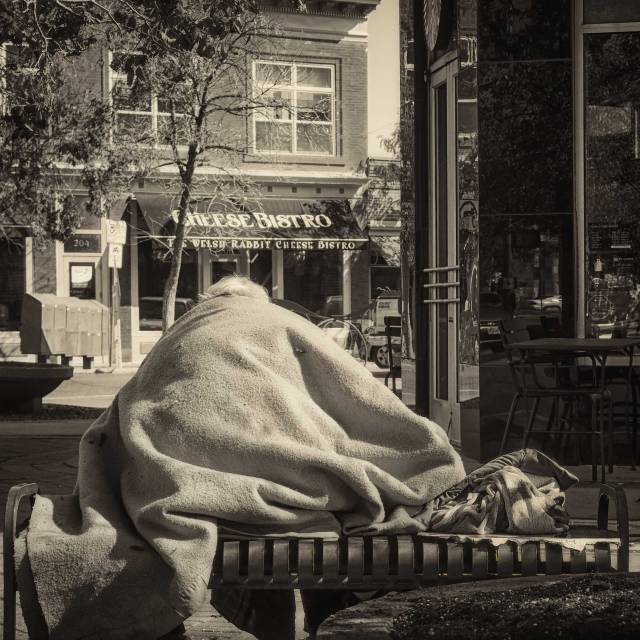
streethomelessness

Lumix GX85   f/5.6   1/400 s   32 mm   200 ISO

Just a few words about today’s homelessness from the AP:

A homeless crisis of unprecedented proportions is rocking the West Coast, and its victims are being left behind by the very things that mark the region’s success: soaring housing costs, rock-bottom vacancy rates and a roaring economy that waits for no one. All along the coast, elected officials are scrambling for solutions.

“I’ve got economically zero unemployment in my city, and I’ve got thousands of homeless people that actually are working and just can’t afford housing,” said Seattle City Councilman Mike O’Brien.

cited:  Amid booming economy, homelessness soars on US west coast, Gillian Flaccus & Geoff Mulvihill, Associated Press, Nov. 9, 2017

Homeless advocates and city officials say it’s outrageous that in the shadow of a booming tech economy – where young millionaires dine on $15 wood-grilled avocado and think nothing of paying $1,000 for an iPhone X – thousands of families can’t afford a home. Many of the homeless work regular jobs, in some cases serving the very people whose sky-high net worth is the reason housing has become unaffordable for so many.

cited: ‘We still need to eat’: Tech boom creates working homeless, Janie Har, Associated Press, November 8, 2017.

And in the shadow of homelessness, tax havens for the wealthy:

The fundamental lesson of the Panama and Paradise Papers is twofold. First, the people everywhere, regardless of whether they live in Russia or America, are being oppressed by the same minuscule social circle of wealthy elites who unduly control our governments, corporations, universities and culture.

We now know without a doubt – thanks to the incontrovertible evidence provided by the Panama and Paradise Papers – that there is a global plutocracy who employ the same handful of companies to hide their money and share more in common with each other than with the citizens of their countries. This sets the stage for a global social movement.

Second, and most importantly, these leaks indicate that our earth has bifurcated into two separate and unequal worlds: one inhabited by 200,000 ultra high-net-worth individuals and the other by the 7 billion left behind.

cited: Why aren’t the streets full of protest about the Paradise Papers?, Micah White, The Guardian, November 10, 2017.

and…continued denial of basic human needs over political and corporate greed

… over the past few weeks, several Republicans have indicated that the tax bill would boost the wealth of the already rich and ensure that their political donations keep flowing to help the GOP hold power in 2018.

“My donors are basically saying, ‘Get it done or don’t ever call me again,’” Rep. Chris Collins (R-N.Y.), himself a millionaire,

Sen. Lindsey Graham (R-S.C.) told reporters on Thursday that a failure to pass tax reform would fracture the Republican Party and lead to more far-right wing primary challengers. “The financial contributions will stop,” he added.

cited: Republicans Admit that CEOs and Donors Really Need the Tax Cut Bill To Pass, Paul Blumenthal, HuffPost, November 9, 2017

How much money does one person really need?

In closing

Little is known about Ono no Komachi’s life, “and the stories about her are drawn from a blending of historic fact and suppositions drawn from her writings.  In The Dark Moon, Hirshfield and Aratani noted that historians believe she was the daughter of the lord of Dewa and served the court in the middle of the ninth century.  Legends, folktales, and songs paint her as the outstanding woman poet of her time and the most beautiful and desirable of woman.  Legend also tells us that towards the end of her life, she lived “in anonymity, isolation, and poverty, an ancient, half-mad hag living outside the city walls, though still writing poetry and possessing a deep understanding of Buddhist teachings.

Can we look at each other and recognize ourselves in each other?

This youtube video is drawn upon Thich Nhat Hanh’s poem Please Call Me By My True Names. 

Why again?

tourdefatweb

A mom whose family’s budget is struggling to meet their basic needs of shelter, food, transportation, education, and medical care inquires, “Why do I as a mother of an ill child need to keep coming back to you to ask you NOT to take away my child’s health care?”

Senator Cory Gardner of Colorado, “Because my campaign fund-raising is drying up…”

I wonder, “and RNC funds are being redirected to Trump’s Russia defense expenses?”

a label


labelsweb

a label transforms a “unknown” person into a preconceived concept

People want to identify and label you so they can place you somewhere they already have set in their mind. …

We have these labels in little piles in our mind and we take them out and stick them on things. That’s our habit. We like to be able to say, “This is an American. That is a Dutch person. This is a Mexican person.” We put the label on as if we know what we mean by Mexican, American, or Dutch. This is a Communist, this is a Republican, this is a capitalist. In fact, the label has no meaning. “This is a person I love, this is a person I hate.” When we put a label on, we can’t see the person. If someone labels you as a “terrorist,” he may shoot you. But if he sees that you are a human being who has his own suffering, who has children and a wife to look after, he won’t be able to shoot you. It’s only when he gives you a label that he can say, “You’re a terrorist; your presence isn’t needed in this world; if you weren’t in the world, it would be a more beautiful place.” It’s all a matter of putting a label on a person. And when you see the real human being, you can’t assign a label anymore. We give labels only in order to praise or to destroy. We have a great bagful of labels–we don’t even know where they came from. And when we stick them onto people, we cut ourselves off from those people, and we can no longer know who they really are.

~Thich Nhat Hanh, Zen Battles

xdrive photo lession – 8 – close up/macros

RAJ’s photo lesson about close ups and macros, encouraged me to create images with my camera set to manual focus, “Remember, only you know the story you are trying to tell, not the camera!”

macrochallenge9517a

Nikon D750  f/6.3 40mm  1/4s  100 ISO

This initial exploration with manual focus brought to mind the summer between the 4th and 5th grade, when I put on my first pair of glasses (Cat Eyes). I can still recall the visual experience of seeing for the first time individualized leaves on trees and multiple shapes and colors of gravel stone…the world, sharpened and focused, was a moment of awe.  Corrective lenses was a means of normalization; yet, there are no words to describe and there are no photographs that can replicate the amazing bokeh of Christmas lights created by astigmatism and myopia.

Nikon D750  f/5  40mm  0.2s  100 ISO

The ease of using auto focus–a reliance upon technology–to create images that satisfy a self-imposed standard has me question if the advancements in genetic, genomic, and reproductive technologies, identified by a UC Berkeley sociologist Troy Duster as a back door to eugenics, to lessen human suffering will also nudge us into a world absent of human uniqueness.