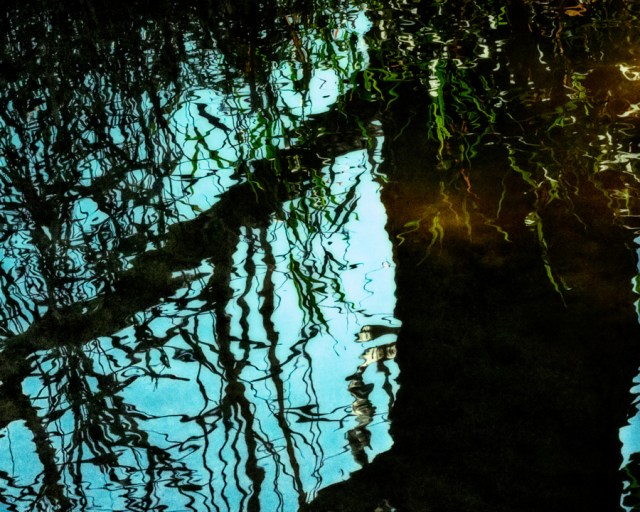
a photo study: contemplative photography XI – patterns of light

contemplative photography 8

This year-long project seems to be drawing upon composition elements that were covered at the beginning of this study.  Recently, I revisited the post which explored the elements of simplicity as part of this series on contemplative photography.

Today, I find myself going back and re-reading the two separate post about rhythm.  Rhythm involves the same or similar elements repeating at regular intervals.  Repetition is easy to find…all around us are shape that are pretty basic and similar to each other.  We see them repeating at regular intervals within nature, design, works of art, architecture, and photography.

 The origin of repetition is from the French repeticion or Latin repetitio(n-), from repetere – repeat.  

When you repeat a certain size or shape or color you add strength to the overall image of a photograph.  If you want to make a statement, you repeat certain elements again and again. If you repeat something once or twice it becomes more interesting. If you repeat something many times it becomes a pattern and takes on a life of its own.

Patterns give us order in an otherwise chaotic world. 

A Karr and M Wood (The Practice of Contemplative Photography) invites photographers to  “see patterns of light–not things that are illuminated, or shadows cast by objects that block the light.”

I found that this exercise “seeing patterns of light” was a bit of a challenge for as I was more drawn towards patterns created by shadows.  Therefore, while on a photo walk, I found that when I connected with light, I had to actually stop and question, “is this a light pattern or a shadow pattern?”

This slideshow requires JavaScript.

I challenge you to open yourself to seeing light…patterns of light. I would enjoy seeing your creations and reading about your experiences and thoughts about light patterns. Let’s tag with #aphotostudy.

early morning readings

photostudystreetcomp7web

“I suggest that… Although healthy persons communicate and enjoy communicating, the other fact is equally true, that ‘each individual is an isolate, permanently non- communicating, permanently unknown, in fact, unfound.’” ~ Winnicott, The Holding Environment

“…What was really incomprehensible was the discussion, as it was called. Cast into and enclosed in the gray lead frame of polite empty British phrases, the people spoke perfectly past one another. Constantly they said they understood each other, answered each other. But it wasn’t so. No one, not a single one of the discussants, showed the slightest indication of a change of mind in view of the reasons presented. And suddenly, with a fear I felt even in my body; I realized that’s how it always is.  Saying something to another, how can we expect it to affect anything? The current of thoughts, images and feelings that flows through us on every side, has such force, this torrential current, that it would be a miracle it it didn’t simply sweep away and consign to oblivion all words anyone else says to us, if they didn’t by accident, sheer accident, suit our own words. Is it different with me? I thought. Did I really listen to anybody else? Let him into me with his words so that my internal current would be diverted.” ~ Pascal Mercier, Night Train to Lisbon (pg 136-137)

“…It is a joy to be hidden but disaster not to be found.” ~ Winnicott, The Maturational Processes and the Facilitating Environment : Studies in the Theory of Emotional Development

early morning readings

waldon-4web81318

“… in the big room they now entered, time had stood still. It was furnished with ascetic sparseness. At one end, facing the wall was a desk and a chair. At the other end, a bed with a small rug in front of it, like a prayer rug. In the middle was a reading chair with a standing lamp and next to it mountains of messy piles of books on the bare floorboards. Nothing else. The whole thing as a sanctuary, a chapel to the memory of Amadeu Inácio de Almeida Prado, doctor, resistance higher and goldsmith of words. The cool, eloquent silence of a cathedral prevailed here, the impassive rustle of a room filled with frozen time.” ~Pascal Mercier, Night Train to Lisbon (pg. 108)

“It was not in the first few moments that I saw all these things, though I saw more of them in the first moments than might be supposed. But, I saw that everything within my view which ought to be white, had been white long ago, and had lost its lustre, and was faded and yellow. I saw that the bride within the bridal dress had withered like the dress, and like the flowers, and had no brightness left but the brightness of her sunken eyes. I saw that the dress had been put upon the rounded figure of a young woman, and that the figure upon which it now hung loose, had shrunk to skin and bone. Once, I had been taken to see some ghastly waxwork at the Fair, representing I know not what impossible personage lying in state. Once, I had been taken to one of our old marsh churches to see a skeleton in the ashes of a rich dress, that had been dug out of a vault under the church pavement. Now, waxwork and skeleton seemed to have dark eyes that moved and looked at me. I should have cried out, if I could.” ~Charles Dickens, Great Expectations

early morning readings

leafstudy111218web

Nikon D750   f/5.6   1/400s   135mm   400 ISO

… You press your mind, your forehead, against the beginning of a book, the cool cover of it, appreciating its impenetrability. It is rectangular and thick, heavy enough to stop a bullet or press a leaf flat. It will, you think, never let you through. And then you begin to lean into it, applying little attentive pressure, and the early pages begin to curl back with a soft, radish-slicing sound, and you’re in. You’re in the book. The thick, segmental chapters fan out into their component pages, and each turned page dematerializes itself, once read, into the fluent, cajoling voice its words carry. …When you reach the last sentence, there rests under you left thumb a monolithic clump of paper through which, it seems, you could not possibly have traveled. ~N Baker (preface), A Book of Books

bare attention

Just as a solid rock is not shaken by the storm, even so the wise are not affected by praise or blame.  ~The Buddha

bareattention

Bare attention flows in opposition to a life guided by streams of unconscious habit patterns and emotional reactivity.  Bare attention awakens us to the stones we stumble over due to the blindness of confusion or ignorance.  It shines a light into the shadows of confusion and ignorance and finds our frustrated desires and suppressed resentments. Bare attention identifies and pursues the single threads of the closely interwoven threads of our thoughts, feelings, and actions, which have over the years formulated the tapestry of our life story.

Bare attention is the clear and single-minded awareness of what actually happens to us and in us at each successive moment of perception.  It is the forerunner of insight.  It is a way of being that is counter to the general manner by which we briefly and fleetingly know or experience the events or people within our daily schedules. Bare attention trains the mind to be detached, open, silent, and alert within the framework of the present moment.  It is an intention to suspend all judgments and interpretations, and to simply note and dismiss them if and when they do occur.

The task within bare attention is to simply acknowledge what occurs just as it occurs.  It is a process of inviting one’s self back into the present, of being mindful of the moment, with the realization that our minds have taken us into an imaginative realm of fantasy, recollections, or discursive thoughts.  It is a means by which to acquaint our selves with an object before our minds alter its presence through conceptual paint overlaid with interpretations.

Bare attention is undertaken with an intention to undo our general ways of being in the world, it is an intention of simply noting and not thinking, not judging, not associating, not planning, not imagining, not wishing.  It notes each occasion of experience as it arises, reaches its peak and then fades away.  It is a sustained mindfulness of experience in its bare immediacy, carefully and precisely and persistently.

bareattention10

Bare attention awakens me to the relationship I have formed with this world through the untested foundations of beliefs, values, guiding principles, and morals. To attend to what formulated these foundations I have found seeds of misconstrued concepts built out of my childhood fears and fantasies.  I have seen a blind faith to family customs, rituals, and cultures.  I have come to understand how some of the holy of holy concepts within my “absolute truths” are unquestioned beliefs which perpetuate suffering.

Excerpts from B Koeford, A Meditative Journey with Saldage

a photo study: contemplative photography IX: equivalence

… to hold a moment, how to record something so completely, that all who see [the picture of it] will relive an equivalent of what has been expressed.    ~Alfred Stieglitz (cited: http://www.metmuseum.org)

The theory of equivalence was inspired by Wassily Kandinsky’s belief that colors, shapes, and lines reflect the inner, often emotive “vibrations of the soul.”  In his cloud photographs, which he termed Equivalents, Stieglitz emphasized pure abstraction, adhering to the modern ideas of equivalence, holding that abstract forms, lines, and colors could represent corresponding inner states, emotions and ideas.

The following are excerpts from Equivalence: The Perennial Trend: Minor White, PSA Journal, Vol. 29, No 7, pp 17-21, 1963 (cited: http://www.johnpaulcaponigro.com)

A change of perspective is a change in state. Jean Piaget reminds us that, “What we see changes what we know. What we know changes what we see.” Perception changes reality… The more conscious the perception the stronger the change. Furthermore, the quality of consciousness one engages perception with influences what is perceived, what is produced, how it is received and the consequences that has. Acting on what one observes, choosing and sustaining one thing / quality amid many others, reinforces that state of being and this is particularly true if during observation one creates something tangible and durable and never more true if multiple related works are created. Often, during the process of manifestation perception continues to change, further extending this process of revelation and transformation.

 The visible can be used to reveal the invisible; the external can be used to reveal the internal.    ~Alfred Stieglitz 

Minor White remarked, “One should photograph things not only for what they are but also for what else they are.” and “Equivalence is a function, not a thing.” He did not mean to suggest that equivalence was merely a rhetorical device. Equivalence is more than a rhetorical device, not a simile that suggests shared commonalities (this is like that), not a metaphor that observes shared qualities through the power of transformation (this is that), but a process inclusive and transcendent of both. Like a simile its power starts with the recognition of shared qualities and like a metaphor its power lies in transformation, but an equivalent transcends both through a heightened state of self-awareness, even to the point of transforming the self through its accompanying effects of clarity and commitment.

Equivalence embraces and elevates the debate over whether photographs are windows (onto the world) or mirrors (into the soul) and whether they are taken (through distant observation, objective to varying degrees) or made (through immediate interaction, subjective to varying degrees), illuminating many more levels of an evolving process. Through equivalence the photographic object created becomes a reflection of both the external things it represents and the internal states of its creator. This reflective capacity is extended to the viewers, who re-experience this shared process in their own ways.

Resonance is a consequence of equivalence. What we create can transform us. We then become co-creators, creating not only things and ideas but selves. What we create can also transform others, triggering cascades of sympathetic vibrations, if we imbue our creations with a persistent resonance, brought on by intensity, clarity and connection (connection to subject, medium, self, and others). Through the experience of art, the powers of perception and transformation can be awakened, in both the ones who create directly and the ones who [perceive] indirectly.

Stieglitz set a shining example for us all. He demonstrated that the full power of our photographs lies not in special subjects or moments but in what we bring to the picture, which can be much more than technical skill, compositional prowess, and cultural awareness. Through photography we can simultaneously bear witness to things / events, affirm our connection / participation with them (even if only as observers, no small thing), and clarify our understanding / interpretation of the confluence of everything that is brought to bear in each moment and the continuing resonances they produce. More than an intellectual interpretation or emotional expression, this is a process of holistic integration.

The photograph can be much more than a material trace of another material; it can even be much more than a trace of light and time; it can also be a trace of spirit, the energetic confluence of body, mind, and emotion, either single or multiple.

contemplative photography 4

White reminds us that this process of self-realization is open to everyone, “With the theory of Equivalence, photographers everywhere are given a way of learning to use the camera in relation to the mind, heart, viscera and spirit of human beings. The perennial trend has barely been started in photography.” Though all photographers do it, not all photographers do it with equal clarity or intensity. Regardless of what level they engage this process, whenever photographers break through to new levels of consciousness the results are transformative for the photographer and the viewer and even the viewed, sometimes subtly and sometimes dramatically is a form of contemplative photography that asks us to see our world in a new way. In some ways it seems very simple, but it is not always easy.

early morning readings

contemplative photography 15

Nikon D750   f/4.5  1/500s   85mm   100 ISO

In a famous passage in the Meditations, Descartes speaks of looking from a window and seeing men pass in the street. ‘Yet,’ he reflects, ‘do I see any more than hats and coats which could conceal automations? I judge that they are men.’ …the observer no longer passes through them to see the living person beneath. He no longer sees what is implied.  However, the attention of the right hemisphere, concerned as it is with the being in context, permits us to see through them to the reality that lies around and beyond them. It could not make the mistake of seeing the clothes and hats in isolation.

The illusion that, if we can see something clearly, we see it as it really is, is hugely seductive. …We never see anything clearly…What we call seeing a thing clearly, is only seeing enough of it to make out what it is; this point of intelligibility varying in distance for different magnitudes and kinds of things…” Ruskin, in Modern Painters, makes the point that clarity is bought at the price of limitationHe gives the example of an open book and an embroidered handkerchief on a lawn.  Viewed from a distance of a quarter of a mile, they are indistinguishable; from closer, we can see which is which, but not read the book or trace the embroidery on the handkerchief: as we go nearer, we ‘can now read the text and trace the embroidery but cannot see the [fibers] of the paper, nor the threads of the stuff’; closer still and we can see the watermarks and the threads, ‘but not the hills and dales in the paper’s surface, nor the fine [fibers] which shoot off from every thread’; until we take a microscope to it, and so on, ad infinitum. At which point do we see it clearly? …Clarity, it seems, describes not a degree of perception but a type of knowledge.  To know something clearly is to know it partially only, and to know it, rather than to experience it, in a certain way ~I McGilchrist, The Master and his Emissary   (pp181-182).

early morning readings

descendingstreetweb91918

Sony RX100 III   f/9   1/250s   25.7m   800 ISO  

“Man tends to regard the order he lives in as natural. The houses he passes on the his way to work seem more like rocks rising out of the earth than like products of human hands. He considers the work he does in his office or factory as essential to the harmonious functioning of the world. … He respects and envies a minister of state or a bank director, and regards the possession of a considerable amount of money as the main guarantee of peace and security. He cannot believe that one day a rider may appear on a street he knows well, where cats sleep and children play…  He is accustomed to satisfying those of his physiological needs which are considered private as discreetly as possible, without realizing that such a pattern of behavior is not common to all human societies. In a word, he behaves a little like Charlie Chaplin in The Gold Rush, bustling about in a shack poised precariously on the edge of a cliff. 

His first stroll along a street littered with glass from bomb-shattered windows shakes his fate in the ‘naturalness’ of his world. The wind scatters papers from hastily evacuated offices, papers labeled ‘Confidential’ or ‘Top Secret’ that evoke visions of safes, keys, conferences, couriers, and secretaries. Now the wind blows them through the street for anyone to read; yet no one does, for each man is more urgently concerned with finding a loaf of bread.  Strangely enough, the world goes on even though the offices and secret files have lost all meaning. Further down the street, he stops before a house split in half by a bomb, the privacy of people’s homes—the family smells, the warmth of the beehive, life, the furniture preserving the memory of lies and hatreds—cut open to public view. … His walk takes him past a little boy poking a stick into a heap of smoking ruins and whistling a song about the great leader who will preserve the nation against all enemies. The song remains, but the leader of yesterday is already part of the extinct past.

He finds he acquires new habits quickly. Once, had he stumbled upon a corpse on the street, he would have called the police. A crowd would have gathered, and much talk and comment would have ensured. Now he must avoid the dark body lying in the gutter, and refrain from asking unnecessary questions.  The man who fired the gun must have had his reasons…. ”  ~C Milosz, The Captured Mind

a photo study: contemplative photography VII – visual engagement

There are no colors out there in the world, Galileo tells us. They only exist in our heads. In the first of our dialogues about the mind, Riccardo Manzotti and I established that by “consciousness” we mean the feeling that accompanies our being alive, the fact that we experience the world rather than simply interacting with it mechanically. We also touched on the problem that traditional science cannot explain this fact and does not include it in its account of reality. That said, there is a dominant understanding of where consciousness happens: in the brain. This “internalist,” or inside-the-head, approach shares Galileo’s view that color, smell, and sound do not exist in the outside world but only in the brain. “If you could perceive reality as it really is,” says leading neuroscientist David Eagleman, “you would be shocked by its colorless, odorless, tasteless silence.”

…the subject/object divide, not to mention the addition of a feeling or “percept,” is particularly pertinent when we talk about color.

…when scientists look inside the brain to see what’s going on, they find only billions of neurons exchanging electrical impulses and releasing chemical substances. They find what they call correlates of consciousness, not consciousness itself; or in this case, they find correlates of color, but not color itself. There is no yellow banana in the head, just the grey stuff

..the other traditional claim, still widely taught in school, that colors exist in light, or that different colors are different wavelengths of light. And of course the colors of the rainbow immediately come to mind. But that explanation doesn’t work 100 percent either. The same wavelength, for example, will give rise to different colors if the surrounding environment is different.

…Three hundred years on, what and where colors actually are remains a mystery.

~cited:  NYR Daily, The Color of Consciousness by Riccardo Monzotti & Tom Parks

We often take something that is clear to us initially, and we begin to embellish, over-think and romanticize it, and then translate it into the photographic medium all the way through Photoshop and filters and everything. We begin with our original experience, and, when it is done, there is little or no relationship between the original perception and the final result.  This the Miksang version of “lost in translation.”

~M Wood, (Opening the Good Eye)

Contemplative practices cultivate a critical, first-person focus, sometimes with direct experience as the object, while at other times concentrating on complex ideas or situations. The practical, radical, and transformative aspects of this practice is noted to increase a deepening concentration and quieting of the mind.

Mindfulness is:

  • Spacious presence
  • Focused attention
  • Wakefulness
  • Recollecting recognition of experience
  • A presence of being that is:
    • Relaxed
    • Aware
    • Receptive
    • Inclusive

To experience photography as a way of seeing and as a contemplative practice, an attitude of genuine receptivity is required. The absence of expectations and preconceptions opens us to the beauty within the ordinary. We are more able to become engaged with the variables within colors, lines, light, forms, textures, space so that within this silent stillness an intimacy inspires us to pick up our camera in order to see through the viewfinder and then…

…we begin to see the difference between a perception and a conception, and our allegiance begins to align with freshness.

~A Karr & M Wood (The Practice of Contemplative Photography)

Being present with a perception of an object that has visually awakened you allows for what is referred to by M Wood as visual discernment in which the photographer delays picking up her camera and allows a resting in a contemplative state of mind.  Within the stillness of this pausing, it is noted that the relationship between the brain, light, and visual form of the object will silently and visually begin an introduction.  To be relaxed, aware, receptive, and inclusive in these moments is to begin to become acquainted with…the photographer, the external form, eyes, eye consciousness, and the  brain’s processing of light, colors, shapes, lines, texture.

And yes, most likely during this process your discursive mind will interrupt the process, like a jealous child.  So, when you become aware of the dialogue, simply note and smile at the thoughts and return to the silent visual introduction…with a relaxed, letting go, and aware presence.  If, you find that you are unable to return…just let go of the experience…other objects of perception are waiting for a similar moment of connection and introduction.

In the fourth posting of contemplative photography, an exercise, Opening a Door to Sensory Seeing was offered as a way to experientially explore what A Karr and M Wood identify as  “flashes of perception.”   Within The Practice of Contemplative Photography, they offer us a process of discovery, Looking Deeply by which to experience “visual discernment.”

  1. Sit within a room that has at least one window.
  2. Gaze around the room in an relaxed and receptive manner with no intention to see anything in particular.
  3. Gaze at the wall in front of you and allow the qualities of the wall, it’s color, texture,  light, shadows, and changes associated with variations of light to introduce themselves to you.
  4. Gaze at the ceiling and notice the the various qualities of the ceiling and the seam where the wall meets the ceiling.
  5. Move your gaze to the floor open yourself to the qualities  of the floor and the elements within your perceptional field.
  6. Gaze at the furniture in the room and identify their unique qualities and differences; i.e., smooth vs rough, heaviness, reflections, colors.  Allow your gaze to shift between different objects within the room.
  7. Look at the window in a way that you  become acquainted with it’s design, sense of feel, texture.  Extend your gaze beyond the window in a similar manner as you have the room…introduce yourself to the sky, clouds, trees, buildings, quality of light.

This slideshow requires JavaScript.

This is the type of extensive engagement with the world that opens us to the subtleties of perception, of becoming aware of  the meeting of our eyes and eye consciousness as we  silently open ourselves to this amazing world.

I would love to hear about your thoughts about visual discernment and the Looking Deeply exercise.

early morning readings

contemplative photography 26 copy

Sony RX100 III  f/5   1/800s   8.8mm  800 ISO

A world without memory is a world of the present. The past only exists in books, in documents. In order to know himself, each person carries his own ‘Book of Life,’ which is filled with the history of his life. By reading its pages daily, he can relearn… Without his Book of Life, a person is a snapshot, a two-dimensional image, a ghost. … Some pass the twilight hours at their tables reading from their Books of Life; others frantically fill its extra pages with the day events.

With time, each person’s ‘Book of Life’ thickens until it cannot be read in its entirety.  Then comes a choice.  Elderly men and women may read the early pages, to know themselves as youth; or they may read the end, to know themselves in later years.

Some have stopped reading altogether.  They have abandoned the past.  They have decided that it matters not if yesterday they were…. no more than it matters how a soft wind gets into their hair. ~A Lightman, Einstein’s Dreams

In his 1991 file ‘Prospero’s Books’, a cinematic adaptation of William Shakespeare’s ‘The Tempest’, Peter Geenaway showed a series of exotic books that were kept in a library on a magical island and revealed just enough of their content to have me wishing the fantasy books were real. Among my favorites are ‘The Book of Colors,’ where “the pages cover the spectrum in finely differentiated shades…a ‘Book of Motion’ that describes, in animated illustrations, all possibilities for dance with the human body. ~J F Simon, Jr., Drawing Your Own Path