Thus you can throw yourself flat on the ground, stretched out upon Mother Earth, with the certain conviction that you are one with her and she with you. You are as firmly established, as invulnerable as she, indeed a thousand times firmer and more invulnerable. As surely as she will engulf you tomorrow, so surely will she bring you forth anew to new striving and suffering. And not merely ‘some day’: now, today, every day she is bringing you forth, not once but thousands upon thousands of times, just as every day she engulfs you a thousand times over. For eternally and always there is only now, one and the same now, the present is the only thing and that has no end.
I longed for snow while we were staying there, but just then I had to go home to my parents. Two days after retiring from the Court a great snow came. The old familiar trees of my home reminded me of those melancholy years when I used to gaze upon them musing when the colours of flowers, the voices of birds, the skies of Spring and Autumn, moon shadows, frost and snow, told me nothing but that time was revolving, and that I was menaced with a dreary future. ~The Diary of Murasaki Shikibu (cited: Diaries of Court Ladies of Old Japan)
“We must look deeply to identify the real suffering of our times and to understand how it has come to be. Our modern way of living brings tension, stress and pain to our body; we are exposed to anger, violence, and fear; we live with the threat of terrorism, the destruction of the ecosystem, war and famine, climate change, the economic crisis, recession, poverty, social injustice, broken families and divorce, and so much more.
Toy Store… Nikon D750 f/1.8 1/25s 35m 100 ISO
How are we living? How are we consuming? What violence, fear, and anger are we ingesting every day through the media around us? How is our lifestyle polluting the environment and creating a toxic level atmosphere for our bodies and our minds, for our families and for future generations? If we can call the suffering, the real ill-being of our times, by its true names and if we an see how it has come to be, we will know exactly what kind of medicine, what kind of healing we need in order to deal with it. The truth of ill-being will reveal the end of ill-being.” ~Thich Nhat Hanh (The Other Shore)
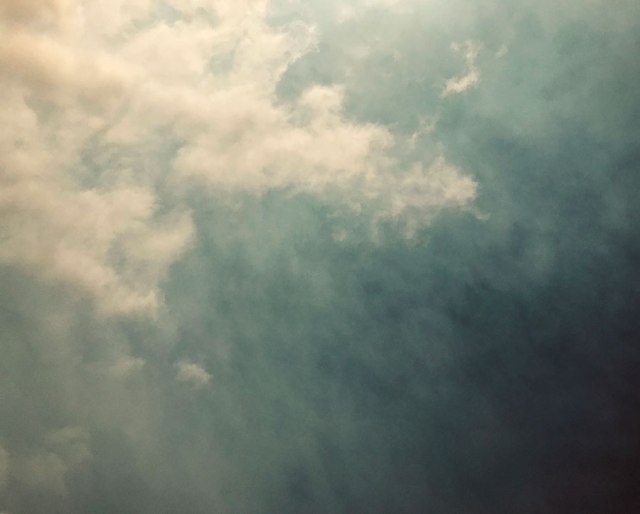
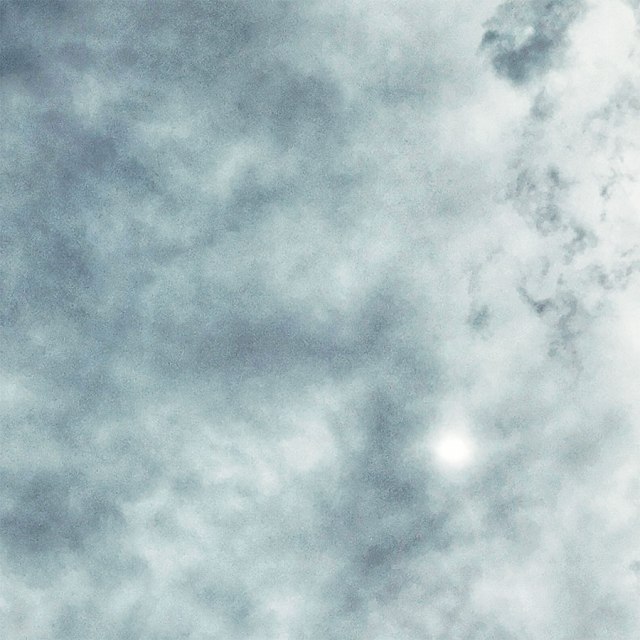
“Before the cloud appeared in the sky she was not nothing. She was the water in the ocean. She was the heat generated by the sun. She was the water vapor rising up to the sky. And when we can no longer see the cloud in the sky, she hasn’t died; she has just transformed into rain or snow. The notion of death is also created by our mind. It is impossible for something to become nothing. The cloud hasn’t died; it is manifesting in its new form as rain, as hail, as snow, as the river, and as the cup of tea in my two hands. So the true nature of the cloud is no-birth and no-death.
“… we can start to see the countless umbilical cords that link us to life all around us. There is an umbilical cord that exists between us and the river. The water we drink every day flows down from mountain springs and streams, right into our kitchen. So the river is also a mother and there is an invisible umbilical cord between us. If we cannot see it yet, it’s because we haven’t looked deeply enough. There is another umbilical cord between us and the clouds, between us and the forests, and another between us and the sun. The sun is like a parent to us. Without our link to the sun we could not live, and neither could anything else. We are nourished and sustained by countless parents. The river, the wild animals, the plants, the soil and all its minerals are our mothers and fathers, and are mothers and fathers to all phenomena on planet Earth. That is why in the sutras it is said that living beings have been our parents through countless lifetimes.
“There are umbilical cords linking us to all that is in the universe and in the entire cosmos. Can you see the link between you and me? If you are not there, I am not here; that is certain. If you do not yet see it, look more deeply and I am sure you will see”
“I have found that the use of clouds in my photographs has made people less aware of clouds as clouds in the pictures than when I have portrayed trees or houses or wood or any other objects.
“In looking at my photographs of clouds, people seem freer to think about the relationships in the pictures than about the subject-matter for its own sake.
“My photographs are a picture of chaos in the world, and of my relationship to that chaos. My prints show the world’s constant upsetting of man’s equilibrium, and his eternal battle to reestablish it.”*
*Cited: Alfred Stieglitz, Master of Photographs: Aperture.
For this week’s photo study, I decided to continue with Ian’s creative composition posts as they seem to be an ideal way to revisit basic elements of composition and explore how to incorporate them into street photography. He begins the second positing with noting the importance of slowing down with intentional “seeing” as a foundation to finding the ideal background and good light and then deciding to or not to press the shutter.
Photography is not what’s important. It’s seeing. The camera, film, even pictures, are not important. ~Algimantas Kezys (cited: H Zehr, The Little Book of Contemplative Photography)
Setting the Stage, Timing the Steps (fishing) Ian writes, “The key concept for this approach is to establish the static elements in your frame first (i.e. background and light), then patiently work to add interesting dynamic elements by moving close and far, exploring various angles, adjusting the camera’s settings, and finally with patience waiting for the person who fits into your story to walk on your stage.
Frame within a Frame Create a frame within the image through the use of doorways, windows, window displays, trees, or any object that creates a frame around your subject.
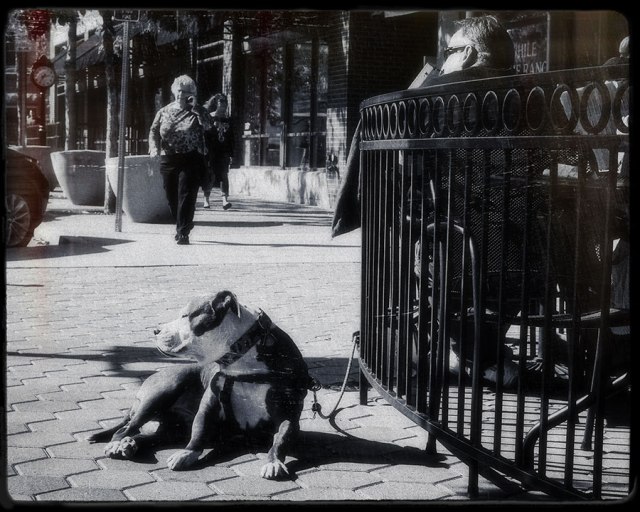
Leading Lines Drawing the viewer’s eye is an important compositional element especially when lines converge toward each other and draw the eye to the subject. I found that the gaze of both the man and the dog create an implied line as well as invite a story.
JuxtapositionIan describes juxtaposition is where two adjacent objects appear to contrast with each other, as within the image below. The person in the foreground leans to the left opening us to the elderly man in the midground who is leading left. The Starbucks coffee cup in the center adds a social justice element as well as a contrast to both men.
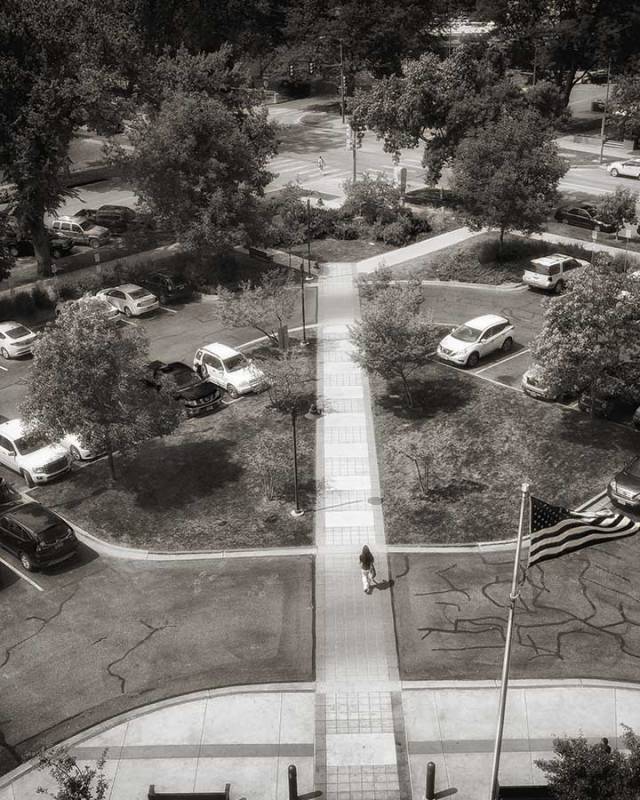
Perspective – create high-angle images by standing on stairs, platforms, balconies or low-angle photos by getting close to the ground and shooting upwards.
ScaleImages where the subject is dwarfed by the environment seems to be a way of introducing feeling into the image and drawing the eye to the person within the frame.
ColorColor intermixed with light, shadows, and silhouettes have the potential to create unique photographs that nudge images away from the photojournalism and documentary genre.
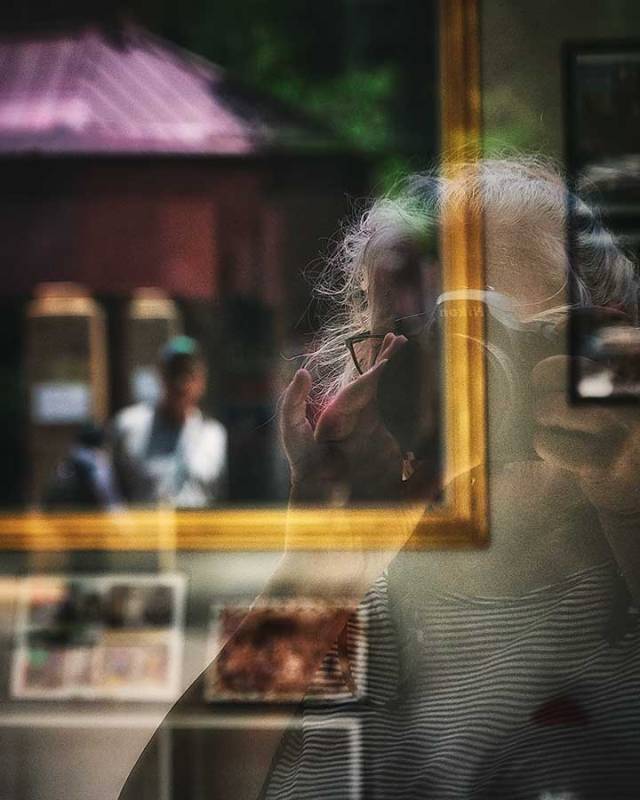
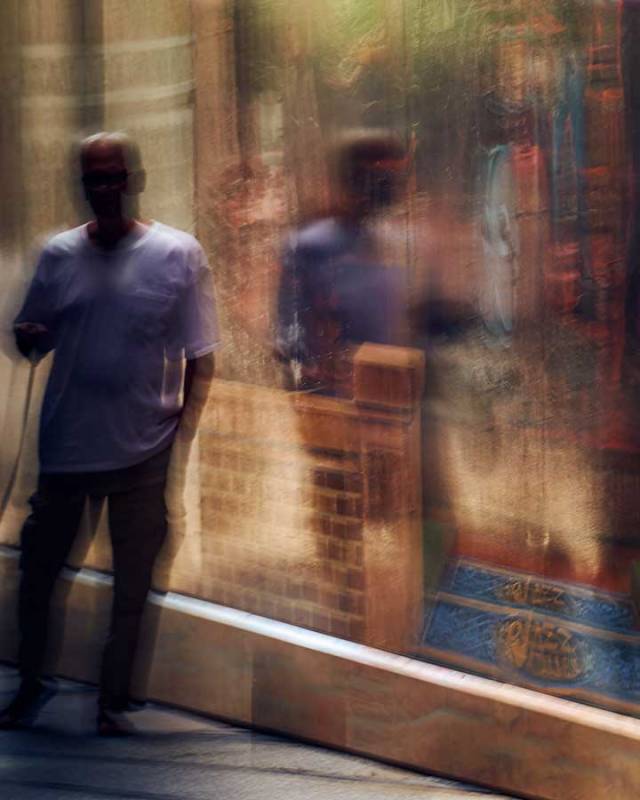
ReflectionsEntire stories can be created through the layers that are created when photographing through glass.
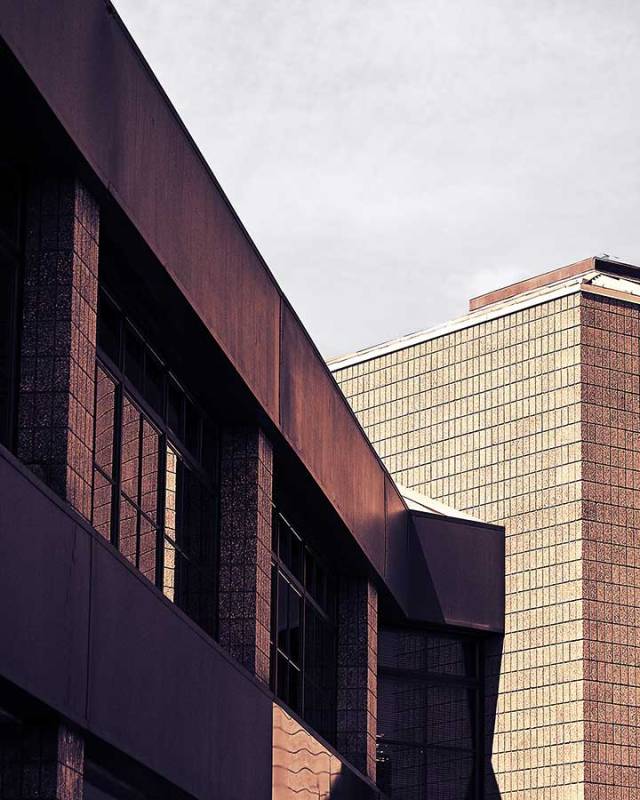
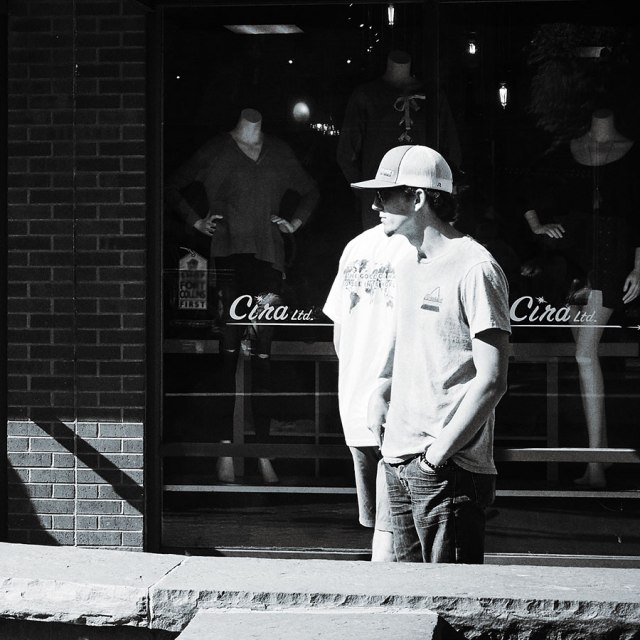
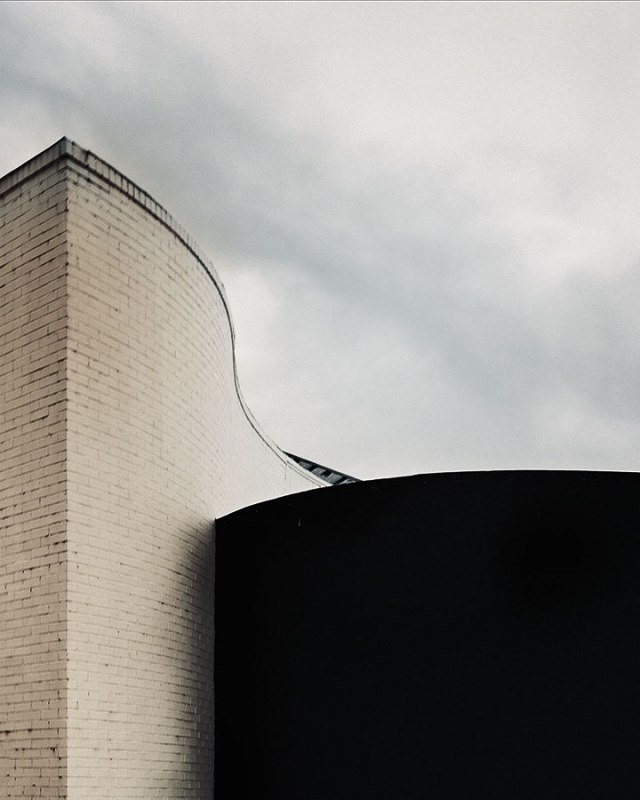
Light and ShadowsUsing your exposure compensation to drop the exposure on the frame (which protects the highlights while creating wonderful deep shadows) will create amazing interactions of shadows, light, and silhouettes.
The Candid Frame Within “Less than Obvious”, Ibarionex encourages us to open ourselves to “seeing” the world’s amazing detail and “being” intentional before we press the shutter.
I hope you find Ian’s educational blog and the Candid Frame to be an invaluable sources of information as well as doorways to a world of creative possibilities. I’m looking forward to seeing your creative work as well as reading your throughs about the use of basic composition elements into street photograph. Let’s tag with #aphotostudy. Until next week…
Art, at its most meaning level, represented for Stieglitz a symbolical and equivalent of man’s most profound and acute power to see. Not what one feels one should see. Or what others have seen. But what one truly and most sacredly experiences oneself. Of equal importance: One’s ‘seeing’ must be communicated in reverent spirit, with deepest respect both for what is portrayed and for the materials with which one works.
~ D Norman (Alfred Stieglitz, Masters of Photography: Aperture)
“A man dies when he refuses to stand up for that which is right. A man dies when he refuses to stand up for justice. A man dies when he refuses to take a stand for that which is true.”
~Dr. Martin Luther King (Selma, Alabama, 8 March 1965)
Wyoming Beef… Nikon D750 f/4.5 1/4,000 85m 100 ISO
An English sub excerpt from the South Korean drama,
“Partners for Justice,” episode 11.
Stellar Hwag: “The meat here just got out of rigor mortis, so it’s super delicious.”
Cha Soo-Ho: “What? Rigor mortis?”
Stellar Hwag: “It’s too tough right after slaughter. But if it’s too ripe, it starts to decompose. Beef ribs are perfect when the temperature and time are right.”
…
Stellar Hwag: “Ripening and decomposition straddle a very thin line. Got it?”
… in recent years, …studies are confirming the health benefits of meat-free eating. Nowadays, plant-based eating is recognized as not only nutritionally sufficient but also as a way to reduce the risk for many chronic illnesses. According to the American Dietetic Association, “appropriately planned vegetarian diets, including total vegetarian or vegan diets, are healthful, nutritionally adequate, and may provide health benefits in the prevention and treatment of certain diseases. cited: Harvard Health
An agenda designed to use cruelty against humanity as a means to win an election? “No!” I silently scream, “how would anyone want to politically benefit from this cloud of torment moving across the United States?”
Is this an example of how the crumbling of the pillars of society–moral shame and moral fear–gives way to a Stephen Miller’s delight at the public outrage and anger of migrant families being torn apart?
In The Atlantic, McKay Coppins writes that Stephen Miller
“… made it clear to me that he sees immigration as a winning political issue for his boss.
‘The American people were warned—let me [be] sarcastic when I remark on that—[they] were quote-unquote warned by Hillary Clinton that if they elected Donald Trump, he would enforce an extremely tough immigration policy, crack down on illegal immigration, deport people who were here illegally, improve our vetting and screening, and all these other things,’ Miller told me. ‘And many people replied to that by voting for Donald Trump.’
“Skeptics will note that most Americans did not, in fact, vote for Donald Trump, and that polls continue to show widespread disapproval of some of his signature immigration positions. But it doesn’t matter. In Miller’s view of the electoral landscape, the president is winning anytime the country is focused on immigration—polls and bad headlines be damned. (This explains why Miller is, according to Politico, leading an effort within the administration to plan additional crackdowns on immigrants in the months leading up to the midterm elections.)
“Speaking to The New York Times, Miller framed his theory this way: ‘You have one party that’s in favor of open borders, and you have one party that wants to secure the border. And all day long the American people are going to side with the party that wants to secure the border. And not by a little bit. Not 55–45. 60–40. 70–30. 80–20. I’m talking 90–10 on that.’
“Of course, if the goal were simply to draw voters’ attention to the border, there are plenty of ways to do it that are less controversial (not to mention, less cruel) than ripping young children from the arms of asylum seekers and sticking them in dystopian-looking detention centers. But for Miller, the public outrage and anger elicited by policies like forced family separation are a feature, not a bug.
“A seasoned conservative troll, Miller told me during our interview that he has often found value in generating what he calls ‘constructive controversy—with the purpose of enlightenment.‘ This belief traces back to the snowflake-melting and lib-triggering of his youth. As a conservative teen growing up in Santa Monica, he wrote op-eds comparing his liberal classmates to terrorists and musing that Osama bin Laden would fit in at his high school. In college, he coordinated an ‘Islamo-Fascism Awareness Week.’ These efforts were not calibrated for persuasion; they were designed to agitate. And now that he’s in the White House, he is deploying similar tactics.”
Instead of using children as a step ladder, let’s be inspired by the resilience of children, like Amanda Mena, and not succumb to the evil within these bullies.
Nick Turpin writes that “…When a child picks up a camera and pushes the button that simple spontaneous image is a Street Photograph, it is, first of all, a raw reaction to the scene in front of it, a person, a car, a color. That primitive urge to react, to make a picture is at the heart of Street Photography beyond any other area of picture making, it comes before any other agenda.
“So we are all Street Photographers before we narrow our sights and impose conditions and rules on ourselves to become Portrait photographers, Fashion Photographers, Landscape Photographers, Art Photographers (whatever that really means) etc.”
Nikon D750 f/20 1/25s 35mm 800 ISO
Eric Kim defines street photography as the “…candid photography of life and human nature. It is a way for us to show our surroundings, and how we as photographers relate to them. We are filtering what we see, to find the moments that intrigue us, and to then share them with others. It’s like daydreaming with a camera.”
Nikon D750 f/1.8 1/10s 35mm 800 ISO
Within “The Ultimate Guide to Street Photography” James Maher writes “…the best image of your life can pop right in front of you on the way to get your morning coffee. This spontaneity is what’s celebrated. That is why grainy images, slightly off-kilter framing a-la Garry Winogrand, or import focus will not alway ruin a street photography. Sometimes they will, and we must aim for technical mastery, but other times they can add to the realness of the moment. Sometimes these deficiencies may actually improve the image.”
Nikon D750 f/2.5 1/2,500 35mm 800 ISO
Sometimes the best way to understand something is to put aside the book, silence the mind, and visually explore the creative works of others. With this in mind, I would like to introduce three of my favorite street photographers.
To journey through Salle de Shoot — Photographie’s blog is to inspired by his creative and unique examples of street photography.
The Streets of Nuremberg.com identifies street photography as “…a free creative design in which the artist’s impression…experiences are brought to life…the aim of street photography to depict reality unadulterated, whereby the specific artistic aspect is expressed in the conscious selection of the detail of reality and the design with photographic means.” To take the time to visit this blog is to view amazing street images as well as educational posts.
And finally, Reinhold Staden Photography’s gifts us with inspiring photography as well as a super visual journey through Berlin.
How do you understand street photography? Do you have one or three street photographers that inspire you? I would love to see your street images and read your ideas about street photography. Let’s tag with #aphotostudy.














 a meditative journey
You must be logged in to post a comment.