When we touch one wave, we are in touch with all the other waves. This wave is continued by the next wave. A wave pretends to appear, it pretends to dwell, it pretends disintegrate, and it pretends to disappear.
~Ono no Komachi (J Hirshfield & M Aratani, The Ink Dark Moon)
Lumix GX85 f/5.6 1/400 s 32 mm 200 ISO
Just a few words about today’s homelessness from the AP:
A homeless crisis of unprecedented proportions is rocking the West Coast, and its victims are being left behind by the very things that mark the region’s success: soaring housing costs, rock-bottom vacancy rates and a roaring economy that waits for no one. All along the coast, elected officials are scrambling for solutions.
“I’ve got economically zero unemployment in my city, and I’ve got thousands of homeless people that actually are working and just can’t afford housing,” said Seattle City Councilman Mike O’Brien.
Homeless advocates and city officials say it’s outrageous that in the shadow of a booming tech economy – where young millionaires dine on $15 wood-grilled avocado and think nothing of paying $1,000 for an iPhone X – thousands of families can’t afford a home. Many of the homeless work regular jobs, in some cases serving the very people whose sky-high net worth is the reason housing has become unaffordable for so many.
And in the shadow of homelessness, tax havens for the wealthy:
The fundamental lesson of the Panama and Paradise Papers is twofold. First, the people everywhere, regardless of whether they live in Russia or America, are being oppressed by the same minuscule social circle of wealthy elites who unduly control our governments, corporations, universities and culture.
We now know without a doubt – thanks to the incontrovertible evidence provided by the Panama and Paradise Papers – that there is a global plutocracy who employ the same handful of companies to hide their money and share more in common with each other than with the citizens of their countries. This sets the stage for a global social movement.
Second, and most importantly, these leaks indicate that our earth has bifurcated into two separate and unequal worlds: one inhabited by 200,000 ultra high-net-worth individuals and the other by the 7 billion left behind.
and…continued denial of basic human needs over political and corporate greed
… over the past few weeks, several Republicans have indicated that the tax bill would boost the wealth of the already rich and ensure that their political donations keep flowing to help the GOP hold power in 2018.
“My donors are basically saying, ‘Get it done or don’t ever call me again,’” Rep. Chris Collins (R-N.Y.), himself a millionaire,
Sen. Lindsey Graham (R-S.C.) told reporters on Thursday that a failure to pass tax reform would fracture the Republican Party and lead to more far-right wing primary challengers. “The financial contributions will stop,” he added.
Little is known about Ono no Komachi’s life, “and the stories about her are drawn from a blending of historic fact and suppositions drawn from her writings. In The Dark Moon, Hirshfield and Aratani noted that historians believe she was the daughter of the lord of Dewa and served the court in the middle of the ninth century. Legends, folktales, and songs paint her as the outstanding woman poet of her time and the most beautiful and desirable of woman. Legend also tells us that towards the end of her life, she lived “in anonymity, isolation, and poverty, an ancient, half-mad hag living outside the city walls, though still writing poetry and possessing a deep understanding of Buddhist teachings.
Can we look at each other and recognize ourselves in each other?
This youtube video is drawn upon Thich Nhat Hanh’s poem Please Call Me By My True Names.
Henri Cartier-Bresson said that photographers deal in things which are continually vanishing, and which no contrivance on earth can bring back again. Not even photography can bring these things back, except in the memory of those who knew them, or in the imagination those who did not.
(cited: J. Szarkowski, Looking at Photographs, pg. 124)
Lumix GX85 f/7/1 1/640s 32 mm 200 ISO
Ólafur Arnalds is a BAFTA-winning multi-instrumentalist and producer from Mosfellsbær, Iceland. Ólafur Arnalds mixes strings and piano with loops and beats crossing over from ambient/electronic to pop.
The faculty of voluntarily bringing back a wandering attention, over and over again, is the very root of judgment, character, and will. No one is [master of himself] if he have it not. An education which should improve this faculty would be the education par excellence. But it is easier to define this ideal than to give practical instruction for bringing it about. ~ William James
The rules of this three-day quote challenge are to post a favourite quote every day for three days, and pass on the challenge to three other bloggers. You can do this at any time you like – even next year – and you can also say, “No thanks.”
While I’ve enjoyed being challenged by others, I find it difficult to invite one blogger over another, so if you would like to join in please accept this invitation to share your favorite quotes. Thank you Amy at The World is a Book for extending an invitation. It eases all those times in the playground when I was among the last to be chosen to be on a team. _()_
~Buson (Y Sawa & E Shiffert, Haiku Master Buson) It began that first Halloween in Des Moines, Iowa, when I found myself wondering if the ghost, goblins, and witches that appeared at my door were also messaging the onset of seasonal changes. It was that year as my daughter’s Halloween costume was atop layers of clothing and hidden by a winter coat, I first noticed–and then again during later years in Wyoming and Colorado–that Halloween is often accompanied by a significant drop in temperature that generally lasted well into spring.
Today, the November 1, 2017 edition of Aljazeera reported that while Halloween is not recognized outside the western world “the date is climatologically significant in that it ends the three-month climatological autumn. Figures will now be confirmed and compared, by climatological statisticians, with autumn seasons from previous years.”
Additionally, at the end of October:
The Indian monsoon withdraws to the tip of India and Sri Lanka and the second cyclone season begins in the Arabian Sea and the Bay of Bengal. The Australian cyclone season officially begins.
Both Australia and South Africa have seen particularly stormy spring seasons and are settling now into summer.
China has entered its winter season with the northeast monsoon now prevalent. In the United States, the last few days of October brought some proper snow to the northern states.
Northern Europe has been battered by a windstorm followed by a big drop in temperature. The system responsible is still covering Belarus in snow. Western Europe, and in particular Iberia, is yet to realise the change of season.
Sometimes one’s private musings do have a bit of merit.
…a sign means something – stop, go, walk, etc. The sign thinks for you. It commands you. A symbol, on the other hand, represents an idea, a process, or a physical entity. But the important word here is represents. The symbol represents something else, something beyond what you are looking at–whereas the sign means only this… Where the sign thinks for you, the symbol asks you to do the thinking–abstract versus the literal.
~Junichiro Tanizaki
A sign painted on a building commanding the passerby to “stop” and “drink…” Submitted in response to Dutch goes the Photo’s challenge.
a label transforms a “unknown” person into a preconceived concept
People want to identify and label you so they can place you somewhere they already have set in their mind. …
We have these labels in little piles in our mind and we take them out and stick them on things. That’s our habit. We like to be able to say, “This is an American. That is a Dutch person. This is a Mexican person.” We put the label on as if we know what we mean by Mexican, American, or Dutch. This is a Communist, this is a Republican, this is a capitalist. In fact, the label has no meaning. “This is a person I love, this is a person I hate.” When we put a label on, we can’t see the person. If someone labels you as a “terrorist,” he may shoot you. But if he sees that you are a human being who has his own suffering, who has children and a wife to look after, he won’t be able to shoot you. It’s only when he gives you a label that he can say, “You’re a terrorist; your presence isn’t needed in this world; if you weren’t in the world, it would be a more beautiful place.” It’s all a matter of putting a label on a person. And when you see the real human being, you can’t assign a label anymore. We give labels only in order to praise or to destroy. We have a great bagful of labels–we don’t even know where they came from. And when we stick them onto people, we cut ourselves off from those people, and we can no longer know who they really are.
After listening to the TED Talk, “Can a Divided America Heal”, I did a brief exploration of the three basic principles of moral psychology
Generally we influenced by intuition and then use that which “feels right” to justify our moral judgments.
The underlying motivation in moral reasoning and communication is directed more towards manipulation or persuasion than exploration of truth.
Morality is a crucial element of tribalism which is the building block for the development of large, cooperative societies.
A bit of personal reflection opens a window of understanding of how I’m more often than not influence by what feels right and yes, the importance I place in intuition over reasoning. Often a movement towards “spiritual” reasoning occurs after a period of solitude and contemplation.
There is also an awareness that I do enjoy the rhythmic power of football tribalism while being perplexed by a religious leader’s comment about limiting compassion to one’s own tribe.
Then finally…do I acknowledge the possibility of some hidden agenda to persuade you to join me in what feels right over someone else’s sense of right? Ugh, I think I’ll close this window for a bit and open one that has us explore a new empathy.
…we have an existential threat on our hands..we need a new kind of empathy…if you want to escape from this [the anger and worry of the last year], read Buddha, read Jesus, read Marcus Aurelius. They have all kinds of great advice for how to drop the fear, reframe things, stop seeing the other people as your enemy. There’s a lot of guidance in ancient wisdom…(Jonathan Haidt)
Ancient wisdom guiding us to “a new kind of empathy.” I believe that the on-the-ground community response to Harvey is a living example of an ancient empathy that has the potential to heal.
I invite you to listen to the TED talk below in which social psychologists Jonathan Haidt and TED Curator Chris Anderson explore the sharp divisions of today and then discuss how we may be able to move forward. _()_
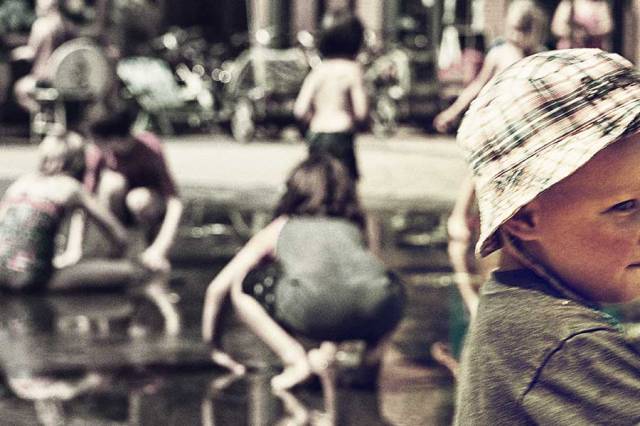
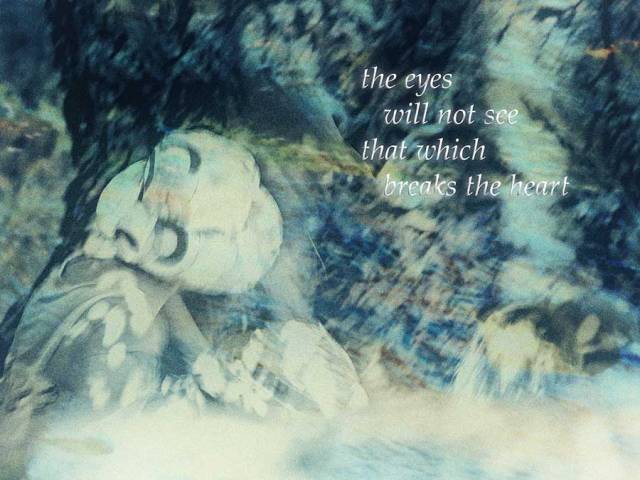
As I was reviewing images taken during a morning walk, this blurry photograph of children, gathered under a weeping willow to escape the summer heat, brought to mind the quote, “the eyes will not see that which breaks the heart.” So with the quote in mind I did a bit of exploring within the Nik Collection, added a couple of layers, and then did a bit of dodging and burning.
The above image, “My Corner of of the World” submitted in response to Ben’s weekly photo challenge is a sharp contrast to the various reports that are coming out of Yemen, “The World’s Worst Humanitarian Crisis.”
“It’s a slow death…We’re just waiting for doom or a breakthrough from heaven…
“Repeated bombings have crippled bridges, hospitals and factories. Many doctors and civil servants have gone unpaid for more than a year. Malnutrition and poor sanitation have made the Middle Eastern country vulnerable to diseases that most of the world has confined to the history books.
“In just three months, cholera has killed nearly 2,000 people and infected more than a half million, one of the world’s largest outbreaks in the past 50 years
“The [coalition airstrikes have] killed and wounded civilians…bombings have also heavily damaged Yemen’s infrastructure, including a crucial seaport and important bridges as well as hospitals, sewage facilities and civilian factories. …[making] it harder for humanitarian organizations to bring in and distribute aid.
“The United States is also a major donor [of humanitarian aid], as well as a primary supplier of arms to the members of the Saudi-led coalition. Although the United States is not directly involved in the conflict, it has provided military support to the Saudi-led coalition, and Yemenis have often found the remnants of American-made munitions in the ruins left by deadly airstrikes.”
The military intervention in Yemen led by the Saudi Arabia’s military has proven to be a “strategic failure” that has killed more than 10,000 people and injure more than 40,000 to date. Yet, a full and official withdrawal is unlikely, “A retreat means defeat…”
All of this leaves me questioning the distractions of the never-ending, on-going political drama from the White House that blinds and deafens me to the unimaginable in Yemen, as well as to the emotional, physical, and relational injury to members of the American military, their families, and Afghanistan civilians in what has become a fading, if not forgotten war, in my corner of the world.
The quote placed inside this image of daisies with a resting beetle brought to mind a quote, by an unknown author, that spoke to my restless soul. Over the past several years, my travels and relocations have diminished a bit more than I wish; and as a consequence, I feel as though I’ve begun to put down roots as my wings are being clipped.


 It began that first Halloween in Des Moines, Iowa, when I found myself wondering if the ghost, goblins, and witches that appeared at my door were also messaging the onset of seasonal changes. It was that year as my daughter’s Halloween costume was atop layers of clothing and hidden by a winter coat, I first noticed–and then again during later years in Wyoming and Colorado–that Halloween is often accompanied by a significant drop in temperature that generally lasted well into spring.





 a meditative journey
You must be logged in to post a comment.