

images submitted in response to Paula’s photo challenge.
images submitted in response to Paula’s photo challenge.
I found myself attracted to these two sunflowers in a fallowed field that borders a trail I walk almost everyday. Since the field is situated next to an apartment complex’s parking lot, it seemed to me that the background would have muddied any image. Therefore, with the aperture value at 5.6, I composed this image following RAJ’s instructions for a technique called “Focus Locking.” First I composed the image with the sunflowers in the center, then pressed the shutter so that the flowers were in focus, and then with a half-pressed shutter I recomposed the image before pressing the shutter fully.

Nikon D750 f/5.6 1/40 300mm 100 ISO
Again
I sneak into your garden
to eat arena berries.
(Please keep yourself hidden
until I go away!)
~Ryokan, cited in: K Tanahashi, Sky Above, Great Wind
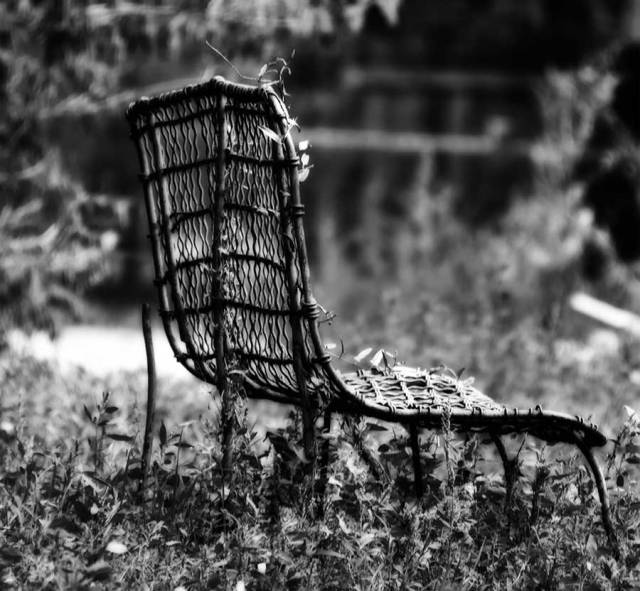
During a recent photo walk, I found myself ignoring a “no trespassing” sign while silently rehearsing innocent detail. If I had not been somewhat oppositional, I would have missed this interesting chair being re-weaved by nature as well as a water lily pond and a kingfisher. Much the same as Ryokan, 190+ years ago, I found myself hoping the homeowners would keep themselves hidden until I went away.

The above image, “My Corner of of the World” submitted in response to Ben’s weekly photo challenge is a sharp contrast to the various reports that are coming out of Yemen, “The World’s Worst Humanitarian Crisis.”
The New York Times, reports:
“It’s a slow death…We’re just waiting for doom or a breakthrough from heaven…
“Repeated bombings have crippled bridges, hospitals and factories. Many doctors and civil servants have gone unpaid for more than a year. Malnutrition and poor sanitation have made the Middle Eastern country vulnerable to diseases that most of the world has confined to the history books.
“In just three months, cholera has killed nearly 2,000 people and infected more than a half million, one of the world’s largest outbreaks in the past 50 years
“The [coalition airstrikes have] killed and wounded civilians…bombings have also heavily damaged Yemen’s infrastructure, including a crucial seaport and important bridges as well as hospitals, sewage facilities and civilian factories. …[making] it harder for humanitarian organizations to bring in and distribute aid.
“The United States is also a major donor [of humanitarian aid], as well as a primary supplier of arms to the members of the Saudi-led coalition. Although the United States is not directly involved in the conflict, it has provided military support to the Saudi-led coalition, and Yemenis have often found the remnants of American-made munitions in the ruins left by deadly airstrikes.”
Al Jazeera, August 23, 2017 notes:
The military intervention in Yemen led by the Saudi Arabia’s military has proven to be a “strategic failure” that has killed more than 10,000 people and injure more than 40,000 to date. Yet, a full and official withdrawal is unlikely, “A retreat means defeat…”
All of this leaves me questioning the distractions of the never-ending, on-going political drama from the White House that blinds and deafens me to the unimaginable in Yemen, as well as to the emotional, physical, and relational injury to members of the American military, their families, and Afghanistan civilians in what has become a fading, if not forgotten war, in my corner of the world.

Nikon D750 f/5.6 1/20s 300mm 100 ISO
Within this week’s photo lesson RAJ restates that a successful picture is one where your viewer lingers for a bit. One way of encouraging a prolonged and concentrated stay is through the use of frames that add depth, bring in the context to the story/object, create mystery, and hide unwanted elements within the image.
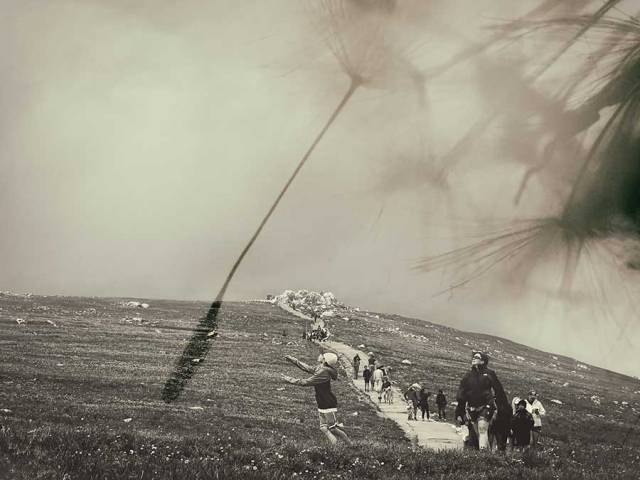
The quote placed inside this image of daisies with a resting beetle brought to mind a quote, by an unknown author, that spoke to my restless soul. Over the past several years, my travels and relocations have diminished a bit more than I wish; and as a consequence, I feel as though I’ve begun to put down roots as my wings are being clipped.

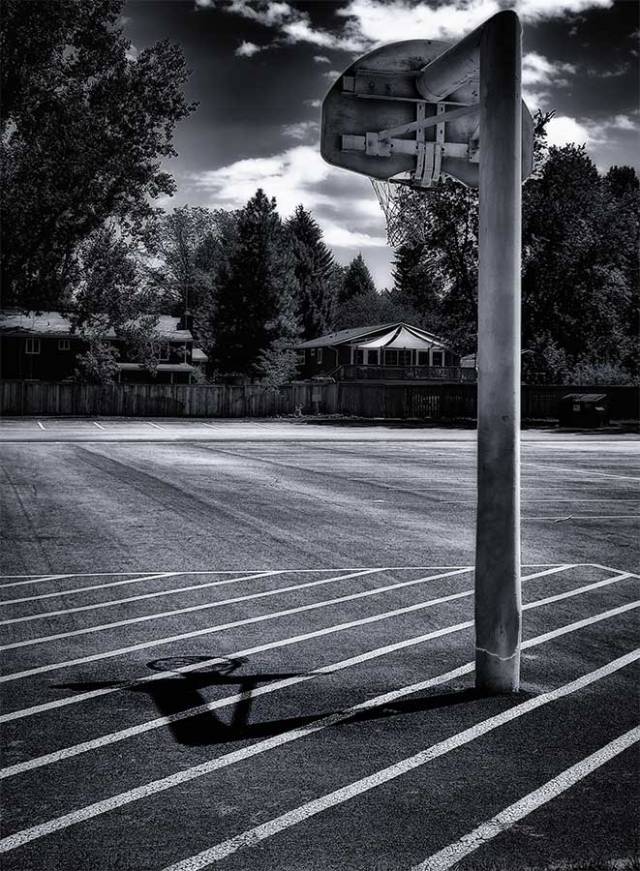
Shadow Basketball
“Why, any one can make up things,” she said. “Have you ever tried?”
She put her hand warningly on Emengarde’s.
“Let us go very quietly to the door,” she whispered, “and then I will open it quite suddenly, perhaps we may catch her.”
She has half laughing, but there was a touch of mysterious hope in her eyes which, fascinated Emengarde, though she had not the remotest idea what it meant, or whom it was she wanted to “catch,” or why she wanted to catch her. Whatsoever she meant, Emengarde was sure it was something delightfully exciting. So, quite thrilled with expectation, she followed her on tiptoe along the passage. They made not the least noise until they reached the door. Then Sara suddenly turned the handle, and threw it wide open. Its opening revealed the room quite neat and quiet, a fire gently burning in the grate, and a wonderful doll sitting in a chair by it, apparently reading a book.
“Oh, she got back to her seat before we could see her?”
Sara exclaimed, “Oh course they always do. They are as quick as lightning.”
Emengarde looked from her to the doll and back again.
“Can she — walk?” she asked breathlessly.
“Yes,” answered Sara. “At least I believe she can. At least I pretend I believe she can. And that makes it seem as if it were true. Have you ever pretended things?”
~Frances Hodgson Burnett, A Little Princess
Some mornings after a review of the news, I become acquainted with a sense of confused powerlessness wishing for a place to scream…loudly and safely scream into the darkness of despair. Uppsala, Sweden may be that place.
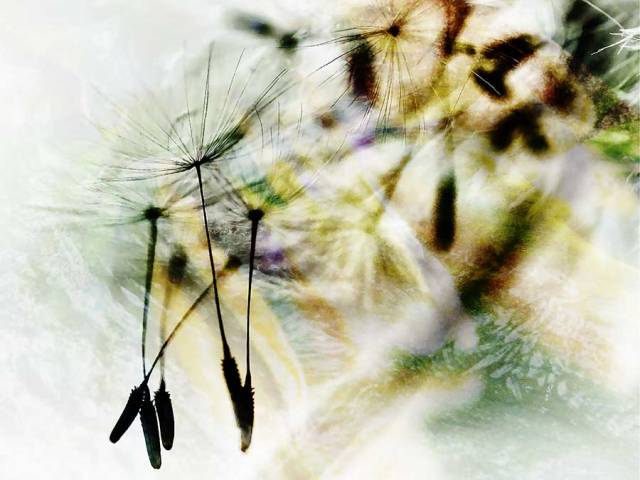

After reading the below except from Thich Nhat Hanh’s Being Peace,
“…The human species is a very young species–we appeared on the Earth only recently. Before that, we were rock, we were gas, we were minerals, we were single-celled beings. We were plants, we were trees, and now we have become humans…”
I found myself pondering, “is life today the outcome of a recycling process of matter within a closed system?”
In a quick Goggle search (The earth a closed system) I found OERu, an amazing open educational site which offers a course, The Inspiring Challenge of Sustainable Development. One of the lesson plans, CSF101, notes:
The Earth is made up of chemical elements – think of the periodic table. That is a list of all basic elemental materials on our planet. Because of gravity, matter (comprising all solids, liquids and gases) does not leave the system. It is a closed box. And, the laws of thermodynamics, long agreed by scientists, tell us that it’s impossible to destroy matter. So the chemical matter we have on Earth will always be here. The important question is, how are those chemicals organised?
It is accepted science that the Earth is an open system for energy. Energy radiates into the Earth’s system, mainly from the sun. Energy is then radiated back into space from the Earth, with the flows being regulated by the Earth’s atmosphere and ozone layer. This delicate balanced transfer of energy maintains the surface temperature at a level that is suited to the forms of life that have evolved and currently exist.
While the course CSF101’s discussion centers on global warming and climate change it seems to correspond with Thich Nhat Hanh’s writings that at one time I was a tree, a rain drop, a cloud, a dandelion.
Today, a participant in Debbie’s Six Word Saturday.
“Bodhi means being awake, and satttva means a living being, so bodhisattva means an awakened being. All of us are sometimes bodhisattvas, and sometimes not.

“Understanding is like water flowing in a stream. Wisdom and knowledge are solid and can block our understanding. In Buddhism, knowledge is regarded as an obstacle for understanding. If we take something to be the truth, we may cling to it so much that even if the truth comes and knocks at our door, we won’t want to let it in.”
Thich Nhat Hanh, The Heart of Understanding
 a meditative journey
You must be logged in to post a comment.