
early morning readings

contemplative photography 26 copy

Sony RX100 III  f/5   1/800s   8.8mm  800 ISO

A world without memory is a world of the present. The past only exists in books, in documents. In order to know himself, each person carries his own ‘Book of Life,’ which is filled with the history of his life. By reading its pages daily, he can relearn… Without his Book of Life, a person is a snapshot, a two-dimensional image, a ghost. … Some pass the twilight hours at their tables reading from their Books of Life; others frantically fill its extra pages with the day events.

With time, each person’s ‘Book of Life’ thickens until it cannot be read in its entirety.  Then comes a choice.  Elderly men and women may read the early pages, to know themselves as youth; or they may read the end, to know themselves in later years.

Some have stopped reading altogether.  They have abandoned the past.  They have decided that it matters not if yesterday they were…. no more than it matters how a soft wind gets into their hair. ~A Lightman, Einstein’s Dreams

In his 1991 file ‘Prospero’s Books’, a cinematic adaptation of William Shakespeare’s ‘The Tempest’, Peter Geenaway showed a series of exotic books that were kept in a library on a magical island and revealed just enough of their content to have me wishing the fantasy books were real. Among my favorites are ‘The Book of Colors,’ where “the pages cover the spectrum in finely differentiated shades…a ‘Book of Motion’ that describes, in animated illustrations, all possibilities for dance with the human body. ~J F Simon, Jr., Drawing Your Own Path

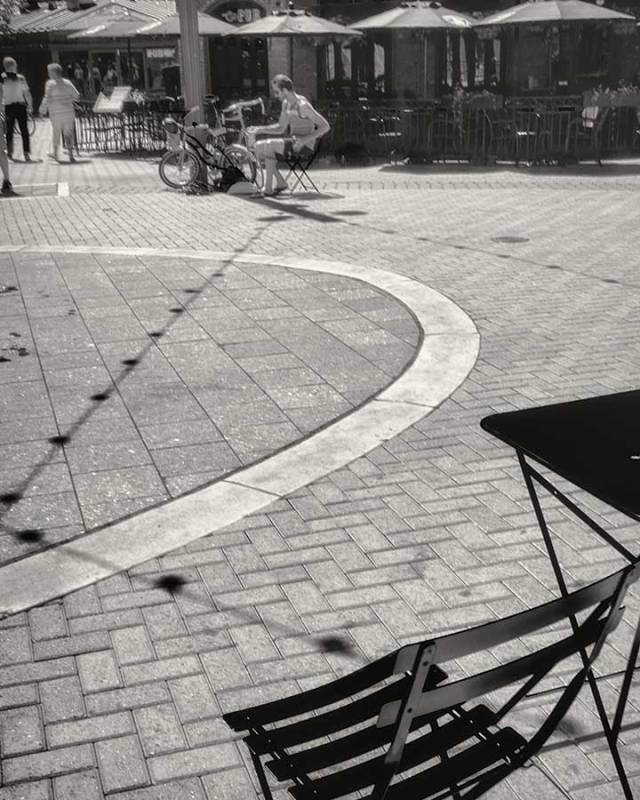
early morning readings

contemplative photography 5

Sony RX100 III  f/4  1/80s  23.9m  250 ISO

“This LeWitt drawing [All Two-Part Combinations of Arcs from Corners and Sides, Wall, Drawing #842, white crayons, black pencil, grid, 14×18 ft.], white lines on a large black field, created a strong presence in the gallery. That presence was beautifully offset by the simplicity of the system it described. Until that show, I believed that conceptual art was about the idea-the concept–and thus that the drawing on the wall was only there to display the idea. I believed this until one day during the show, when I found myself alone in the gallery in front of the wall and my vision was filled with black paint and the pebbly, waxy marks of the white crayon. At that moment the piece seemed to open a door in my mind. Rather than the concept being processed like art in my brain, I felt a sense of integration–my eyes and body were involved, a union between the concept and the materials, neither standing alone. My view transitioned from an analytical appreciation of a system called ‘art’ into an utter, complete presence with an artwork…” ~J F Simon, Jr., Drawing Your Own Path

“Observe the changes that take place in your mind under the light of awareness. Even your breathing has changed and become ‘not-two’ (I don’t want to say ‘one’) with your observing self. This is also true of your thoughts and feelings, which, together with their effects, are suddenly transformed. When you do not try to judge or suppress them, they become intertwined with the observing mind.” ~Thich Nhat Hanh, The Sun My Heart

lines & shapes

street-3web

Nikon D750     f/22     1/25     35mm     800 ISO

“…after trying for so long to program computers to make drawings autonomously, I noticed one key factor that distinguished me from the machine: I wanted to make a good drawing. The first step in making a good drawing is recognizing and giving voice to the desire to create. The creative urge is the engine that will drive the great effort it takes to pursue art over the long term, and understanding the nature of this desire will be critical in staying motivated long enough to develop good work.

“…What makes a drawing good? It would be impossible to list all the qualities of a good drawing, and in any case the list would be different for each of us and each artwork we liked. Luckily, we don’t need a precise definition. We understand how to proceed with our creative work by developing our intuition and learning to pay attention to what we value and respond to.”

~J F Simon, Jr (Drawing Your Own Path)