the uncertainty within grief’s reweaving memories…
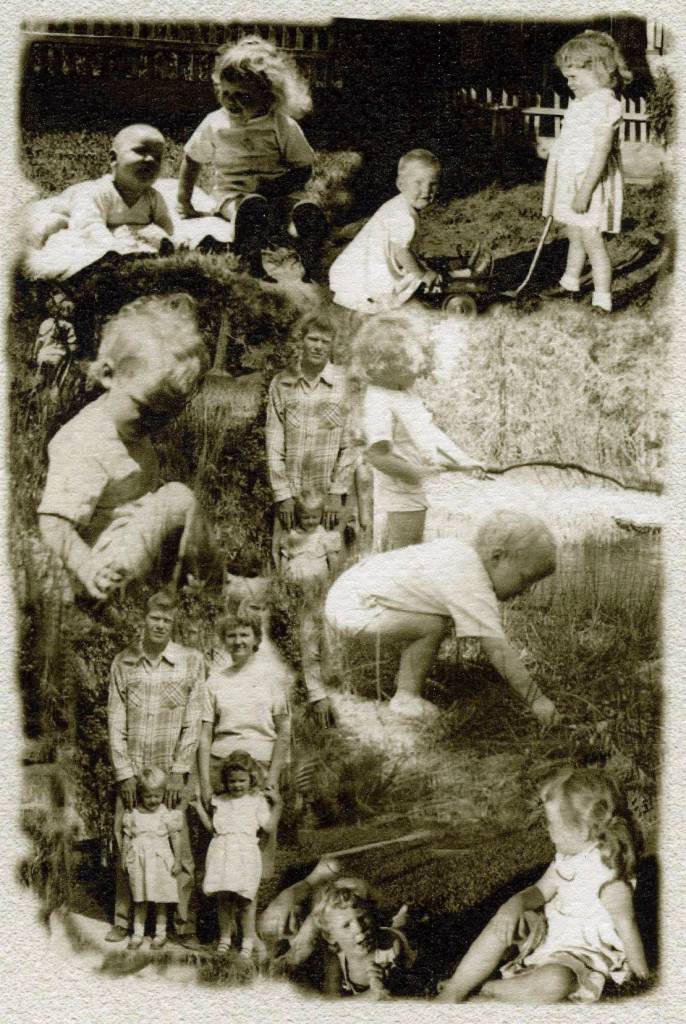
The personal story is a narrative of our unique sense of identity. We create our identities through the stories we weave onto a tapestry that is formed against the background of our family mythologies. We pull threads from of an assemblage of recalled details from our pasts and weaved them into images that cast us in whatever role corresponds with our current situations, feelings, thoughts, or actions. The colored threads of this tapestry are often re-embroidered to reflect the creative and dynamic process of our perspectives as we shift in, out, and between various roles, feeling states, and cognitions. As we reflect on our self-created images we are in turn affected by them; therefore, there is an unconscious re-weaving of our tapestries. ~The Meditative Journey with Saldage
To be human was to be a sentient being who remembers.*
“The third-century classic Jinshu summarized the paradox of memory: ‘Qing you yi sheng, bu yi ze wu qing.’ No words in English can capture the condensed reservations expressed in nine simple characters. The first four summarize ancient psychology: emotion is born out of remembrance. The next five advise the wise to stem this process of arousal altogether: where there is no remembrance, emotion will dissolve as well. The point, simply put, is that distress causes memory. To be sure, it is human to have feelings, but this can be curbed by a willful quieting of the emotional upheaval caused by remembrance.
“Simcha, the Hebrew word for ‘joy,’ has as its root macha, meaning ‘to remove’ or ‘wipe away.’ To be joyful, in this sense, is to be free of the tearful weight of the past.
“In the end, however, neither Chinese or Jewish rememberers settled for the peace of a memoryless world.
“The opposite of quietude can be found in the story of Lot’s wife… Here, a woman who refuses to walk away from history is turned into salt–a concrete symbol of endless weeping. Lot’s wife captures the need to remain connected to the past and dares to stand still when the known world is about to crumble. Although some might argue that Lot’s wife looked back with nostalgic regret for past pleasures, Anna Akhmatova, in the poem, ‘Lot’s Wife,’ suggest she did so out of her refusal to become deaf to the grief embedded in the past.”*
In China a person who will not forget the past is described as ‘one who did not drink Old Lady Meng’s soup.’ Borrowed from Buddhist folklore, Old Lady Meng dispenses the Broth of Oblivion to souls leaving the last realm of the underworld on their way to reincarnation. After drinking her soup, the soul is directed to the Bridge of pain that spans a river of crimson water. There, two demons lie in wait: Life-Is-Not-Long and Death-is-Near. They hurl the soul into waters that will lead to new births.
Old Lady Meng is more than a quaint antidote for the Greeks’ Mnemosyne. She embodies a psychological understanding about the forces that promote, indeed demand, forgetting for the sake of ongoing life. It is not enough to note that water is linked with amnesia in Chinese folklore as much the same way that the river Lethe is associated with forgetting in Greek mythology. The challenge here is to make sense of the distinctively Chinese attachment to remembrance in spite of the benefits of Old Lady Meng’s soul.
In Jewish tradition, too, the benefits of amnesia were acknowledged along with the sacred commitment to recollection. There is a midrash, or Torah-based story, that teaches us a lesson similar to that of Lady Meng: ‘God granted Adam and Eve an all-important blessing as they were about to leave the Garden of Eden: I give you, He said, ‘the gift of forgetfulness.” What is so precious about amnesia? Why would God, who demands fidelity to memory, offer the relief from recollection? Perhaps it is because without some ability to forgive and forget we might become bound by grudges and hatred. To remember everything may be immobilizing. To flee from memory, however, leads to an ever more debilitating frenzy.(40-41)**
“The morning chill came through an open window. The morning had begun its transformation from black to variations of dark blues to lighter hues outlining night’s black shadows. It had just passed…the morning ritual. The magical moment of silence in which all of the world – right before the sun’s rays lightens the sky – seems to hush in stillness.
Then in the distance one songbird followed by another as if a congregation’s ‘Amen.’
My mother came to visit. I may have called her as I, with a cup of steaming tea, looked up at the antique framed cross stitch hanging on the dining room wall.
It was during one of those rare visits to her home in which she shared a beautiful piece of counted cross stitch. I saw the delight in her face as she told me it was a gift…a gift of gratitude to someone unknown to me…a stranger. Aged jealously rose unbidden and formed a barrier between mother and daughter.
Within that moment, forgotten…a white tablecloth, each corner embroidered…a crocheted lap blanket…a crocheted dolly sewed onto a pillow cover…applique images within a child’s alphabet book.
And then. ‘Would you like me to make you one?’
‘Yes! Oh yes! Please let me frame it.’
Within an antique framed cross stitch…a magical moment. An exchange of love and validation
Excerpt from, bc kofford, “My Mother Came to Visit”
The personal story is a narrative of our unique sense of identity. We create our identities through the stories we weave onto a tapestry that is formed against the background of our family mythologies.
We pull threads from of an assemblage of recalled details from our pasts and weave them into images that cast us in whatever role corresponds with our current situations, feelings, thoughts, or actions. The colored threads of this tapestry are often re-embroidered to reflect the creative and dynamic process of our perspectives as we shift in, out, and between various roles, feeling states, and cognitions. As we reflect on our self-created images we are in turn affected by them; therefore, there is an unconscious re-weaving of our tapestries.
Excerpt: Koeford, B., A Meditative Journey with Saldage
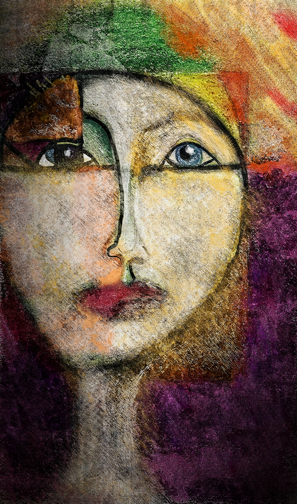
self portraiture created through the use of mixed media
In China a person who will not forget the past is described as ‘one who did not drink Old Lady Meng’s soup.’ Borrowed from Buddhist folklore, Old Lady Meng dispenses the Broth of Oblivion to souls leaving the last realm of the underworld on their way to reincarnation. After drinking her soup, the soul is directed to the Bridge of Pain that spans a river of crimson water. There, two demons lie in wait: Life-Is-Not-Long and Death-is-Near. They hurl the soul into waters that will lead to new births.
Old Lady Meng is more than a quaint antidote for the Greeks’ Mnemosyne. She embodies a psychological understanding about the forces that promote, indeed demand, forgetting for the sake of ongoing life. It is not enough to note that water is linked with amnesia in Chinese folklore as much the same way that the river Lethe is associated with forgetting in Greek mythology. The challenge here is to make sense of the distinctively Chinese attachment to remembrance in spite of the benefits of Old Lady Meng’s soul.
In Jewish tradition, too, the benefits of amnesia were acknowledged along with the sacred commitment to recollection. There is a midrash, or Torah-based story, that teaches us a lesson similar to that of Lady Meng: ‘God granted Adam and Eve an all-important blessing as they were about to leave the Garden of Eden: I give you, He said, ‘the gift of forgetfulness.” What is so precious about amnesia? Why would God, who demands fidelity to memory, offer the relief from recollection?Perhaps it is because without some ability to forgive and forget we might become bound by grudges and hatred. To remember everything may be immobilizing. To flee from memory, however, leads to an ever more debilitating frenzy.(40-41)**
self portraiture created through the use of mixed media
In China a person who will not forget the past is described as ‘one who did not drink Old Lady Meng’s soup.’ Borrowed from Buddhist folklore, Old Lady Meng dispenses the Broth of Oblivion to souls leaving the last realm of the underworld on their way to reincarnation. After drinking her soup, the soul is directed to the Bridge of pain that spans a river of crimson water. There, two demons lie in wait: Life-Is-Not-Long and Death-is-Near. They hurl the soul into waters that will lead to new births.
Old Lady Meng is more than a quaint antidote for the Greeks’ Mnemosyne. She embodies a psychological understanding about the forces that promote, indeed demand, forgetting for the sake of ongoing life. It is not enough to note that water is linked with amnesia in Chinese folklore as much the same way that the river Lethe is associated with forgetting in Greek mythology. The challenge here is to make sense of the distinctively Chinese attachment to remembrance in spite of the benefits of Old Lady Meng’s soul.
In Jewish tradition, too, the benefits of amnesia were acknowledged along with the sacred commitment to recollection. There is a midrash, or Torah-based story, that teaches us a lesson similar to that of Lady Meng: ‘God granted Adam and Eve an all-important blessing as they were about to leave the Garden of Eden: I give you, He said, ‘the gift of forgetfulness.” What is so precious about amnesia? Why would God, who demands fidelity to memory, offer the relief from recollection?Perhaps it is because without some ability to forgive and forget we might become bound by grudges and hatred. To remember everything may be immobilizing. To flee from memory, however, leads to an ever more debilitating frenzy.(40-41)**
“…to remain alive is to be subject to the grinding force of memory. Day and night the millstone turns, shaping the soul and softening the heart. To some, this going around and around the same subject may seem like emotional paralysis. But there is also something freeing about this attachment to remembrance. One day, one hour, one child, keep cutting through to the present. All other days take shape around this circle of emptiness.” ~V Schwarcz (Bridge Across Broken Time)
To be human was to be a sentient being who remembers.*
“The third-century classic Jinshu summarized the paradox of memory: ‘Qing you yi sheng, bu yi ze wu qing.’ No words in English can capture the condensed reservations expressed in nine simple characters. The first four summarize ancient psychology: emotion is born out of remembrance. The next five advise the wise to stem this process of arousal altogether: where there is no remembrance, emotion will dissolve as well. The point, simply put, is that distress causes memory. To be sure, it is human to have feelings, but this can be curbed by a willful quieting of the emotional upheaval caused by remembrance.
“Simcha, the Hebrew word for ‘joy,’ has as its root macha, meaning ‘to remove’ or ‘wipe away.’ To be joyful, in this sense, is to be free of the tearful weight of the past.
“In the end, however, neither Chinese or Jewish rememberers settled for the peace of a memoryless world.
“The opposite of quietude can be found in the story of Lot’s wife… Here, a woman who refuses to walk away from history is turned into salt–a concrete symbol of endless weeping. Lot’s wife captures the need to remain connected to the past and dares to stand still when the known world is about to crumble. Although some might argue that Lot’s wife looked back with nostalgic regret for past pleasures, Anna Akhmatova, in the poem, ‘Lot’s Wife,’ suggest she did so out of her refusal to become deaf to the grief embedded in the past.”*
Metaphor ferries memory across time. It allows us to enter worlds of imagination and feeling that might otherwise be closed to us …
Ricoh f/10 1/24s 7.3mm 80 ISO
… memory can take refuge in silence…*
The rememberer … is a person who defies the natural laws of decay, one who makes of the heart a more hospitable ground for traces of the past… The rememberer might also be a lonely rebel against the passage of time. To resist the erasers occasioned by this passage, memories have to be written down.
Although yi (memory) brings up unsettling emotions, and simcha (joy) depends on wiping away old aches, remembrance remains the only way not to betray the past.






 a meditative journey
You must be logged in to post a comment.