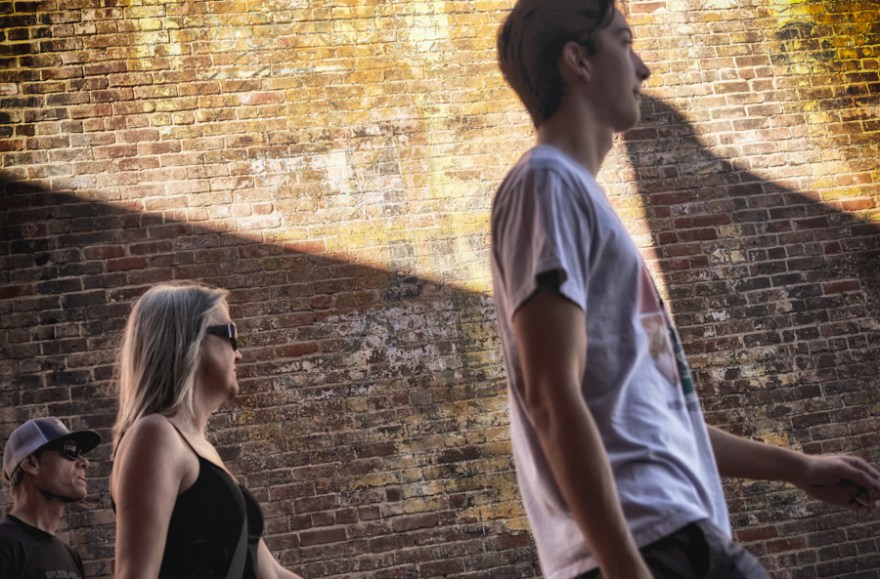
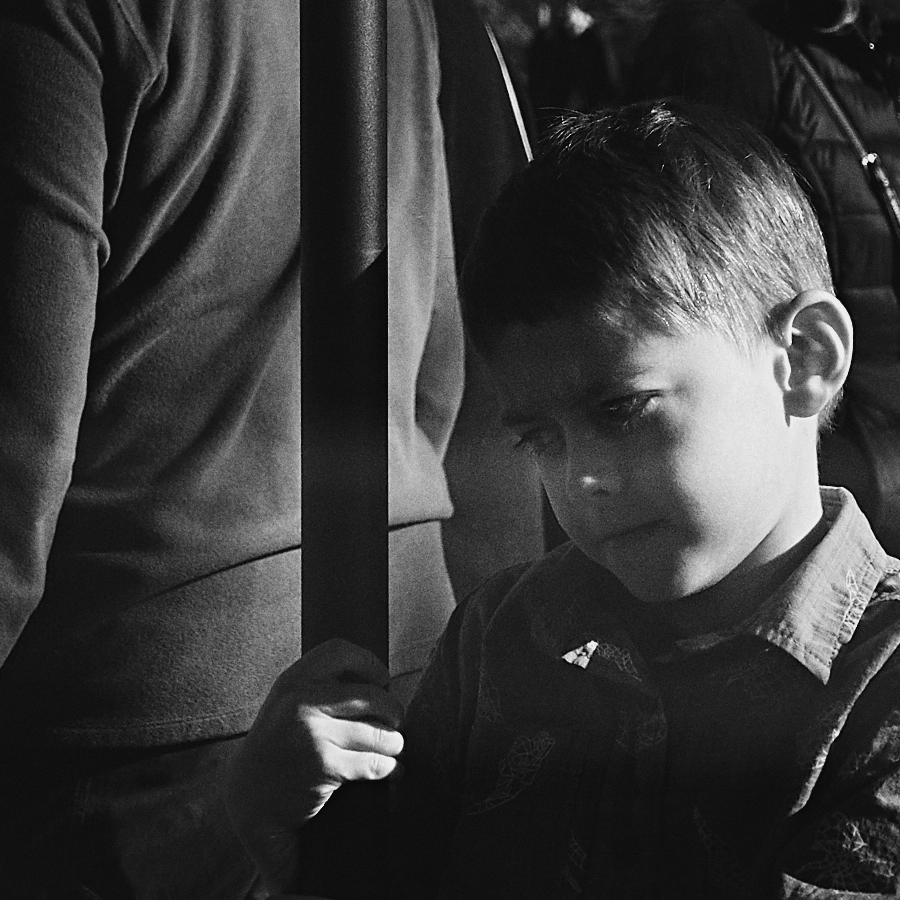
a photo study: street portraiture


My brain is tired.  After fourteen posts in which my thinking/photographic self weaved in, through, and out of contemplative photography, I decided it was time to shift “focus” to the genre of street portraiture by inviting a number of amazing photographers to share their creative endeavors.

But first, what is street portraiture?

Well to me, a street portrait is just a photograph/portrait of someone you meet on the streets (stranger). Generally it is focused on their face, but doesn’t need to be. A “portrait” just means a “likeness” of someone. For example, you can shoot a “full body portrait” of someone, and you can also shoot a closeup face portrait of someone. ~Eric Kim

On the photo forums they are always debating whether street portraiture is street photography.

There are no hard and fast rules. But in general, if a picture contains a person on the street and is posed / staged, it is street portraiture. If the photo of the person is candid,  it is street photography. Street portraiture may come under realm of street photography, but it is not to be confused with candid, non staged street work. Now, there are no photo police to decide such matters, so people are free to call em as they see em. ~ Daniel D. Teoli Jr.

Now let’s visit the website 123Photogo who shares with us that …character portraits is a whole different type of portrait photography, but, truly an art form that is just totally fun

BRINGING OUT THE CHARACTER IN A PORTRAIT

Jamie Windsor offers us “Tips for taking portraits of strangers”:

Mikaël Theimer’s talk about his connecting with strangers

Amazing examples of street portraiture to inspire you to pick up your camera and connect with life on the street.

 https://www.viewbug.com/blog/street-portraits-photo-contest-finalists

http://www.zunlee.com/streetportraits#10

I am looking forward to seeing one or more of your creative connection with people on the street.  Let’s tag with #aphotostudy.  Thank you for being a part of this learning journey.

princess nukada

princessnukadaweb111118

Nikon D750   f/5.6  1//400s   300mm   640 ISO

When spring escapes

freed from being huddled in winter’s sleep,

the birds that had been stilled

burst into song.

The buds that had been hidden

burst into flower.

The mountains are so thickly forested

that we cannot reach the flowers

and the flowers are so tangled with vines

that we cannot pick them.

When the maple leaves turn scarlet

on the autumn hills,

it is easy to gather them

and enjoy them.

We sigh over the green leaves

but leave them as they are.

That is my only regret–

so I prefer the autumn hills.

~Princess Nukada – 7th Century (K Rexroth I Atsumi, The Burning Heart*)

*note:  Princess Nukada lived in the later half of the 7th Century. She was the daughter of Prince Kagami, wife and the favorite of Emperor Temmu.


early morning reading

ponder

“When others make us angry at them–at their shamelessness, injustice, inconsideration–they exercise power over us, they proliferate and gnaw at our soul, then anger is like a white-hot poison that corrodes all mild, noble, and balanced feelings and robs us of sleep. Sleepless, we turn on the light and are angry at the anger that has lodged like a succubus who sucks us dry and debilitates us. We are not only furious at the damage, but also that it develops in us all by itself, for while we sit on the edge of the bed with aching temples, the distant catalyst remains untouched by the corrosive force of the anger the eats at us.  On the empty internal stage bathed in the harsh light of mute rage, we perform all by ourselves a drama with shadow figures and shadow words we hurl against enemies in helpless range… And the greater our despair that it is only a shadow play and not a real discussion with the possibility of hurting the other and producing a balance of suffering, the wilder the poisonous shadows dance and haunt us even in the darkest catacombs our dreams. (We will turn the tables, we think grimly, and all night long forge words that will produce in the other the effect of a fire bombs that now he will be the one with the flames of indignation raging inside while we, sooth by schadenfreude, will drink our coffee in cheerful calm.)

What could it mean to deal appropriately with anger?  We really do’t want to be soulless creatures who remain thoroughly indifferent to what they come across, creatures who appraisals consist only of cool, anemic judgments and nothing can shake them up because nothing really bothers them. Therefore, we can’t seriously wish not to know the experience of anger and instead persist in an equanimity that wouldn’t be distinguished from tedious insensibility.  Anger also teaches something about who we are. Therefore this what I ‘d like to know: What can it mean to train ourselves in anger and imagine that we take advance of its knowledge without being addicted to its poison?

We can be sure that we will hold on to the deathbed a part of the last balance sheet–and this part will taste bitter as cyanide–that we have wasted too much, much too much strength and time on getting angry and getting even with other in a helpless shadow theater, which only we, who suffered in impotently, knew anything about. Why did our parents, teachers and other instructors…Not give us in this case any compass that could have helped us avoid wasting our soul on useless, self-destructive anger.” ~Pascal Mercier, Night Train to Lisbon (pp.377-378)

izumi shikibu

I’ve traveled 

that dark path to the world

which comes down from this mountain

just to see you

one last time.

~Izumi Shikibu (J Hirshfield & M Aratani, The Ink Dark Moon)

grandjct 1

Interstate I-70  Western Colorado…                                                                                                            Nikon D750   f/7.1    1/800s    85mm    100 ISO


weekly photo challenge: red

mountain’s red leaves
the setting sun returns
to the sky
~Issa (www.haikuguy.com)

This week’s photo challenge offered by Jenn at Traveling at Wits End is to photograph the color red.

Yesterday I woke to snow that was hiding a layer of ice. A few weeks ago I realized that one of the identifications of aging is when the presence of ice is less and less seen as an opportunity to enjoy the excitement of ice sledding and more and more of a “danger, danger” message.

So instead of undertaking a photo walk this weekend, I decided to take this time to wander about my photo library to find photos that have a “pop of red” to share this winterly weekend.

Bambi and Thumper…on ice

a photo study: contemplative photography XII – seeing space

I’m continuing this series of contemplative photography with an exploration of the element of space.  Andy Kerr and Michael Wood at Seeing Fresh note that the challenge in their space assignment is to shift our intention from seeing forms in space to seeing visual space itself; that is, the space that surrounds things and space that is between things.

Opening myself to seeing space as around and between objects

John McQuade and Miriam Hall invited me to drop my orientation to things by introducing dot-in-space.  My understanding of dot-in-space began with a review of a previous post a photo study: negative space in which I wrote:

In photography negative space is perhaps the most important element as it embraces the subject within your image — the element of interest — helping it stand out and inviting the viewer’s attention.  It is the aspect within a photograph that generally doesn’t attract much attention.  It is sometimes referred to as white space and has the potential to change what appears to be an average subject into an outstanding image. 

It is easy to focus our attention on the subject, on what we see as the most important element of the photograph. Adding to or taking away negative space affects the subject within an image as they effectively become smaller or larger within the frame of your image. 

negativespace-1web

simplification and negative space

McQuade and Hall write:

When we see, we always see something. … Seeing something means that we see a foreground dot against a background space…you cannot simply see or make an image of space. An image of the clear, blue sky would not likely be a perception or an image of space.  It might look somewhat blank and not very dynamic, but perception is always dynamic… A cloud in the sky would cause the sky itself to fall into the background of the cloud, which then becomes the foreground (the dot.)

contemplativephotodotweb

dot in foreground

spaceweb

space in foreground

In photographing space, McQuade and Hall suggest that I invert the relationship between the dot and the space so that the dot becomes a supportive element for dynamic space.  When the dot recedes to the visual background, the space element assumes the function of the foreground.   The dot (which often occupies an edge or corner of an image) then, serves as an anchor.

This slideshow requires JavaScript.

McQuade and Hall furthers their discussion of space by encouraging the photographer to open the self to the subtlety of space which moves beyond the dot and to the experience of space.  Within this level, a trace element of the dot within these images are always present, but it is not the focus.

…the main quality of visual space is that it is pervasive…it is a feature of the whole perception.

…pay attention to how your eye and mind react. If one, your eye doesn’t land somewhere, but instead, is buoyed by an overall space; and if two, your mind does not fixate somewhere but, at least initially, rests in a sense of expanse, then this is an equivalent image of space. 

This slideshow requires JavaScript.

As with all mind shifts this aspect of contemplative photography has nudged me outside my usual way of seeing the world.  Negative space in other photographic genres is a means to embrace the subject within your image — the element of interest — helping it stand out.  In contrast, contemplative photography invites the subject to move into the background so that space becomes the element of interest.

As always I would love to read your comments and view your images.  Let’s tag with #aphotostudy.

Within the website Seeing Fresh, visitors will find an introduction to Karr and Wood’s discussion of contemplative photography as well as a series of photographic assignments on color, texture, simplicity, light, and space that include representative images.