In the summer night
The evening still seems present,
But the dawn is here.
To what region of the clouds
Has the wandering moon come home?
~ Kiyohara no Fukayabu (cited: Ogura Hyakunin Isshu)

In the summer night
The evening still seems present,
But the dawn is here.
To what region of the clouds
Has the wandering moon come home?
~ Kiyohara no Fukayabu (cited: Ogura Hyakunin Isshu)

you missed this morning’s NPR’s Morning Edition.
“Let’s write a song about a woman telling a guy off.”
Ulaby, Neda. “‘You Don’t Own Me,’ A Feminist Anthem with Civil Rights Roots, Is All About Empathy.” June 26, 2019
https://www.npr.org/2019/06/26/735819094/lesley-gore-you-dont-own-me-american-anthem
“Many have taken up the song [You Don’t Own Me] as a symbol of women’s empowerment — like when the female cast of Saturday Night Live sang ‘You Don’t Own Me’ with actress Jessica Chastain the night of the 2018 Women’s March — but this fiercely feminist anthem was written by two men. David White died earlier this year, but John Madara, now 82 years old, says the two songwriters were disgusted by how much music written for female singers in the early 1960s centered on mooning over guys and decided to try something: “Let’s write a song about a woman telling a guy off.
“Madara says the song’s sensibility was also shaped by his upbringing in a multiracial Philadelphia neighborhood and his participation in the civil rights movement. ‘I saw how black people got treated,’ he says. ‘It was horrible, horrible, horrible. My friends and I got locked up in Philadelphia and Mississippi, and they treated us like gangsters. And my black friends got hit more than I got hit. [The police] had billy clubs and hit you across the legs, but the black guys got hit across the body. Those are things you don’t forget.'”
And while we’re talking about empathy, please join
Lights for Liberty is calling for communities around the country to join them in holding an event called: “Lights for Liberty: A Vigil to End Human Detention Camps”. The event will take place on Friday, July 12. To find out more about the organization and their plans for this national vigil you can go to their website – https://www.lightsforliberty.org/

“on your left,” I heard
on a bicycle built for two
youth passing me…bye

How can I be substantial if I do not cast a shadow? I must have a dark side also if I am to be whole.
~Carl Jung (cited: Sean Tucker, Embace your Shadows: A lesson for Light and Life)
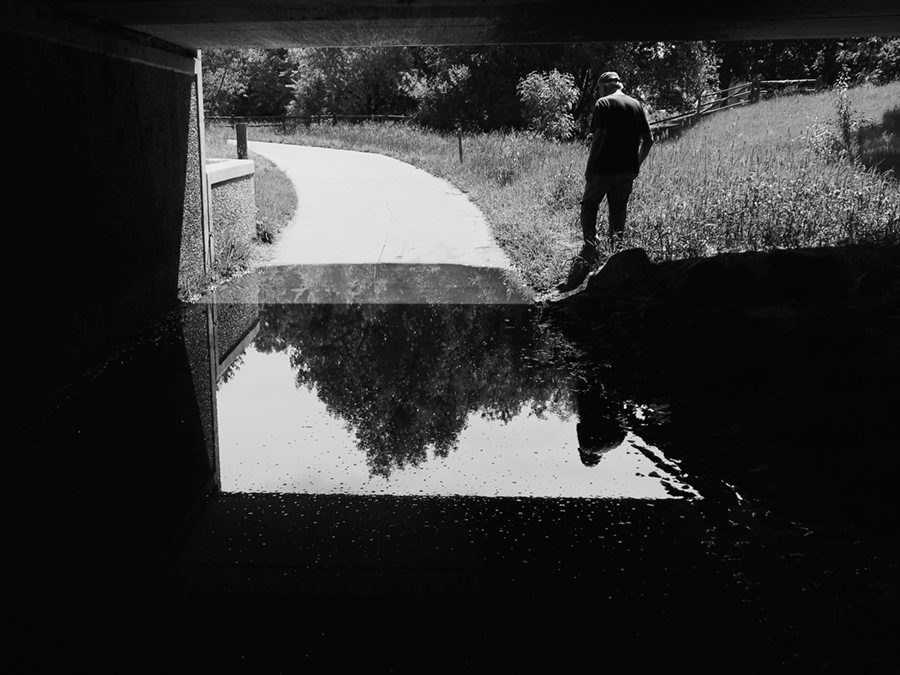
The only time we are changing as human beings is in the shadows, the dark times.
Sean Tucker: Embrace your Shadows: A Lesson for Light and Life

“… literature provided me with alternate threads by which to darn a harmonious, yet delusional, understanding of death, of fatherless children, of a family. To move into this realm is to be cuddled in the arms of a chair, mesmerized by the pages of a book unfolding like an accordion, embraced by a transparent sound barrier, and transported into fantasies found through fictional characters. While my mind’s eye grasped the hand of my naïve emotional self and together we observed the telling of storied lives, there was a seeking mind that simultaneously identified revealing markers to create a map, not to a place of hidden treasures, but to a place that felt like a home.
I was six years old the first time this happened. Martin and Cooney’s Five Little Peppers and How they Grew eased my aloneness with the emptiness left by my father’s death and filled it with a reformulated concept of family. Later, it was Alcott’s characters within Little Women and Little Men who gave me permission to vicariously be a fatherless child united with loving adults who validated sacrifice, patience, and compassion. Burnett’s themes of grief and loss within The Little Princess identified the behaviors, choices, and attitudes necessary to survive the evils of dark despair until the rescue by an unknown and unidentified savior, just and righteous.”
~B Catherine Koeford, A Mediative Journey with Saldage homesickness for a place, a time, a person that cannot be
a lightning flash
soaked in green glaze
far beyond the field
~Kuroda Momoko (trans: M Ueda, Far Beyond the Field)

The Chinese expression for “nostalgia” is xiangchou, literally “village sadness” … the grief that accompanies the traveler who cannot find a way back to the home village.
Vera Schwarcz, Bridge Across Broken Time

Hiraeth (pronounced [hiraɪ̯θ] is a Welsh concept of longing for home. Many Welsh people claim hiraeth is a word which cannot be translated, meaning more than solely “missing something” or “missing home.” To some, it implies the meaning of missing a time, an era, or a person. It is associated with the bittersweet memory of missing something or someone, while being grateful of their existence. It can also be used to describe a longing for a homeland, potentially of your ancestors, where you may have never been. Similarly, the Cornish equivalent is hireth.
lost in the woods —
only the sound of a leaf
falling on my hat ~Tagami Kikusha (trans: Makoto Ueda, Far Beyond the Field)
Hiraeth bears considerable similarities with the Portuguese concept of saudade, Galician morriña, Romanian dor, Gaelic cianalas, Russian toska (тоска), German Sehnsucht and Ethiopian tizita (ትዝታ)
I cannot speak of
Yudono, but see how wet
My sleeve is with tears.
~Matsuo Basho, The Narrow Road to Oku (trans: Donald Keene)

“…I was hearing the forest grow!

Then a peaceful sensation came over me, a sense that I didn’t have to do anything, that nature was taking care of itself. …The forest grew itself in the same way that my body breathed. What are Earth’s natural systems, living systems, always up to? Growing and reproducing. The living world is a creative place, because living things are always creating. Humans are not separate from this creation… We are creating our lives, while all around us the world is a creative place. …when I sit and draw, I am expressing that same creative energy. I open and let the drawings emerge.
John F Simon, Drawing your own Path
 a meditative journey
You must be logged in to post a comment.