life’s passages … 95

May I find the Equanimity that will lift a veil of shamed despair and acquaint me to the perceived and perceiver absent of greed, anger, and ignorance.


wyominglandscape-8web

This journey with saldage has brought me to a place and time in which to unweave and sort through the pseudo-beliefs I have simply, without question, absorbed through the lens of childhood fantasy and comprehension.  To begin this process is to reformulate beliefs through a process of mindfulness and analysis and then to know for myself, “These things are bad, blamable, censured by the wise; undertaken and observed, these things lead to harm and ill… These things are good, blameless, praised by the wise… These things lead to benefit and happiness.”

It is not an easy undertaking to not simply believe what has been learned within family, school and church as well as conclusions reached through readings. The invitation to not simply follow tradition brings to the surface conflicts with compliance and opposition that come from an avalanche of values and guiding principles that outlines how I understand the roles and expectations of women.

To not adhere to that which was surmised within family stories about an ancestor, who upon seeing a swarm of locust “knelt in his patch of grain and pleaded with his Maker to spare his wheat” and then saw them divide and not damage his remaining crops. Or within the story about the ancestor, who during a trip from New York to England, calmed the seas with a prayer, and while in England, after much fasting and prayer administered to a deaf and dumb boy who was subsequently healed. To not simply believe opens a door of pondering about generations of family members who intimately knew powerlessness and insecurity, who eased their feelings of incompetence through prayer, and whose conceptions blinded them to their neighbors’ plight.
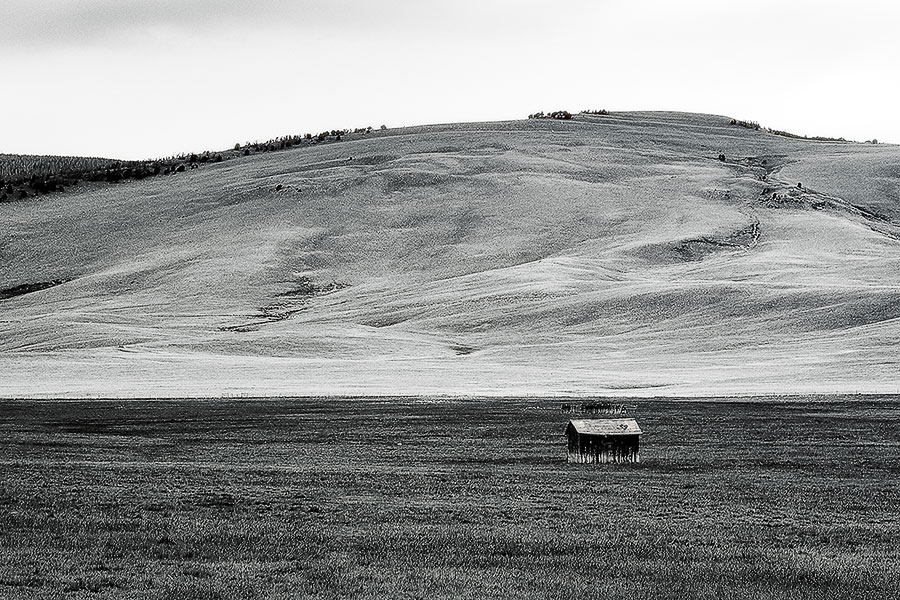
wyominglandscape-6a-web


To not simply believe that I must endure suffering is to reject the axiom that there is an absence of fundamental faith and goodness. To not adhere to the assumed abilities of ancestors frees me from the belief that a sincere act of making amends for my sins will open the doors to Shangri-La.  To not simply draw upon scripture unbinds me to the shame that I don’t have the faith – even of the size of a mustard seed – to be deeded as “good and without sin” so what I wish for, even that which goes counter to nature’s laws, will be granted.  To ease the suffering within discontent is to not simply hold to be true that I am to acquiesce to pain until the final judgment of death, and only then will I be forever at peace, or forever condemned to an existence of even greater suffering.

To not simply believe opens my ears to the incongruence within a belief in an all-knowing presence who, if not validated, punishes, absent of the grace within loving-kindness.  To not simply believe brings a compassionate acknowledgment to the painful efforts to sway God into granting me my desires through bargaining, sacrifice, negation, and suffering, and to finally surrender with acceptance to “Thy will be done on earth as it is in heaven.”  To not simply believe sheds light upon the greed, aversion, and delusions that are intertwined into my conception of and relationship with life.

I do hold that my beliefs and the subsequent desire for their illusive promises of validation, forgiveness, or reunification have set me upon an unending path of suffering.  These beliefs lead to harm and ill as they are like thorns that tear into my heart.  This searing pain releases resentment intertwined with envy, awakens alienation, and denies me the essence of Christ’s wisdom and loving compassion.

wyominglandscape-7web

Christ stood before self-righteous anger and commanded that only the one without sin was to cast the first stone of punishment and, at another time and in the midst of his own suffering, sought forgiveness for those who “know not what they do.”   Within these written words, I hear compassion speaking for the suffering intertwined within anger ungoverned by moral shame and moral dread.  Compassion is telling us how suffering, entangled into knots of mental, emotional, and social turmoil, deafens us to our guiding principles and blinds us to the horrors our moral shame will witness as it awakens from darkened ignorance.


The practice of the presence of God as being comparable to that of consciousness finally makes possible “full awareness” applied to every thought, world, and deed.   ~ Unknown

Excerpts from B Koeford, A Meditative Journey with Saldage

wednesday evening with Paul Celan

“Reachable, near and not lost, those remained amid the losses this one thing: language.

horsetooth reservoir… Nikon D750 f/7.1 1/25s 85mm 100 ISO

“It, the language remained, not lost, yes in spite of everything. But it had to pass through its wounded wordlessness, pass through frightful muting, pass through the thousand darknesses of deathbringing speech. It passed through and giveback no words for that which happened.” ~Paul Celan* (cited: V. Schwarcz, Bridge Across Broken Time p. 85)

*Poet, translator, essayist, and lecturer, influenced by French Surrealism and Symbolism. Celan was born in Cernăuţi, at the time Romania, now Ukraine, he lived in France, and wrote in German. His parents were killed in the Holocaust; the author himself escaped death by working in a Nazi labor camp. “Death is a Master from Germany”, Celan’s most quoted words, translated into English in different ways, are from the poem ‘Todesfuge’ (Death Fugue). Celan’s body was found in the Seine river in late April 1970, he had committed suicide.

life’s passages … 81

Death of a loved one disturbs the relationships that sustain a person’s sense of ‘identity’ and the high level of binding and cathexis concentrated on the person who is lost is suddenly disrupted . . . there is a close link between the doctrines of egolessness and suffering.

De Silva, Padmasiri. An Introduction to Buddhist Psychology. Landam, MD, 2000.
Poudre Canyon… f/7.1 1/200s 28mm 4500 ISO

Through this lens of Buddhist thought, I begin to feel a crumbling of a child’s self with an understanding of how my father’s absolute and final absence from our lives disrupted the multiple relationships between my father, mother, sister, and me.  Besides the sudden severing of the identity I was forming via my father, the connecting emotional threads between those of us that were left, although still intact, were unknowingly stretched and pulled by our own individual fears of egolessness.

My father’s death left my mother, a young woman deaf from infancy, with two daughters and pregnant with her first son.  I do not recall whose idea it was to wander outside the house early that morning as my mother slept.  I can, however, imagine my young self following my older sister as if an invisible thread that tied us together tugged me along as she, with her five-year-old world view, undertook an emotional duty to find our father.  Did we believe we could find him fly fishing in the creek that ran alongside the house? Or was there something about the water that enticed us into abandoning our search?  I can recall to this day the cessation of anxiety and arising rapture that coincided with my surrender to the inevitable. Two young men, I am told, rescued us both from this search for our father.

Koeford, BC. A Meditative Journey with Saldage Homesickness for a place, a time, a person that cannot be

life’s passages … 79

To be human was to be a sentient being who remembers.*

“The third-century classic Jinshu summarized the paradox of memory: ‘Qing you yi sheng, bu yi ze wu qing.’ No words in English can capture the condensed reservations expressed in nine simple characters. The first four summarize ancient psychology: emotion is born out of remembrance. The next five advise the wise to stem this process of arousal altogether: where there is no remembrance, emotion will dissolve as well. The point, simply put, is that distress causes memory. To be sure, it is human to have feelings, but this can be curbed by a willful quieting of the emotional upheaval caused by remembrance.

“Simcha, the Hebrew word for ‘joy,’ has as its root macha, meaning ‘to remove’ or ‘wipe away.’ To be joyful, in this sense, is to be free of the tearful weight of the past.

“In the end, however, neither Chinese or Jewish rememberers settled for the peace of a memoryless world.

“The opposite of quietude can be found in the story of Lot’s wife… Here, a woman who refuses to walk away from history is turned into salt–a concrete symbol of endless weeping. Lot’s wife captures the need to remain connected to the past and dares to stand still when the known world is about to crumble. Although some might argue that Lot’s wife looked back with nostalgic regret for past pleasures, Anna Akhmatova, in the poem, ‘Lot’s Wife,’ suggest she did so out of her refusal to become deaf to the grief embedded in the past.”*

*Vera Schwarcz, Bridge Across Broken Time

life’s passages … 65

brendakofford_dandelionproject9118b-webThe ocean of suffering is immense, but if you turn around, you can see the land. The seed of suffering in you may be strong, but don’t wait until you have no more suffering before allowing yourself to be happy. When one tree in the garden is sick, you have to care for it. But don’t overlook all the healthy trees. Even while you have pain in your heart, you can enjoy the many wonders of life — the beautiful sunset, the smile of a child, the many flowers and trees. To suffer is not enough. Please don’t be imprisoned by your suffering. … When you have suffered, you know how to appreciate the elements of paradise that are present. If you dwell only in your suffering, you will miss paradise. Don’t ignore your suffering, but don’t forget to enjoy the wonders of life. For your sake and the benefit of many beings.

When I was young, I wrote this poem. I penetrated the heart of the Buddha with a heart that was deeply wounded.

My youth
an unripe plum.
Your teeth have left their marks on it.
The tooth marks still vibrate.
I remember always,
remember always

Since I learned how to love you,
the door of my soul has been left wide open
in the winds of the four directions.
Reality calls for change.
The fruit of awareness is already ripe,
and the door can never be closed again.

Fire consumes this century,
and mountains and forest bear its mark.
The wind howls across my ears,
while the whole sky shakes violently in the snowstorm.

Winter’s wounds lie still,
Missing the frozen blade,
Restless, tossing and turning
in agony all night.

I grew up in a time of war…Once the door of awareness has been opened, you cannot close it. The wounds of war in me are still not all healed. … Embrace your suffering, and let it reveal to you the way to peace.

~Thich Nhat Hanh (The Heart of the Buddha’s Teaching, pp. 3-5)

Life’s passage … 57

The storm at the window

has escalated its roaring,

the sounds of children

muffled in the dim,

tells us night is far from gone ~ Unknown

I have found myself slipping and sliding along a fragile thread of feelings, anger at one end and at the opposite…oddly enough…moments of joy. Within anger, the sensations of this unpleasant state of being, finds itself standing at a crevice throwing curses into the wind. Curses that rise from the politicans’ and medias’ detached words of intimate stories of war and victims of war, hunger, homeless, negation of human rights, grief and loss. The reported justification of words and actions my head cannot get around.

Standing there looking into this great void of leadership, compassion, and truth tellers brings forth a powerlessness that forms an expanding curse that repeats again and again — resisting a call to return to the flow of the in-breath and out-breath, blocking an invitation to return to the present. It screams, louder and louder, despite the knowing that no one hears,

“As the night settles within your home, may the nightmares begin with a silence, a silence that only the dead know, that invites eyes – pair of eyes … eyes empty of life and filled with despair, fear, betrayal, anger, confusion intermixed with increasing variations of the voices, the human beings (mothers, fathers, children, grandparents, aunts, uncles, cousins, nieces, nephews) filling your inescapable nights with the depths of their grief and loss. And may it come to be that these nightmares sit upon the graves of all that come after you.”

Mindful of the flow of the in-breath and out-breath…the duration of the breath’s movement…like the movement of ocean waves…absorbing and releasing. Mother Earth, our true healer, absorbing these physically unpleasant feelings I’ve identified as anger and releasing me from anger’s tension and pain. Tears…tears…silent tears that emerge from my soul…my own acquaintance with grief, powerlessness, despair, confusion, loss of trust.

Yes, loss of trust. Yearning for those days of innocence…of ignorance of the shadow within humans…of faith in those of position of trust. Crumbling, fragmented trust…as I hear the unspoken dispassionate words, “Let the market rule.”

Returning to the breath…to the present…to the belief that my empowerment comes from the choice to seek solitude, to connect with family/friends, to welcome the morning sun, to appreciate the beauty of the seasons in their transition, to find expression through the arts, to silence this horrid reality as I escape inhumanity, to have deep gratification for all first responders who witness human anguish, to smile with the joy that arises when I hear from family and friends, to express gratitude to the many unknown subers whose translations open the door to escape through foreign dramas, to open myself to the wisdom of Thich Nhat Hanh as I find refuge within the teachings of the dharma and the sharing and listening to the hearts within sangha.

Joy…the positive sensations of joy.

Anger…joy. One unpleasant, one pleasant, connected together by a thread of life. I do hope that my shadow…the hidden aspect of me finds comfort with the flow of my in-breath and out-breath and is embraced by the warmth of human compassion, loving-kindness, and inclusiveness.

May this curse find solace and fade…fade…fade.

May the thread connecting, suffering and joy, two diverse sensations never be severed.

May I continue to find peace and joy within the movements of the in-breath and out-breath.

May the trust I place within compassion and loving-kindness guide me through these uncertain times.

May you know peace and joy.

May you be embraced by the warmth of trust and peace

May you find inclusiveness within these times of solitude.

life’s passages … 37

I was a child,
Nostalgia seemed a small stamp:
I was here…
My mother was there.

When I grew up
Nostalgia became a ticket:
I was here…
My bride was there.

Years later,
Nostalgia was a little tomb:
I was outside…
My mother was inside.

And now,
My nostalgia is a shallow strait:
I am at here…
The mainland is there.

~ Yu Guang Zhong

Orchid… Sony RX100-3 f/2.8 1/640 25.7 800 ISO

“The Chinese expression for “nostalgia” is xiangchou, literally “village sadness.” …xiangchou describes the grief that accompanies the traveler who cannot find a way back to the home village…[it] is not a geographical predicament but a spiritual state of being. First he finds himself outside the mother as a tiny emblem of apartness, then he is the man who contemplates her tomb. The shallow waters of the Taiwan straits are, similarly, not only a spatial divide between the island and the mainland but a reminder of the longing for, and the impossibility of going back to, ancestral roots.” *

*cited: V Schwarcz (Bridge Across Broken Time)

life’s passages … 34

we tell stories
of the far mountains
’round the brazier
~Issa*

contemplativephoto-reflectionweb9719
Baring the Soul…Nikon D750   f/4.5   1/1,250   85m   100 ISO

Stories, myths, and parables acknowledge and respect the unique individuality of each of us. Myths give voice, through their use of symbols, to what is hidden, unknown, or evasive. Stories that share the dynamics of human interactions silently plant a seed of personal truth in the dark component of each of us, waiting for the appropriate time to bloom and to nourish. They also illustrate the universal theme of suffering and its resolution. Parables, with their multiple levels of meaning, honor the unique perspective and understanding of both listener and speaker.  These multiple layers of meaning touch what is salient to the reader and thus gift all readers with an invitation to define for self their own understanding, interpretation, and application.**  

*cited: haikuguy.com

**Excerpts from B Koeford, A Meditative Journey with Saldage

saturday morning with James Hillman

There is more in human life than our theories of it allow.  Sooner or later something seems to call us onto a particular path…This what I must do, this is what I’ve got to have.  This is who I am…

…the call may have been more like gentle pushings in the stream in which you drifted unknowingly…you sense that fate had a hand in it.*

cited: James Hillman, The Soul’s Code  In Search of Character and Calling.

sunday morning with freud

In a tiny grove with flowers everywhere, young girls of days gone by sit looking in their mirrors.

They say: “Sometimes we think that we have grown old. That our hair is white and our eyes no longer clear as the new moon … but it is not true! Our mirrors are bewitched with winter, and they lie! It is the mirrors that make our hair like snow and wrinkle our young faces! But wicked winter can bewitch our mirrors only, not ourselves … Forever we are unchanged.” ~Wang Chang-ling*

Freud noted that suffering comes from three directions: the feebleness of our bodies, the superior power of nature, and more painful to us than that of any other, our relations with others. He also wrote, “In the last analysis, all suffering is nothing else than sensation; it only exists in so far as we feel it, and we feel it in consequence of certain ways in which our organism is regulated.” The few who possess the ability to experience pleasure through special dispositions and gifts do not have “an impenetrable amour against the arrows of future.”**

*Trans Anonymous. The Jade Flute by various authors. The Project Gutenberg eBook of the Jade Flute

** source: Peter Gray, ed., The Freud Reader  (New York, 1998)

lens-artists: fragments

Within the field of applied cognitive psychology it is noted that memory fragments are components of our autobiographical knowledge. It is noted that some autobiographical memories may be stand-alone snippets of one’s past, ‘fragment memories’ or memories of particular moments, ‘free fragments’.

I am acquainted with a mind filled with multiple crosscurrents of unfinished thoughts, stifled emotions, and passing moods. There is also a growing recognition that at times I am overwhelmed by discursive thoughts that are formed by habitual ways of thinking, led by my own various prejudices, impacted by personal preferences or aversions, colored by laziness or selfishness, and intensified by faulty or superficial observations. Sometimes I awaken to myself to find that while engaged in a behavior, my mind has entered a dreamlike state, and therefore events and conversations are vague and fragmentary. 

The feeling of an “I” emerges from a reflection of the stream of experiential consciousness that awakens when I becomes aware of being observed by an internalized watcher or seer who is felt but never known.   Therefore, there is no denying that there is a wavering consciousness, an “I”, that knits together streams of memories, thoughts, feelings, and interactions in such a manner that I am able to formulate an awareness of identity, continuity, striving, as well as an sense of myself and others.

… when we hold a flower we see that it is composed of multiple elements, some tangible – leaves, stem, thorns, petals, stamens – and others intangible – scent, color, memories.   If you were to remove any of these constituent parts, would you find a known entity? As we are unable to find the flower in the absence of any one of these parts, we are also unable to find an enduring solid flower in any one of these elements.   Hence the belief in a permanent solid self proves to be a mere illusion as we find a self riddled with gaps and ambiguities that appear coherent because of the monologue we keep repeating, editing, censoring, and embellishing in our minds.

This week’s lens-artists’ photo challenge – bushboys world – is indeed a challenge as I found myself tossed back into a couple of graduate school psych classes.

March 23, 2023

Utah Governor Signs New Laws to Protect Children From the Harms of Social Media Usage

Utah took aggressive steps on March 23, 2023 to rein in teens’ social media use when Gov. Spencer Cox signed legislation designed to limit kids’ social media exposure, including a 10:30 p.m. to 6:30 a.m. curfew on social media use and age verification requirements.

East High students march on State Capitol and call for gun control a day after school shooting (March 23, 2023)

“We just buried Luis”: East High parents, students fume after another shooting and call for stricter security

  • More than 100,000 American children attended a school at which a shooting took place in 2018 and 2019.
  • Research indicates a higher rate of antidepressant use among those exposed to a school shooting in the years following the gun violence.
  • School shootings lead to drops in student enrollment and a decline in average test scores.
  • School shootings also lead to an increase in student absenteeism and the likelihood of needing to repeat a grade in the two following years.
  • Students exposed to shootings at their schools are less likely to graduate high school, go to college, and graduate college, and they are less likely to be employed and have lower earnings in their mid-20s.

Postscript

In 2019, authorities within CHINA restricted minors to playing 90 minutes a day on weekdays and banned them from playing between 10 p.m. and 8 a.m. In 2021, they issued restrictions in which minors are allowed to play online games for only an hour a day and only on Fridays, weekends and public holidays. Game approvals were halted for eight months.