It is my deepest hope that you consider how children have been given the message that they need to speak with a trusted adult whenever they have been inappropriately touched by another or impacted by other classifications of child abuse. In fact, our powerlessness as adults to ensure the safety of our children have put the responsibility for address squarely on the shoulders of the victim…the powerless.
As a retired therapist, I find myself recalling how victims of domestic violence and sexual assault would speak, with tears in their eyes, of the need to remain silent as a way of protecting their families. It is incongruent…an injured soul seeking to protect another’s soul.
And, as evident today, when a victim does speak, she faces such scrutiny that serves to message to those who remain silent that to speak is to add to the negation that already tears into their being. Shamed by the initial act and then shamed again through outsiders with their own agenda.
Look to your children…imagine them being silent to protect you. Listen to your public words…imagine them being said to your children, the young ones who will suffer in silence to shield you from harm.
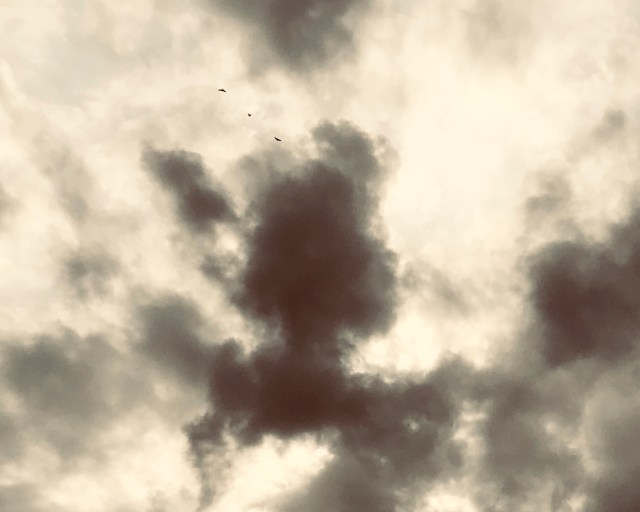
Earlier this week, while watching the forever changing clouds that journey pass my home, I remembered the fascination, during an undergraduate psych class, I had with the Rorschach Test. This projective psychological test, commonly known as the ink block test, was developed in 1921. In 1943 the US military implemented the Harrow-Erickon Multiple Choice Rorschach Test for the large scale screening of U.S. military personnel. While the first outcomes reported impressive predictive power, later work showed that the test had very limited value.
What do you see in this image of clouds?
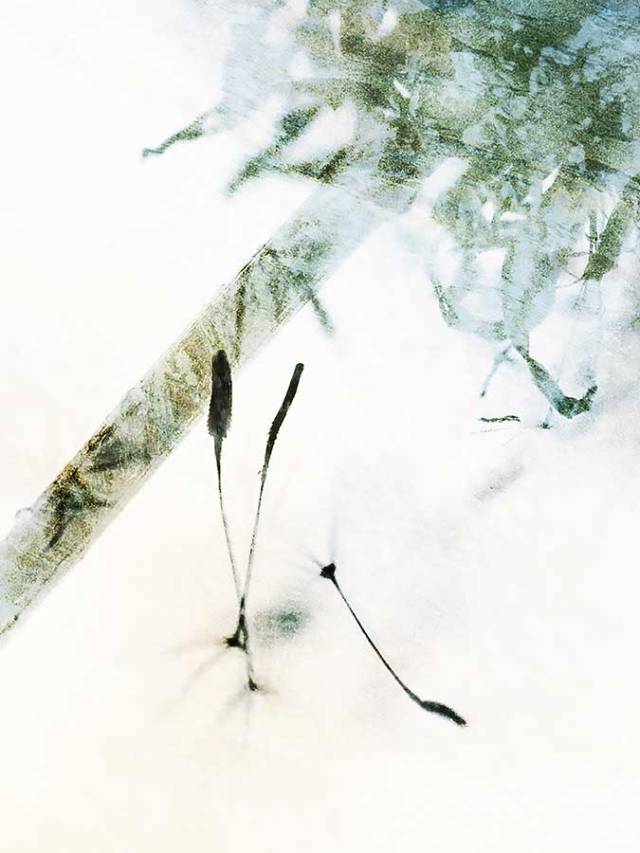
Image submitted in response to Jenn’s, Traveling at Wits End, challenge to “get out of the box” and create an image that looks like something else or looks different than it really is.
Spring Creek…Nikon D750 f/4.5 1/2,000 85mm 100 ISO
“…we never just ‘see’ something in the sense that a photographic plate receives rays of light. In the real world we bring a lot of our selves to the party. And that means gaze alters what it finds.”
cited: Iain McGilchrist, The Master and his Emissary
“About twelve years ago, I met a homeless woman who identified herself as a sundowner. She described how each evening’s sun invited her to settle down along the side of her life’s path so that her journey could begin afresh in the morning sun. She eloquently described an undercurrent of yearning that ebbed and flowed throughout her soul and how, in her past days, she found herself at the mercy of private memories, thoughts, and imaginations and had encountered, time and time again, various degree of discontent despite the seemingly fulfilling qualities of her life.
As I hear the suffering within women who story their lives through the multi-colored threads of substance use, I find myself acknowledging a similarity within each of these unique stories with my own metaphysical search for someone, something, or some place that remains beyond the forever next horizon.Each of our unique narratives reveal an unending wandering with satchels of discontent that tell of a spiritual emptiness and an emotional intimacy with a homesickness for a place one knows cannot be.”
~B Catherine Koeford (A Meditative Journey with Saldage)
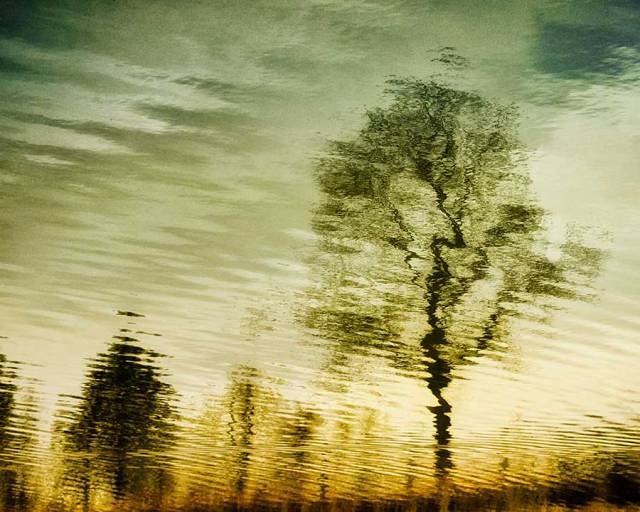
Nikon D750 f/1.8 1/10 35mm 100 ISO (neutral density lens)
Every moment that we’re alive in this body, in this human manifestation, we’re emitting energy. This energy can be transformed but it can’t die; it remains in the world forever. … A thought is an action because it already has energy and it has the power to affect things. When we produce a thought of compassion, understanding, and love, that thought has the power to heal our body, our mind, and the world. If we produce a thought of hatred, anger, or despair, that thought has an affect not only on ourselves but on the world; it can destroy us and lead to the obstruction of many other lives.
Suppose a nation produces a collective thought of anger and fear and decides to go to war. The whole country is then producing fear and anger. That collective fear and anger can cause much real destruction and suffering. … The thoughts and feelings we send out to into the world have a powerful effect. Every thought we produce, everything we do and say, is an action. These actions continue forever. They can transform, but like the cloud, they will not disappear. We have to recognize the power of our [actions] and make a firm determination to be mindful of our thoughts, speech, and actions in order to heal ourselves and the Earth.
My mother once described a job interview for a dietary postion within a small community hospital in which she was asked if she could cook. She described how she directed the woman’s gaze to the various pictures of her children that were placed about her living room and invited the woman into her kitchen to show her that she, indeed, as a mother did and could cook.
This question, was experienced by my mother as an example of discrimination…a prejudice of deafness. As I listened to my mother’s story, I understood the question as appropriate to the job. What I interpreted to be discrimination came from the environment in which the interview occurred…not at the hospital, but within the privacy of her own home.
How many job interviews take place within a job applicant’s home?
Being a child of my mother’s and a female, I believed I came to understand discrimination, oppression, and marginalization, both personally and through my mother’s life stories. As a child, she was required by state law to attend a deaf school and initially attended a school that was close enough to the family home to allow for weekends with the family. Yet, because the school was located out of state, she had to enroll in a state school much further away, Consequently, she was then only able to be with family during specific holidays. This is of a time when letters were her only course of connection with her family.
Also, the school she attended had a policy prohibiting communication through the use of sign language as a means to assist the students to fit in with the “hearing world.” I smile today, remembering her pride as she described the opposition to this policy. She and her classmates would gather together in an attic, at night, to teach one another how to speak in sign.
The events of today have invited me to reflect upon my own behaviors — and even my reaction to my mother’s job interview experience — and to see them as being influenced by discrimination, marginalization, and oppression especially in light of my understanding of “microaggression.”
Microaggressions are the everyday verbal, nonverbal, and environmental slights, snubs, or insults, whether intentional or unintentional, which communicate hostile, derogatory, or negative messages to target persons based solely upon their marginalized group membership. In many cases, these hidden messages may invalidate the group identity or experiential reality of target persons, demean them on a personal or group level, communicate they are lesser human beings, suggest they do not belong with the majority group, threaten and intimidate, or relegate them to inferior status and treatment.
…microaggressions are active manifestations and/or a reflection of our worldviews of inclusion/exclusion, superiority/inferiority, normality/abnormality, and desirability/undesirability. Microaggressions reflect the active manifestation of oppressive worldviews that create, foster, and enforce marginalization. Because most of us consciously experience ourselves as good, moral and decent human beings, the realization that we hold a biased worldview is very disturbing; thus we prefer to deny, diminish or avoid looking at ourselves honestly. Yet, research suggests that none of us are immune from inheriting the racial, gender, and sexual orientation biases of our society. We have been socialized into racist, sexist and heterosexist attitudes, beliefs and behaviors. Much of this is outside the level of conscious awareness, thus we engage in actions that unintentionally oppress and discriminate against others.
I have come to realize that to there are no benign questions…and that a small section of my indignities towards another arise, in part, from my own denial and ignorance. Awakening to the suffering of others and to the unintentional harm I have caused others brings tears to my eyes as well as leaves me floundering in how to apologize.
It is my hope this sharing of Br Phap Man’s video, “Inclusivity and Justice”, is a small step that brings about a healing awakening that overcomes walls of various shapes, formations, and sizes.
…Just beyond the field is a house weathered gray by the seasons and weakened by the stresses of time. In the golden rays of the morning light, the young girl is kicking up dust clouds, searching through the barren soil for seeds of her past, and desiring to be freed from yesterday’s delusions. She walks over to the side of the road and bends over; as she stands, I see three keys, dangling from her left hand. One key is silver, another is gold, and the third is made of diamonds. I feel the pain of fear awaken as the warmth of this early autumn day touches the frozen shield that embraces her heart
…literature provided me with alternate threads by which to darn a harmonious, yet delusional, understanding of death, of fatherless children, of a family. To move into this realm is to be cuddled in the arms of a chair, mesmerized by the pages of a book unfolding like an accordion, embraced by a transparent sound barrier, and transported into fantasies found through fictional characters. While my mind’s eye grasped the hand of my naïve emotional self and together we observed the telling of storied lives, there was a seeking mind that simultaneously identified revealing markers to create a map, not to a place of hidden treasures, but to a place that felt like a home.
B Catherine Koeford, A Meditative Journey with Saldage
The ocean of suffering is immense, but if you turn around, you can see the land. The seed of suffering in you may be strong, but don’t wait until you have no more suffering before allowing yourself to be happy. When one tree in the garden is sick, you have to care for it. But don’t overlook all the healthy trees. Even while you have pain in your heart, you can enjoy the many wonders of life — the beautiful sunset, the smile of a child, the many flowers and trees. To suffer is not enough. Please don’t be imprisoned by your suffering. … When you have suffered, you know how to appreciate the elements of paradise that are present. If you dwell only in your suffering, you will miss paradise. Don’t ignore your suffering, but don’t forget to enjoy the wonders of life. For your sake and the benefit of many beings.
When I was young, I wrote this poem. I penetrated the heart of the Buddha with a heart that was deeply wounded.
My youth an unripe plum. Your teeth have left their marks on it. The tooth marks still vibrate. I remember always, remember always
Since I learned how to love you, the door of my soul has been left wide open in the winds of the four directions. Reality calls for change. The fruit of awareness is already ripe, and the door can never be closed again.
Fire consumes this century, and mountains and forest bear its mark. The wind howls across my ears, while the whole sky shakes violently in the snowstorm.
Winter’s wounds lie still, Missing the frozen blade, Restless, tossing and turning in agony all night.
I grew up in a time of war…Once the door of awareness has been opened, you cannot close it. The wounds of war in me are still not all healed. … Embrace your suffering, and let it reveal to you the way to peace.
~Thich Nhat Hanh (The Heart of the Buddha’s Teaching, pp. 3-5)
The stream of thought flows on; but most of its segments fall into the bottomless abyss of oblivion. Of some, no memory survives the instant of their passage. Of others, it is confined to a few moments, hours, or days. Others, again, leave vestiges which are indestructible, and by means of which they may be recalled as long as life endures.
~William James (The Principles of Psychology, Vol.1, pg. 643)
Speaking of memories, may I introduce you to an American science-fiction film, Marjorie Prime, that was based on Jordan Harrison’s Pulitzer Prize-nominated play of the same name.
The faculty of voluntarily bringing back a wandering attention, over and over again, is the very root of judgment, character, and will. No one is [master of himself] if he have it not. An education which should improve this faculty would be the education par excellence. But it is easier to define this ideal than to give practical instruction for bringing it about. ~ William James
The rules of this three-day quote challenge are to post a favourite quote every day for three days, and pass on the challenge to three other bloggers. You can do this at any time you like – even next year – and you can also say, “No thanks.”
While I’ve enjoyed being challenged by others, I find it difficult to invite one blogger over another, so if you would like to join in please accept this invitation to share your favorite quotes. Thank you Amy at The World is a Book for extending an invitation. It eases all those times in the playground when I was among the last to be chosen to be on a team. _()_
The spring sunlight, flowers blooming, and green trees create a landscape that looks like embroidery. This is an object of perception and it’s a beautiful thing to focus on. …if we don’t consider the role of our mind, and just focus on what we see as the independent reality around us, there will be contradictions.
The Vietnamese poet Nguyen Du said, ‘When a person is sad, the scenery is never happy.’ How we are feeling determines how we see the world. Why are some people able to experience happiness when they look at the moon and see its beauty, while others see the same moon as sad or depressing? This question can’t be answered unless both the subject [person] and object [moon] are taken into account.



 The ocean of suffering is immense, but if you turn around, you can see the land. The seed of suffering in you may be strong, but don’t wait until you have no more suffering before allowing yourself to be happy. When one tree in the garden is sick, you have to care for it. But don’t overlook all the healthy trees. Even while you have pain in your heart, you can enjoy the many wonders of life — the beautiful sunset, the smile of a child, the many flowers and trees. To suffer is not enough. Please don’t be imprisoned by your suffering. … When you have suffered, you know how to appreciate the elements of paradise that are present. If you dwell only in your suffering, you will miss paradise. Don’t ignore your suffering, but don’t forget to enjoy the wonders of life. For your sake and the benefit of many beings.

 a meditative journey
You must be logged in to post a comment.