the stories we weave

This slideshow requires JavaScript.

Individuals have within themselves vast resources for self understanding and for altering their self concepts, basic attitudes, and self directed behavior; these resources can be tapped if a definable climate of facilitative psychological attitudes can be provided.   ~ Carl Rogers

I am acquainted with a mind filled with multiple crosscurrents of unfinished thoughts, stifled emotions, and passing moods. There is also a growing recognition that at times I am overwhelmed by discursive thoughts that are formed by habitual ways of thinking, led by my own various prejudices, impacted by personal preferences or aversions, colored by laziness or selfishness, and intensified by faulty or superficial observations. Sometimes I awaken to myself to find that while engaged in a behavior, my mind has entered a dreamlike state, and therefore events and conversations are vague and fragmentary.  Sometimes I acknowledge this process or attribute it to boredom, anxiety, doubt, impatience, exhaustion, misjudgments, and self-salient triggers.

Protecting oneself, one protects others; protecting others, one protects oneself . . . And how does one, in protecting oneself, protect others? By the repeated and frequent practice of meditation.

And how does one, in protecting others, protect oneself? By patience and forbearance, by a non-violent and harmless life, by loving kindness and compassion.” But self-protection is not selfish protection. It is self-control, ethical and spiritual self-development.  ~ The Buddha
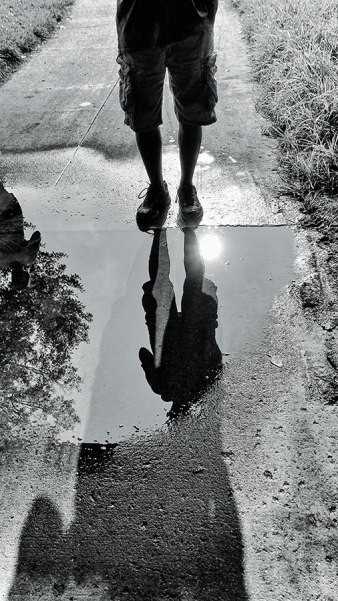
springcreekbnwreflections2web

Every healing intervention is motivated by suffering and hope – be it of the individual, family, friends, or a community agency.  The value within suffering is that it contains a message of incongruence that awakens the motivation to heal. William James wrote that life is the manifestation of behaviors that attempt to avoid, overcome, or remove that which is seen to block us from that which we desire.

The personal story is a narrative of our unique sense of identity.  We create our identities through the stories we weave onto a tapestry that is formed against the background of our family mythologies. We pull threads from of an assemblage of recalled details from our pasts and weaved them into images that cast us in whatever role corresponds with our current situations, feelings, thoughts, or actions. The colored threads of this tapestry are often re-embroidered to reflect the creative and dynamic process of our perspectives as we shift in, out, and between various roles, feeling states, and cognitions.  As we reflect on our self-created images we are in turn affected by them; therefore, there is an unconscious re-weaving of our tapestries.

 Our self-stories as well as our family mythologies create and maintain our identities and thus influence how we anticipate experiences, act, and subsequently interpret our situation.  Becoming aware of the tapestry and images we are creating frees us to review patterned behaviors, reframe our story through different colored concepts, and to release rigid interpretations.

landscape 1

While a person sits in a recovery group and labels her struggle with drug and alcohol as an “addiction”, she has begun to free herself from the power inherent in long-held secrets.   As she tells her story she is weaving a tapestry of images that validates the hidden stories within others and thus invites listeners to abandon their alienated shame, anxieties, confusion, and anger. When she labels the various demons within addiction she dwindles their power as she un-shields their false promises.  At the same time, the power of detrimental thinking begins to dwindle as its unsubstantiated lies are confirmed within the stories of others.

Within such a supportive and non-judgmental environment, each is invited into a process of bare attention that is non-coercive as they uncover the seeds of their suffering and thus begin to strengthen their recovery with renewed energy.  It is after a meeting during the quiet of one’s alone time that each attendee begins a process of dismissing what is personally invalid, questioning harmful behavioral patterns, or replacing painful concepts with constructive meanings.  They, through their own individual reflection, take what is helpful for them at the moment and let the rest flow away.
contemplativephoto-peace

Through this process of externalization, validation, and reformation an individual is being invited to become other to herself as if she were the audience in a movie theatre watching her life story being retold on a screen.  Consequently, a new relationship with the self is formed that lessens the suffering that comes out of subjective rigidity, alienation of self as “the only one”, and attachment to shame and guilt.

Excerpts: Koeford, B., A Meditative Journey with Saldage

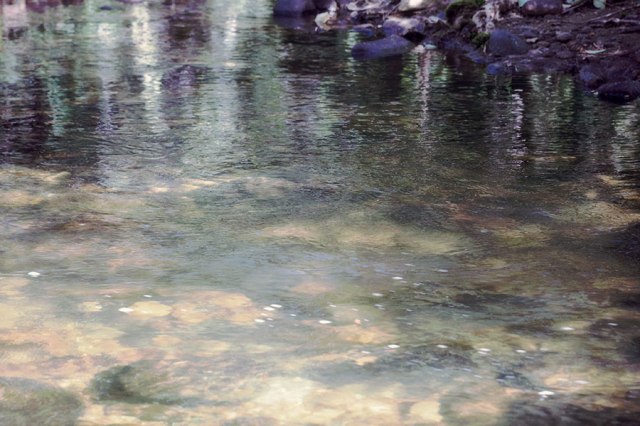
pond reflections

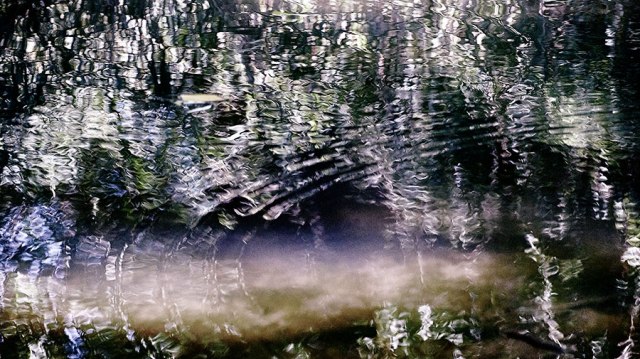
mind stream–rippling

a tumble jumble babble

current–afterthoughts

pondreflectionsweb82418

light patterns…Nikon D750   f/4.5   1/400s  85mm   200 ISO

“…there is something more fundamental about the world that is brought into being by the right hemisphere, with its betweenness, its mode of knowing which involves reciprocation, a reverberative process, back and forth, compared with the linear, sequential, unidirectional method of building up a picture favored by the left hemisphere.” ~I McGilchrist, The Master and his Emissary

early morning readings

contemplative photography 5

Sony RX100 III  f/4  1/80s  23.9m  250 ISO

“This LeWitt drawing [All Two-Part Combinations of Arcs from Corners and Sides, Wall, Drawing #842, white crayons, black pencil, grid, 14×18 ft.], white lines on a large black field, created a strong presence in the gallery. That presence was beautifully offset by the simplicity of the system it described. Until that show, I believed that conceptual art was about the idea-the concept–and thus that the drawing on the wall was only there to display the idea. I believed this until one day during the show, when I found myself alone in the gallery in front of the wall and my vision was filled with black paint and the pebbly, waxy marks of the white crayon. At that moment the piece seemed to open a door in my mind. Rather than the concept being processed like art in my brain, I felt a sense of integration–my eyes and body were involved, a union between the concept and the materials, neither standing alone. My view transitioned from an analytical appreciation of a system called ‘art’ into an utter, complete presence with an artwork…” ~J F Simon, Jr., Drawing Your Own Path

“Observe the changes that take place in your mind under the light of awareness. Even your breathing has changed and become ‘not-two’ (I don’t want to say ‘one’) with your observing self. This is also true of your thoughts and feelings, which, together with their effects, are suddenly transformed. When you do not try to judge or suppress them, they become intertwined with the observing mind.” ~Thich Nhat Hanh, The Sun My Heart

a photo study: contemplative photography V – things in themselves

conttemplative 7

Seeing begins with respect, but wonder is the fuel which sustains vision.~Steven J Meyers

I believe we all intimately know of that moment…the moment, an early morning moment, that occurs just as we lift a window frame.  That fleeting moment as morning awakens us…before the mind discriminates, defines, labels, associates, and tucks away into memory…the moment of awareness to, awakening to the touching, the greeting..our vulnerability to morning’s sensual presence…That’s magic, the “things in themselves.”

our eye consciousness and ear consciousness can touch the world of suchness without distorting it.  With mind consciousness, we tend to distort…

Thich Nhat Hanh (Understanding the Mind) writes that there are three fields of perception: perception of things-in-themselves, as presentation, and as mere images, and that the way we perceive reality has everything to do with our happiness and suffering.

The perception of things-in-themselves is when we are perceiving directly without distortion or delusions. This is the only one of the three modes of perception that is direct. This way of perceiving is in the stream of…suchness; that is, “reality as it is.”  … Everything—a leaf, a pebble, you, me—comes from suchness. Suchness is the ground of our being, just as water is the ground of being of a wave.  

Are we capable of touching reality-in-itself? … A flower can be the manifestation of the world of suchness, if we perceive it directly.  It all depends on our mode of perception whether we touch the suchness of a flower or only an image of it that our minds have created. Our perceptions rarely reach the mode of things-in-themselves, however.  We usually perceive things in the other two modes, as representations or mere images. 

The first five consciousness-the sense consciousness of eye, ear, nose, tongue, and body—are capable of touching the realm of things-in-themselves, especially when they contact their objects of perception without the participation and intervention of mind consciousness.  When mind consciousness gets involved, however, there will always be some thinking and imagination, and the image brought to it by one of the sense consciousnesses will become distorted. 

We are capable of reaching the field of things-in-themselves, the world of suchness, but because we think and discriminate we don’t usually perceive things as they truly are.  The nature of our mind is obstructed.  This means that we build a world full of illusions for ourselves because of the distorted way we perceive reality.  Meditation is to look deeply in order to arrive at reality—first the reality of ourselves and then the reality of the world.  To get to that reality, we have to let go of the images we create in our consciousness… Our practice is to correct this tendency to discriminate and think dualistically, so that reality will have a chance to reveal itself. (pp 65-71)  

This slideshow requires JavaScript.

Miksang, a Tibetan word, has been translated to ‘Good Eye.’ Miksang photographers write that when we see with/through a Good Eye we see the world as it is for the first time.  This is because this way of seeing is absent of memory and association.  The world is manifesting to us, as it is out of nowhere.

Julie DuBose wrote (Shambhala Times, April 7, 2017, “What is Miksang Really?”) that the basis of Miksang photography

…is the open space of availability in our minds. When our mind and eye connect directly with a visual perception, it is like a flash of lightening arising from this empty open space. Without the voltage, the electric presence of the flash of contact inherent in the image, it is flat and lifeless, somebody’s idea. This is the juice of direct perception. If we can maintain our connection to this raw energy of perception through to our expression of the perception with our camera, then it will be completely expressed in our image. 

There is no halfway, half a flash of perception. The perception and the resulting image either does, or does not, have the living, raw experience of that moment of voltage embedded in it. There is no in between. This is the joy of “fresh” seeing.

A. Karr and M. Wood (The Practice of Contemplative Photography) notes that contemplative photography begins with “the flash of perception.”  

In the flash of perception…there is a space for things to come to you. Experience is definite, because there is no doubt about what you are seeing… Whatever it is, it is here, and there is no doubt involved, no shakiness.  The nature of perception is sharp, with a brilliant, clear quality.  The flash of perception is a moment of seeing that is one-pointed, stable, and free from distraction.  Experience is not diffused or scattered or moving. It is direct and in focus. It is stable because it is not tossed about by winds of thought or emotion. There is a stillness and roundedness as awareness remains with perception.

W. Rowe (Zen and the Magic of Photography) introduces the reader to Roland Barthes’ description of the essence of photography, the “punctum”,a small, distinct point.  

The punctum, “will break (or punctuate) the studium*…photographs that are “in effect punctuated, sometimes even speckled with these sensitive points; precisely, these marks, these wounds, are so many points.”  Punctual rises out of the scene, seeks out the viewer, disturbs the studio, wounds, cuts, pricks, and stings the viewer…also has the power to provide sudden enlightenment… a tiny shock, is usually found in the detail bringing “certain photographs very close to haiku.”

Only the moon

and I, on our meeting-bridge

alone, growing cold ~Teiga (S. Hill, The Sound of Water)

contemplationcolor5web

Torsten Andreas Hoffmann (Photography as Meditation: Tap into the Source of Your Creativity) indicated that within:  

the context of photography and shooting images, the photographer must be at the right place, with the right lens and the right aperture, at exactly the right moment to capture the picture.  Successful images, however, are not guaranteed based solely on having the correct posture and intent. However, by letting go of intent, the stillness of the mind can take over and you can attain oneness with your surroundings. Barthes refers to this concept using the term “satori,” which describes the highest state of enlightenment and comprehension in Zen. I prefer to use the term “Samadhi,” which indicates a state of utmost vigilance and attention. Photographs taken while in this state may achieve the quality of puncture.

As I was pondering my understanding of “the flash of perspective”, as an experience of a shock that is like being awakened from sleep by a loud noise and Barthes’ punctual that “disturbs, wounds, cuts, picks, and stings the viewer to an haiku moment, images of Buddhist masters who drop a book or strike with a stick as a means of wakening wandered into my thoughts.  As a therapist, I came to understand that there is an immediate response to “shock” that may be expressed as denial, laughter, tears, shaking, screaming, or tears that occurs as a way for the body/mind to re-establish a state of equilibrium.  Also, my own personal life experiences have taught me that expected moments of “shock” (as opposed to those horrid moments that come out of the blue) are more likely to be responded to with a more grounded and contemplative state of being. 

“Wounds, cuts, shocks, picks, stings…are not these words of violence incongruent to a contemplative state?  With all this said, I find myself wondering if these “shock” elements identified by contemplative photographers may have, even the smallest tendency, to blur and distract me from those now moments of “things in themselves.”  If so, then how could I open myself to being a photographer who receives and shares the gift that awaits my awareness? To lessen the tendency to shift away from an “awakening?”  What are they ways to cultivate an attitude of receptivity, an openness to what might be given to me?  To engage in a photo walk that is more like meditation or a spiritual discipline than a search or a hunt?  

aloneweb82518

I have come to a place of consideration that one small way in which to become acquainted with underlying attitudes and be in a more graceful receptive place to receive “things in themselves” is to begin to become aware of the words/attitudes that have the potential to define the process by which I photograph. 

I ask myself will I be more able to see with respect, as noted by Steven J Meyers, if I intentionally silence the words “shoot,” “capture,” “frame,” “take,”  “exposed,” “cover,” “take the shot,” in order to open myself to  “receive,” “connect with,” “create,” “be present with,” “wonder,” “surprise,” “reveal.”

And then, will I be more able to open myself to the expression of a temporary enlightenment, in which I see into the life of things.”

*studium…

the intention of the photographer…the elements of an image rather than the sum of the image’s information and meaning.  …the elements of the punctum penetrate the studium—they have the ability to move the viewer in a deep and emotional way.  

Pond Reflections

contemplative-photographyreflectionsweb91618

They did not die in the hurricane.

They died in pain, at home, of kidney failure unable to access the dialysis clinic for weeks.

They died, gasping for hours near the end, when the oxygen tank they needed to breathe gave out.

They died in the dark and the heat of unsanitary ICU units, of burns or gunshot wounds received before the hurricane that they almost certainly would have survived otherwise.

They died, burning up with fever, of leptospirosis from being in touch with flood waters during the effort to save their neighbors.

They died in fear and confusion after being forced to go off their regular medication.

They died of heat stroke.

They died of diseases of antiquity, in a crisis is of neglect unworthy the greatest, wealthiest and most powerful nation in human history.

They died. But we lived. And we remember.   ~ Eleazar David Melendez

early morning readings II

In this world, time is like a flow of water, occasionally displaced by a bit of debris, a passing breeze.  Now and then, some cosmic disturbance will cause a rivulet of time to turn away from the mainstream, to make connection back stream. When this happens, birds, soil, people caught in the branching tributary find themselves suddenly carried to the past.   ~A Lightman, Einstein’s Dreams

Reality in itself is a stream of life, always moving.  ~Thich Nhat Hanh, The Sun My Heart

Cartier-Bresson’s photograph of children playing in the rubble of war…may become a metaphor or symbol of hope. The image over my desk of a grieving mother and child after an earthquake in Armenia, made by my photographer friend Mark Beach, symbolized for me the sorrow and tragedy that is part of life.  An image I once made of the source of the mighty Susquehanna River–a spring flowing into a bathtub in a field that serves as a water tank for cows, then spilling over to begin a stream–reminds me that the restorative juice “river,” with which I am associated, has many small sources.  ~H Zehr, The Little Book of Contemplative Photography

contemplating the leaf

https://vimeo.com/285926090

One autumn day while walking in a park, I became absorbed in the contemplation of a very small and beautiful leaf in the shape of a heart. It was turning red and barely hanging on to the branch, about to fall. I spent a long time with this leaf …. Usually we think of the tree as the mother and the leaves as its children. But contemplating the leaf, I could see that the leaf was also a mother to the tree. The sap that the tree’s roots take up, called xylem sap, is only water, amino acids, and minerals, not rich enough to nourish the tree. So the tree distributes that sap to the leaves, which, with the help of the sun and carbon dioxide, transform it into phloem sap, rich in sugars, which the leaves send back to nourish the tree. So the leaves are also a mother to the tree. …

“We are like that leaf. When we were in our mother’s womb, we were also linked to her by a stem, an umbilical cord. All our nourishment came through the umbilical cord. Our mother breathed for us, ate for us, drank for us, did everything for us. Then one day that cord was cut, and we started to think of our mother and ourself as two different entities. In fact, our mother continued to nourish us like before. Our parents are present in every cell of our body. We continue to receive nourishment from our mother, as well as the suffering and the troubles of our mother, which continue to influence us, as they did when we were in the womb. That cord is still there, not just until we turn eighteen, but for our whole life.

”When we can see the umbilical cord, we can start to see the countless umbilical cords that link us to life all around us. There is an umbilical cord that exists between us and the river…. So the river is also a mother and there is an invisible umbilical cord between us. … There is another umbilical cord betweens and the clouds, between us and the forests, and another between us and the sun. The sun is like a parent to us. Without our link we to the sun we could not live, and neither could anything else. We are nourished and sustained by countless parents….

Excerpt From
The Other Shore
Thích Nhất Hạnh

i awaken to…

waldon-24web9518

a metaphysical search…Nikon D750  f/7.1   1/25s  135m 100 ISO

I awaken to the mourning dove’s appeal for the sound of another, and find the passing dream state, like many before, was spent wandering through a petrified forest unlike any created by the ancient uniting of Gaea, Mother Earth, and Uranus, Father Heaven. It was filled with a longing, a seeking; it was a series of moments of futile endeavors.

As I walked upon moonlit pathways, edged by shadows of hidden yesterdays as well as shrouded by entangled memories, I encountered afterimages, echoes, phantoms, fragmented sequels, refrains, and vague specters.  Now and then, it felt as though I had stepped on a “mind-trap” and suddenly became entangled inside an invisible emotional net that swirled me around and around from one apparition to another.  Each apparition messaged that I have gone around and around in discursive circles once, twice, a thousand times throughout my lifetime of nights.  I say to myself, “I’ve been here before.  I’ve re-imaged, revisited, and reviewed past dreams as if I were an author rewriting a long ago discarded novel about an outcast.”   Within this uncertainty a voice urges compassionate reflection.

Within stilled and silent reflection is an awareness of the emergence of a cluster of physical sensations from my stream of experiential consciousness.  Together with the awareness of this particular cluster of physical sensations is the identification of a feeling I have labeled as “homesickness for a place, person, or time” and the creation of a story about an “I” who is an outcast.

TWO TRUTHS

From this point, I ask of myself, “What are the defining characteristics of a person who is an outcast?”  I question if I have had these characteristics since the moment of my conception.  I then discern if my relationship with all living beings, from my spouse to the robin outside my house, is limited to and defined by these characteristics.  In other words, have I always been an outcast, and does every living being relate to me as an outcast?

I come to the conclusion that the answer to both of these questions is no.  I now hear an encouragement to release the story line that arises from a false identification with “I am an outcast.”  In conjunction with the release of this story line is the subsequent letting go of the construct of an unknown person, place, or time.  Within the emptiness that accompanies this release arises a consciousness of feeling – sadness intertwined with loneliness.  To find that to simply acknowledge this particular cluster of physical sensations with “sadness and loneliness is arising” and to resist the urge to identify with these feelings releases me from the wellspring of suffering within the label of “outcast.”

I am now free to concentrate on that discernment of myself as being freed from this metaphysical search, and to focus on this inferential understanding and to concentrate on discerning the impermanence of sadness and loneliness. This is the discriminating awareness that arises from meditating.

Thus you must train yourself:  “In the seen there will just be the seen; in the heard, just the heard; in the reflected, just the reflected; in the cognized, just the cognized.” . . . when in the seen there will be to you just the seen; . . .  just the heard;  . . . just the reflected; . . . just the cognized, then  . . . you will not identify yourself with it, you will not locate yourself therein.  When you do not locate yourself therein, it follows . . . this will be the end of suffering.         ~ The Buddha

Excerpts from B Koeford, A Meditative Journey with Saldage

pond reflections

pondreflectionsweb291318

Nikon D750   f/5.6   1/400   180m   350 ISO

In the higher Buddhist view, appearances rise from emptiness and dissolve again…It is a process like birth, living, and dying…practice letting come and go…we may rest longer and longer in the space of openness…Don’t try to shape the oneness, or see it as one thing or another, or gain anything from it. Just let things be. This is the way to find your center.  ~Tulku Thondup, The Healing Power of Mind

a photo study: contemplative photography IV – seeing

contemplativephoto-3web82118

From my research about “seeing” through the eyes of a photographer, I learned that within our day-to-day lives we usually connect with the visual aspects of our world through various cognitive lenses.  For example, a continuum of perceiving begins with sensory seeing on one side and conceptual seeing on the other.  Sensory seeing perceives that which appear to our senses, and conceptual seeing perceives that which appear to the mind’s eye. 

For example, while riding a train you glance up from your reading and do a quick glance at your fellow travelers.  You may see a young adolescent, with blue hair, engrossed by the sounds coming through his earphones, an elderly couple with multi-colored silk scarves loosely wrapped around their necks and their gray-streaked hair, a handsome man, in a gray-toned business suit, snapping a newspaper as he becomes engrossed in an article, and towards the front you see and hear a group of tittering, fashionably-attired women.

Sensory seeing takes in the colors and textures of this environment—the sights, sounds, smells, tastes, and so on. 

All the rest of your experience is conceptual. You see the visual forms of the “young adolescent”, “elderly couple,” “handsome man,” and “fashionably-attired women.” “Young,” “elderly,” “handsome,” “fashionably-attired” are not visible to the eye; these adjectives are the result of the thinking mind, the discriminating mind. 

sonycity-4web8918

There are times as we move in and out of the dance of life, we become totally engrossed in the conceptual realm which blinds us to the sensory elements that create our world. Other times, our thinking mind begins to hush and a door opens to a sensory world.  Generally, these two ways of being-in-the-world are in a mental flux in which we create stories with a blending and folding of what we are “seeing” overlaid with our “thinking.” It seems to me that this creative process serves to put-into-order the stuff within the environment so that there is an easing of uncertainty and to bring about a certainty of space and time; yet, this lessening of anxiety has the potential to obscure the richness and natural beauty of our sensory world. 

Reality is transformed by our looking at it, because we enter it with our baggage of concepts. …But it is not easy to abandon concepts. …The armor of a scientist is his or her acquired knowledge and system of thought, and it is most difficult to leave that behind. … religious seekers have always been reminded that they must let go of all of their concepts to experience reality… ~ Thich Nhat Hanh (The Sun My Heart, p.82)

Personal concepts such as what is beautiful, artistic, worthwhile become blinding filters that overlay a photographer’s eye as they direct a search for subjects that fit into these personal templates.  I was nudged away from my search for symmetric tree templates during a  project in which I would spend 5 minutes being present with a Michael Kerr image.  In time, I found myself slowly becoming freed from the fetters of this obsession to find the perfect tree. 

Contemplative Photography

The word “contemplate” means to be within a process of reflection that draws on a deeper level of intelligence than our usual way of thinking about things. The root meaning of the word “contemplate” is connected with careful observation. It means to be present with something in an open space. This space is created by letting go of the currents of mental activity that obscure our natural insight and awareness.

Contemplative photography is a method of seeing and photographing the world in unique ways—through fresh eyes—inviting us to open ourselves to  the richness and beauty through our sensory eyes.  For example: capturing the beauty of shadows, elegance of lines or clash of colors, the elements which a passer by, lost in thought, will be unable to see.

Photography can be used to help distinguish the seen from the imagined, since the camera registers only what is seen. It does not record mental fabrications. As the photographer Aaron Siskind said, “We look at the world and see what we have learned to believe is there, [what] we have been conditioned to expect… But, as photographers, we must learn to relax our beliefs.”

Sensory Seeing

…the right presence of mind’ involves an empty and open state of mind with no definite plans, thoughts, desires, expectations, purposes, or ego-involvement-but where all is possible. ~Eugen Herrigel, cited W Rowe, Zen and the Magic of Photography

One thing that all these explanations have in common is that it is the process of clear seeing that is central to being at one with the present moment; to connecting with what you are experiencing.

How does clear seeing produce clear images? When you see clearly, your vision is not obscured by expectations about getting a good or bad shot, agitation about the best technique for making the picture, thoughts about how beautiful or ugly the subject is, or worries about expressing yourself and becoming famous. Instead, clear seeing and the creativity of your basic being connect directly, and you produce images that are the equivalents (this is Alfred Stieglitz’s term) of what you saw. What resonated within you in the original seeing will also resonate in the photograph.

Henri Cartier-Bresson offers key insights into this approach. He is reported to have said,  “Thinking should be done beforehand and afterwards—never while actually taking a photograph. Success depends on the extent of one’s general culture, on one’s set of values, one’s clarity of mind and vivacity.”

…the creative mind of a photographer is like a piece of unexposed film. It contains no preformed images but is always active, open, receptive, and ready to receive and record an image. ~Minor White cited: W Rowe, Zen and the Magic of Photography

Exercise:  Opening a Door to Sensory Seeing

The moment of clear seeing—an unfiltered flash of perception with silenced concepts generally last for a fraction of a second. Before the rush of the thinking, discriminating, conceptualizing, judging mind, we are gifted with a clarity of perception and basic form: color, light, texture, line, pattern, shape, space.  

To open ourselves to “clear seeing”, I’m inviting you to open yourselves to an experiential exercise; to become a sensor of experience to flashes of perception.  


This slideshow requires JavaScript.

  • First: place yourself in location where you feel free and relaxed…in your home or someplace outdoors.  Don’t scan the environment, just relax. 
  • Second:  ground yourself by connecting with the sensation of your feet on the ground, knowing that the earth is below and the sky is above.  Clear your mind and silence a desire to see and find something to photograph.  
  • Third: Imagine you are a camera with your eyes, your shutter, closed.
  • Fourth:  Breathe in…be aware of the flow of your in-breath.  Breathe out…be aware of the sensation of your out-breath… Breathe in…aware of the length of your in-breath.  Breathe out…aware of the length and sensation of your out-breath.  Breathe in…and be aware of your body relaxing.  Breathe out…smile with your relaxing body. 
  • Fifth: Slowly turn 180 degrees with your eyes closed. Breathe in…be aware of your in-breath.  Breathe out…be aware of your out-breath. Allow yourself to be aware of the sounds and physical sensations that surround you in this environment.  No thinking, no judging, no expectations, no planning…just awareness of you in your body with your eyes closed. 
  • Sixth:  Open you eyes suddenly.  Open them wide and let your eyes settle on whatever greets you. Noice what happens the first instant, and then what flows from there. After a few minutes, close your eyes as suddenly as you opened them before.  In a few moments, the after-image of what greeted you will begin to fade.  
  • Seventh: Move your body in a quarter turn and, with your eyes still closed shift your head downwards toward the ground. Repeat the in and out breathing exercise in the fourth step. 
  • Eight:  Open your eyes suddenly. Notice your experience. Then, after a few seconds, close your eyes and move your head upwards.  Repeat the fourth, sixth and seventh steps.  Continue this exercise for about five minutes, each time closing your eyes, shifting the tilt of your head, and turning absent of a preconception of what you will see when you open your shutter.
  • Ninth:  Return to the sixth step with camera in hand.  When you open your eyes, photograph that which greets your open eyes (if your mind begins to seek, compose, categorize, discriminate, negate, or judge close your eyes and allow the after-image to fade). 
  • Tenth: Close your eyes and move on to step seven, photographing what your eyes connect with.  Enjoy this exercise for 5 minutes.

I am finding myself excited about this learning phase of “a photo study.”  I am looking forward to your images and thoughts.  Let’s tag with #aphotostudy.

our minds…

https://vimeo.com/286879475

…our minds can seem like such a ragged and disorderly place, disturbed by the slightest sound, thought, or impulse. Seeing the moving, restless character of the mind is the first step toward…concentration, mindfulness, tranquillity, insight, oneness.
~Tulku Thondup, The Healing Power of Mind