“The BC and Federal Governments have abruptly stepped away from talks that were scheduled for this week as the Wet’suwet’en Hereditary chiefs justly stated they would not ask other Nations to stand down as a precondition to having Nation to Nation talks.
“Powerful actions and a widespread will to struggle against injustice have proliferated in response to the raid on Tyendinaga as anger grows at the Government’s use of force and steadfast refusal to negotiate in good faith.
“The Government’s demand that blockades end for talks to begin illustrate how powerful this movement is and how afraid they are of widespread and sustained Indigenous resistance. The Wet’suwet’en Hereditary chiefs have asked for people to continue to act in support of their demands.
“… people have risen up in defiance of colonial injunctions and set up new rail and road blockades across the country: Over 500 people shut down rail traffic in Toronto, The Port of Vancouver was shut down for over 24 hours, Kahnawake Mohawks reinforced their barricades in response to an injunction, Indigenous youth retook the BC Legislature vowing to stay until Nation to Nation talks occur, and new rail blockades went up in Chase, Abbotsford, Maple Ridge, Hamilton, Gitxsan territory, Lennoxville among many other incredible actions.
“As police begin to act more aggressively towards new blockades many people have made tactical temporary retreats avoiding arrests and setting themselves up to continue to struggle in a sustained fashion.”
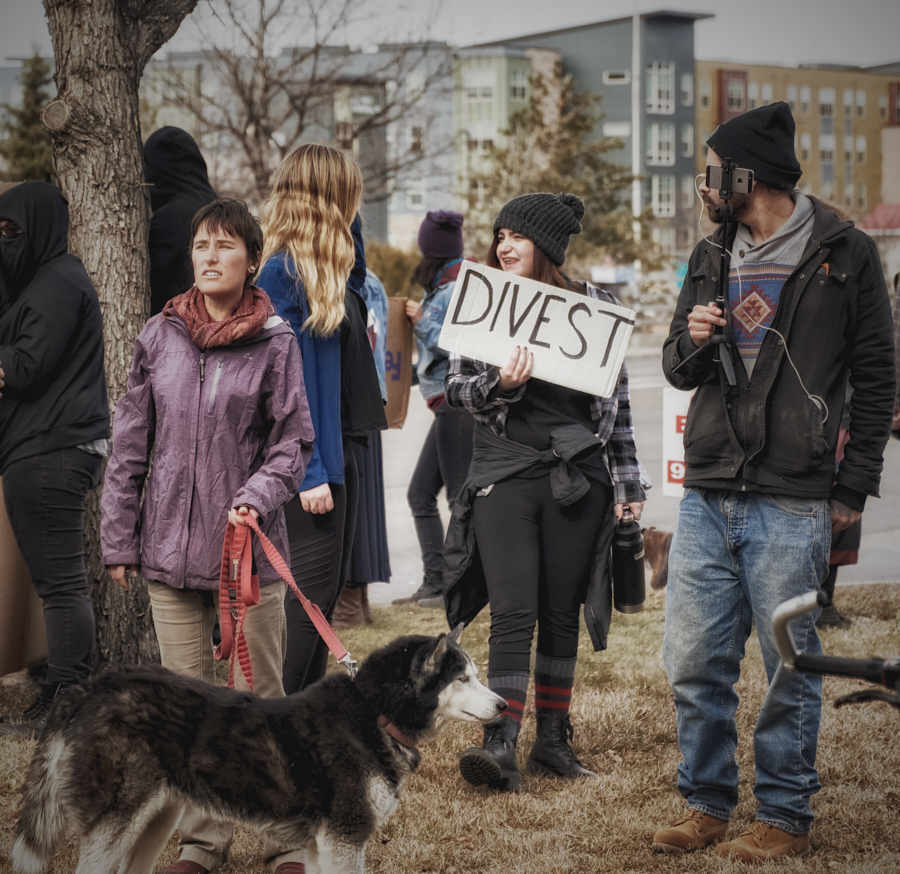
Solidarity Action with Unis’tot’en Water Protectors
(Yinka Dini – People of this Earth) Unis’tot’en – People of the Headwaters
The Unis’tot’en (C’ihlts’ehkhyu / Big Frog Clan) are the original Wet’suwet’en Yintah Wewat Zenli distinct to the lands of the Wet’suwet’en. Over time in Wet’suwet’en History, the other clans developed and were included throughout Wet’suwet’en Territories. The Unis’tot’en are known as the toughest of the Wet’suwet’en as their territories were not only abundant, but the terrain was known to be very treacherous. The Unis’tot’en recent history includes taking action to protect their lands from Lions Gate Metals at their Tacetsohlhen Bin Yintah, and building a cabin and resistance camp at Talbits Kwah at Gosnell Creek and Wedzin Kwah (Morice River which is a tributary to the Skeena and Bulkley River) from seven proposed pipelines from Tar Sands Gigaproject and LNG from the Horn River Basin Fracturing Projects in the Peace River Region
The Unist’ot’en Camp is an indigenous re-occupation of Wet’suwet’en land in northern “BC, Canada.” The Camp is on high alert in response to the Coastal Gaslink’s application for an injunction, as well as served notice for a civil lawsuit to claim financial damages for “occupying, obstructing, blocking, physically impeding or denying access” against the Camp on their own unceded territory and denying the collective hereditary leadership of the Wet’suwet’en.
‘Wiggus’, the Wet’suwet’en word for respect. In the landmark Supreme Court Decision of Delgamuukw Gisday’wa Wiggus it was defined as “respect for all living-beings, starting with oneself”.
The Unist’ot’en Camp has been a beacon of resistance for nearly 10 years. It is a healing space for Indigenous people and settlers alike, and an active example of decolonization. The violence, environmental destruction, and disregard for human rights following TC Energy (formerly TransCanada) / Coastal GasLink’s interim injunction has been devastating to bear, but this fight is far from over.
Coastal GasLink is a project of TransCanada Pipelines Ltd., the same subsidiary of TransCanada behind the controversial Keystone XL tar sands pipeline. The 420-mile Coastal GasLink pipeline would carry fracked gas from northeast British Columbia to LNG Canada, a massive proposed liquefied natural gas (LNG) terminal that exemplifies the sector’s climate and human rights impacts.
JPMorgan Chase
Bank of Montreal
Deutsche Bank
Canadian Imperial Bank of Commerce
Go to Mazaskatalks.org to see if your bank is invested in fossil fuels
Divestment is the opposite of investment. It is removing your funds, benefits, capital and stock from companies and approaching institutions asking them to remove their money out of companies for either ethics and/or financial reasons.
In this era of “reconciliation”, Indigenous land is still being taken at gunpoint. INVASION is a new film about the Unist’ot’en Camp, Gidimt’en checkpoint and the larger Wet’suwet’en Nation standing up to the Canadian government and corporations who continue colonial violence against Indigenous people.
Fossil fuels have been utilized as our primary energy source since the industrial revolution in the mid 18th century. Fossil fuels have provided jobs as well as heat and electricity before and during our lifetimes. The problem is that the extraction process and burning of fossils fuels have caused extreme pollution of low income (indigenous, Black and People of color) communities, threatened sensitive ecosystems and is causing green house gases to climb at all-time highs. The world is now heating at an unprecedented rate: storms, hurricanes and other natural disasters are becoming more frequent and powerful than we have ever seen. In the midst of the 6th mass extinction and overall threat of climate change, we need to oppose all future fossil fuel expansion projects, and make a just and fast transition to renewable energy.
This week’s post was made in response to the lens-artist’s challenge by Viveka – capital. It was created to advance global awareness of the Costal Gaslink Project.
The heat of a warming planet, like an artist’s palette knife on a canvas, etches its way across Western forests, slowly altering ecosystems that have flourished for centuries. cited: Climate change is transforming Western forests. Mark Jaffe, The Colorado Sun July 25, 2019
“As ecosystems change, there are going to be winners and losers,” said Thomas Veblen, a biogeographer and distinguished professor at the University of Colorado. “The regulator function of the forest could diminish … leading to more runoff and flash floods. With a reduction of the forest canopy, we are going to see the potential for greater erosion. The question is how much of the forest will fail to regenerate.”
Coasts, oceans, ecosystems, weather and human health all face impacts from climate change, and now valuable soils may also be affected. Climate change may reduce the ability of soils to absorb water in many parts of the world, according to a new study. And that could have serious implications for groundwater supplies, food production and security, stormwater runoff, biodiversity and ecosystems. cited: Climate change may cut soil’s ability to absorb water. Rutgers University, Science Daily, September 11, 2019
… a study published in the journal Nature last year showing that regional increases in precipitation due to climate change may lead to less water infiltration, more runoff and erosion, and greater risk of flash flooding.
The Arctic Ocean could become ice-free in the summer in the next 20 years due to a natural, long-term warming phase in the tropical Pacific that adds to human-caused warming, according to a new study: cited: Ice-free Arctic summers could happen on earlier side of predictions. American Geophysical Union, Science Daily,February 27, 2019.
There are different climate models used by researchers to predict when the first ice-free Arctic September will occur. Most models project there will fewer than 1 million square kilometers of sea ice around the middle of this century, but projections of when that will occur vary within 20-year windows due to natural climate fluctuations.
Nikon D750 f/3.2 1/4,000 40mm
A global study has found a paradox: our water supplies are shrinking at the same time as climate change is generating more intense rain. And the culprit is the drying of soils, say researchers, pointing to a world where drought-like conditions will become the new normal, especially in regions that are already dry. cited: The long dry: Why the world’s water supply is shrinking. University of New South Wales, Science Daily, December 13, 2018.
“It’s a double whammy,” said Sharma. “Less water is ending up where we can store it for later use. At the same time, more rain is overwhelming drainage infrastructure in towns and cities, leading to more urban flooding.”
Fighting climate breakdown is about much more than emissions and scientific metrics – it’s about fighting for a just and sustainable world that works for all of us.
On Sept. 20-27, climate action organizers are planning a Global Climate Strike, with hopes that massive and consistent turnout will make a difference. If you’d like to join the 2019 Global Climate Strike, there are lots of ways you can get involved. And if there isn’t a strike planned in your city, the organizers want to help you plan one yourself.
“The climate crisis is an emergency but we’re not acting like it,” the strike’s official website reads. “People everywhere are at risk if we let oil, coal and gas companies continue to pour more fuel on the fire.” And yes, though past strikes have focused on students, adults are welcome and absolutely encouraged to take part, too.
Water covers 70% of our planet, and it is easy to think that it will always be plentiful. However, freshwater—the stuff we drink, bathe in, irrigate our farm fields with—is incredibly rare. Only 3% of the world’s water is fresh water, and two-thirds of that is tucked away in frozen glaciers or otherwise unavailable for our use
As a result, some 1.1 billion people worldwide lack access to water, and a total of 2.7 billion find water scarce for at least one month of the year. Inadequate sanitation is also a problem for 2.4 billion people—they are exposed to diseases, such as cholera and typhoid fever, and other water-borne illnesses. Two million people, mostly children, die each year from diarrheal diseases alone.
Many of the water systems that keep ecosystems thriving and feed a growing human population have become stressed. Rivers, lakes and aquifers are drying up or becoming too polluted to use. More than half the world’s wetlands have disappeared. Agriculture consumes more water than any other source and wastes much of that through inefficiencies. Climate change is altering patterns of weather and water around the world, causing shortages and droughts in some areas and floods in others.
At the current consumption rate, this situation will only get worse. By 2025, two-thirds of the world’s population may face water shortages. And ecosystems around the world will suffer even more




 a meditative journey
You must be logged in to post a comment.