“…all critical intention is too far from me. With nothing can one approach a work of art so little as with critical words: they always come down to more or less happy misunderstandings. Things are not all so comprehensible and expressible as one would mostly have us believe, most events are inexpressible, taking place in a realm which no word has ever entered, and more inexpressible than all else are works of art, mysterious existences, the life of which, while ours passes away, endures.”
cited: Rainer Maria Rilke Letters to a Young Poet (Trans: M D Herter Norton)
“At night, as I lay in the camp on my plank bed, surrounded by women and girls gently snoring, dreaming aloud, quietly sobbing and tossing and turning, women and girls who often told me during the day, ‘We don’t want to think, we don’t want to feel, otherwise we are sure to go out of our minds,’ I was sometimes filled with an infinite tenderness, and lay awake for hours letting all the many, too many impressions of a much too long day wash over me, and I prayed, ‘Let me be the thinking heart of these barracks.’ And that is what I want to be again. The thinking heart of a whole concentration camp. I lie here so patiently and now so calmly again, that I feel quite a bit better already. I feel my strength returning to me; I have stopped making plans and worrying about risks. Happen what may, it is bound to be for the good.
cited: E Hillesum, An Interrupted Life. p.191 Trans: A Pomerans)
“Klaas, all really wanted to say is this: we have so much work to do on ourselves that we shouldn’t even be thinking of hating our so-called enemies. We are hurtful enough to one another as it is. And I don’t really know what I mean when I say that there are bullies and bad characters among our own people, for no one is really ‘bad’ deep down. I should have liked to reach out to that man with all his fears, I should have liked to trace the source of his panic, to drive him ever deeper into himself, that is the only thing we can do, Klass, in times like these.
“And you, Klass, give a tired and despondent wave and say, ‘But what you propose to do takes such a long time and we don’t really have all that much time, do we? …
“And I repeat with the same old passion, although I am gradually beginning to think that I am being tiresome, ‘It is the only thing we can do, Klass, I see no alternative, each of us must turn inwards and destroy in himself all that he thinks he ought to destroy in others. And remember that every atom of hate we add to this world makes it still more inhospitable. …'”
cited: The Interrupted Life The Diaries of Etty Hillesum, pp.179-180.
“Where the prairie converges with the plains, the foothills watch. They have long been the relatives of these lands and witnesses to all adventures, explorations, and settlings. The plains and prairie have also long been partners in this space; they are the original innovators, the knowers and teachers. The foothills remain present as protectors of those west winds and incubators of the snow and rain that feed these spaces, peoples, and purposes.
Our sense of this place, our sense of this land, is beckoned through this convergence and their ancestral traditions. Waters flow in snake rivers, are cradled in valleys where corn and long grasses, such as Indian ricegrass and needlegrass, grew and grow, dozens of flowers, including prickly poppy, yucca, rabbitbrush, and prairie sunflowers, bloom and nestle; these are the homes for the bison, pronghorn, and deer, as well as swift fox, burrowing owls, and golden eagles.
These lands, siblings of the Rockies, hold many lessons and ways of being. The clay still holds knowledge and footprints of beings, events, and experiences. It, the clay, waits for new stories and new understandings. Communities were here over 12,000 years ago; those were the times of the mammoth. And, although they are often called the Paleo-Indians, they were here: relatives, ancestors of societies and knowers of land, sensors of place, and practitioners of purpose….”
“I bow my head before you as I look deeply and recognise that you are present in me and that I’m a part of you. I was born from you and you are always present, offering me everything I need for my nourishment and growth. My mother, my father, and all my ancestors are also your children. We breathe your fresh air. We drink your clear water. We eat your nourishing food. Your herbs heal us when we’re sick. …
“Sometimes I forget. Lost in the confusions and worries of daily life, I forget that my body is your body, and sometimes even forget that I have a body at all. Unaware of the presence of my body and the beautiful planet around me and within me, I’m unable to cherish and celebrate the precious gift of life you have given me. Dear Mother, my deep wish is to wake up to the miracle of life. I promise to train myself to be present for myself, my life, and for you in every moment. I know that my true presence is the best gift I can offer to you, the one I love.”
~ Thich Nhat Hanh, Love Letter to the EarthPlum Village
“Thursday Morning, 9.30. On a summer’s day like this I lie in bed as if cradled in sweet arms. It makes one feel so indolent and languid. And when he sang, ‘The Linden Tree’ last time (I thought it so beautiful that I asked him to sing me a whole forest-full of linden trees), the lines on his face looked like old, age-old, tracks through a landscape as ancient as creation itself.”
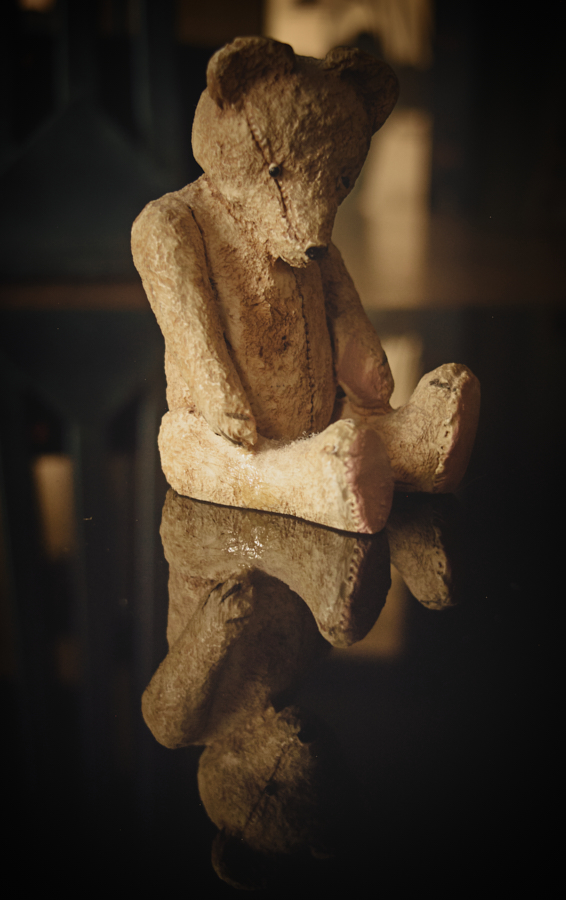
“When you are a Bear of Very Little Brain, and you Think of Things, you find sometimes that a Thing which seemed very Thingish inside you is quite different when it gets out into the open and has other people looking at it.”
~A A Mille, Winnie-the Pooh
Ursine… Ricoh GX100 f/2.9 1/28s 7.3mm 80 ISO
Image and quote submitted in response to Lost in Translation’s Pick a Word Challenge: Ursine
“… literature provided me with alternate threads by which to darn a harmonious, yet delusional, understanding of death, of fatherless children, of a family. To move into this realm is to be cuddled in the arms of a chair, mesmerized by the pages of a book unfolding like an accordion, embraced by a transparent sound barrier, and transported into fantasies found through fictional characters. While my mind’s eye grasped the hand of my naïve emotional self and together we observed the telling of storied lives, there was a seeking mind that simultaneously identified revealing markers to create a map, not to a place of hidden treasures, but to a place that felt like a home.
I was six years old the first time this happened. Martin and Cooney’s Five Little Peppers and How they Grew eased my aloneness with the emptiness left by my father’s death and filled it with a reformulated concept of family. Later, it was Alcott’s characters within Little Women and Little Men who gave me permission to vicariously be a fatherless child united with loving adults who validated sacrifice, patience, and compassion. Burnett’s themes of grief and loss within The Little Princess identified the behaviors, choices, and attitudes necessary to survive the evils of dark despair until the rescue by an unknown and unidentified savior, just and righteous.”
~B Catherine Koeford, A Mediative Journey with Saldage homesickness for a place, a time, a person that cannot be
The Chinese expression for “nostalgia” is xiangchou, literally “village sadness” … the grief that accompanies the traveler who cannot find a way back to the home village.
Vera Schwarcz, Bridge Across Broken Time
Sony RX 3… f/2.8 1/400s 25.7mm 800 ISO
Hiraeth (pronounced [hiraɪ̯θ] is a Welsh concept of longing for home. Many Welsh people claim hiraeth is a word which cannot be translated, meaning more than solely “missing something” or “missing home.” To some, it implies the meaning of missing a time, an era, or a person. It is associated with the bittersweet memory of missing something or someone, while being grateful of their existence. It can also be used to describe a longing for a homeland, potentially of your ancestors, where you may have never been. Similarly, the Cornish equivalent is hireth.
lost in the woods —
only the sound of a leaf
falling on my hat ~Tagami Kikusha (trans: Makoto Ueda, Far Beyond the Field)
Hiraeth bears considerable similarities with the Portuguese concept of saudade, Galician morriña, Romanian dor, Gaelic cianalas, Russian toska (тоска), German Sehnsucht and Ethiopian tizita (ትዝታ)
Week 24 Inspiration: Who inspires you (Inspiration comes from many places. Tell us about who inspires you.)
Sony NEX-5N f/13 1/800s 150mm 100 ISO
My introduction to Bruce Percy’s color landscape images invited me to study the amazing images of Michael Kenna and to visualize landscape photography through an eye towards minimalism and muted colors. “As I’ve grown older, I’ve found that I’m much more attracted to the wilderness and the people that live on the edges of it. Photography is a great way of getting closer to the land and the cultures that inhabit it.” ~Bruce Percy cited: Wotfoto.com
Ricoh GX100 f/3.5 1/620s 10.5mm 80 ISO
What I have found interesting in this exploration and study of various photographers, is that while I am inspired by Bruce Percy and Michael Kenna, I am also drawn to the street photographs created by Jasper Tejano who offers the viewer amazing colored images of life on the street, “… color street photography, to me, presents life with much more realism and dynamism. Especially with my work on silhouettes, the darkness of my subjects will just drown in the different shades of gray. I need color to make my subjects emerge from the frame.” ~Jasper Tejano
Images submitted in response to Dogwood Photography’s annual 52-week photography challenge.
Death of a loved one disturbs the relationships that sustain a person’s sense of ‘identity’ and the high level of binding and cathexis concentrated on the person who is lost is suddenly disrupted . . . there is a close link between the doctrines of egolessness and suffering.
De Silva, Padmasiri. An Introduction to Buddhist Psychology. Landam, MD, 2000.
Poudre Canyon… f/7.1 1/200s 28mm 4500 ISO
Through this lens of Buddhist thought, I begin to feel a crumbling of a child’s self with an understanding of how my father’s absolute and final absence from our lives disrupted the multiple relationships between my father, mother, sister, and me. Besides the sudden severing of the identity I was forming via my father, the connecting emotional threads between those of us that were left, although still intact, were unknowingly stretched and pulled by our own individual fears of egolessness.
My father’s death left my mother, a young woman deaf from infancy, with two daughters and pregnant with her first son. I do not recall whose idea it was to wander outside the house early that morning as my mother slept. I can, however, imagine my young self following my older sister as if an invisible thread that tied us together tugged me along as she, with her five-year-old world view, undertook an emotional duty to find our father. Did we believe we could find him fly fishing in the creek that ran alongside the house? Or was there something about the water that enticed us into abandoning our search? I can recall to this day the cessation of anxiety and arising rapture that coincided with my surrender to the inevitable. Two young men, I am told, rescued us both from this search for our father.
Koeford, BC. A Meditative Journey with Saldage Homesickness for a place, a time, a person that cannot be





 a meditative journey
You must be logged in to post a comment.