“The sight of the leaves ever reminds me strangely of my own sadness. I cannot go within, but lie on the veranda; mayhap my end is not far off. I feel a vague anger that others are in comfortable sleep and cannot sympathize with me. Just now I hear the faint cry of a wild goose.* Others will not be touched by it, but I cannot endure the sound.
How many nights, alas!-
Sleepless-
Only the calls of the wild geese-
~The Diary of Izumi Shikibu (cited: Diaries of Court Ladies of Old Japan)
*Footnote within the Diary of Court Ladies of Old Japan notes that the “wild geese visit Japan in Autumn and fly away northwards in the early spring. They are never alone, and their cries calling to each other make the solitary woman feel loneliness more keenly.”
Every life is a point of view directed upon the universe. Strictly speaking, what one life sees no other can. Every individual, . . . is an organ, for which there can be no substitute, constructed for the apprehension of truth . . . Without the development, the perpetual change and the inexhaustible series of adventures which constitute life, the universe, or absolutely valid truth, would remain unknown . . . Reality happens to be like a landscape, possessed of an infinite number of perspectives, all equally veracious and authentic. The sole false perspective is that which claims to be the only one there is. ~José Ortega y Gasset
Death of a loved one disturbs the relationships that sustain a person’s sense of ‘identity’ and the high level of binding and cathexis concentrated on the person who is lost is suddenly disrupted . . . there is a close link between the doctrines of egolessness and suffering.
De Silva, Padmasiri. An Introduction to Buddhist Psychology. Landam, MD, 2000.
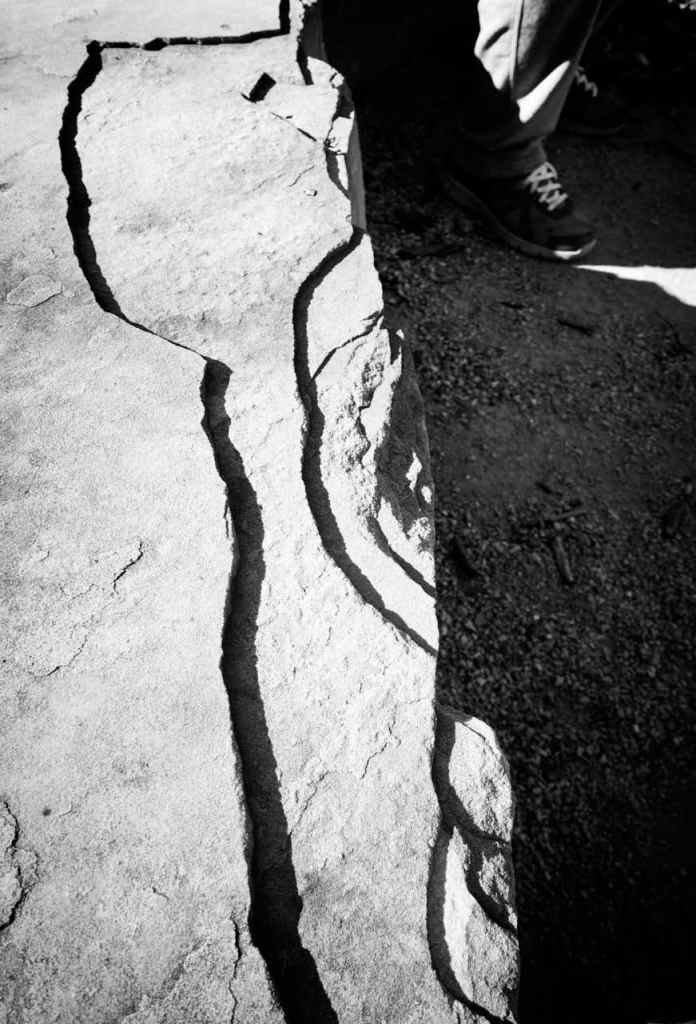
Poudre Canyon… f/7.1 1/200s 28mm 4500 ISO
Through this lens of Buddhist thought, I begin to feel a crumbling of a child’s self with an understanding of how my father’s absolute and final absence from our lives disrupted the multiple relationships between my father, mother, sister, and me. Besides the sudden severing of the identity I was forming via my father, the connecting emotional threads between those of us that were left, although still intact, were unknowingly stretched and pulled by our own individual fears of egolessness.
My father’s death left my mother, a young woman deaf from infancy, with two daughters and pregnant with her first son. I do not recall whose idea it was to wander outside the house early that morning as my mother slept. I can, however, imagine my young self following my older sister as if an invisible thread that tied us together tugged me along as she, with her five-year-old world view, undertook an emotional duty to find our father. Did we believe we could find him fly fishing in the creek that ran alongside the house? Or was there something about the water that enticed us into abandoning our search? I can recall to this day the cessation of anxiety and arising rapture that coincided with my surrender to the inevitable. Two young men, I am told, rescued us both from this search for our father.
Koeford, BC. A Meditative Journey with Saldage Homesickness for a place, a time, a person that cannot be
To be human was to be a sentient being who remembers.*
“The third-century classic Jinshu summarized the paradox of memory: ‘Qing you yi sheng, bu yi ze wu qing.’ No words in English can capture the condensed reservations expressed in nine simple characters. The first four summarize ancient psychology: emotion is born out of remembrance. The next five advise the wise to stem this process of arousal altogether: where there is no remembrance, emotion will dissolve as well. The point, simply put, is that distress causes memory. To be sure, it is human to have feelings, but this can be curbed by a willful quieting of the emotional upheaval caused by remembrance.
“Simcha, the Hebrew word for ‘joy,’ has as its root macha, meaning ‘to remove’ or ‘wipe away.’ To be joyful, in this sense, is to be free of the tearful weight of the past.
“In the end, however, neither Chinese or Jewish rememberers settled for the peace of a memoryless world.
“The opposite of quietude can be found in the story of Lot’s wife… Here, a woman who refuses to walk away from history is turned into salt–a concrete symbol of endless weeping. Lot’s wife captures the need to remain connected to the past and dares to stand still when the known world is about to crumble. Although some might argue that Lot’s wife looked back with nostalgic regret for past pleasures, Anna Akhmatova, in the poem, ‘Lot’s Wife,’ suggest she did so out of her refusal to become deaf to the grief embedded in the past.”*
*The continuous writing of the cursive Japanese characters is often compared to a meandering river. “Ink seems to have frozen up” means that her eyes are dim with tears, and no more she can write continuously and flowingly.
“…you cannot know how many people your words, actions and thoughts have touched.
When I make a pot of oolong tea, I put tea leaves into the pot and pour boiling water on them. Five minutes later there is tea to drink. When I drink it, oolong tea is going into me. If I put in more hot water, making a second pot of tea, the tea from those leaves continues to go into me. After I poured out all the tea, what will be left in the pot is just the spent tea leaves. The leaves that remain are only a very small part of the tea. The tea that goes into me is a much bigger part of the tea. It is the richest part.
We are the same; our essence has gone into our children, our friends and the entire universe. We have to find ourselves in those directions and not in the spent tea leaves. I invite you to see yourself reborn in forms that you say are not yourself. You have to see your body in what is not your body. This is called your body outside of your body.”
A song out there… Why, it is a beggar singing! If this old man who never had a silver coin can sing, why must you with rich gold memories sit here and sigh?
~Tu Fu (cited: The Jade Flute: Chinese Poems in Prose, gutenberg.org)
You must be logged in to post a comment.