She is like the Moon, who, opening the gate of Heaven,
goes up over the clouds.
We, being in the same heavenly Palace, pass the night
in remembering the footfalls of the past.
Just as a solid rock is not shaken by the storm, even so the wise are not affected by praise or blame. ~The Buddha
Bare attention flows in opposition to a life guided by streams of unconscious habit patterns and emotional reactivity.Bare attention awakens us to the stones we stumble over due to the blindness of confusion or ignorance.It shines a light into the shadows of confusion and ignorance and finds our frustrated desires and suppressed resentments. Bare attention identifies and pursues the single threads of the closely interwoven threads of our thoughts, feelings, and actions, which have over the years formulated the tapestry of our life story.
Bare attention is the clear and single-minded awareness of what actually happens to us and in us at each successive moment of perception.It is the forerunner of insight.It is a way of being that is counter to the general manner by which we briefly and fleetingly know or experience the events or people within our daily schedules. Bare attention trains the mind to be detached, open, silent, and alert within the framework of the present moment.It is an intention to suspend all judgments and interpretations, and to simply note and dismiss them if and when they do occur.
The task within bare attention is to simply acknowledge what occurs just as it occurs.It is a process of inviting one’s self back into the present, of being mindful of the moment, with the realization that our minds have taken us into an imaginative realm of fantasy, recollections, or discursive thoughts.It is a means by which to acquaint our selves with an object before our minds alter its presence through conceptual paint overlaid with interpretations.
Bare attention is undertaken with an intention to undo our general ways of being in the world, it is an intention of simply noting and not thinking, not judging, not associating, not planning, not imagining, not wishing.It notes each occasion of experience as it arises, reaches its peak and then fades away.It is a sustained mindfulness of experience in its bare immediacy, carefully and precisely and persistently.
Bare attention awakens me to the relationship I have formed with this world through the untested foundations of beliefs, values, guiding principles, and morals. To attend to what formulated these foundations I have found seeds of misconstrued concepts built out of my childhood fears and fantasies.I have seen a blind faith to family customs, rituals, and cultures.I have come to understand how some of the holy of holy concepts within my “absolute truths” are unquestioned beliefs which perpetuate suffering.
Excerpts from B Koeford, A Meditative Journey with Saldage
This week Traveling at Wits End’s guest post is St. Louis-based photographer David Adams. He writes that doors:
can be many things. They can be barrier, they can be invitations. They can be utilitarian, they can be ornate. Doors show personality or they can protect us from the world.
David challenges photographers to find “closed doors…no peaking inside” and to look for color, shape, decoration, as well as details…to find a door with personality.
The first time I found myself photographing doors was about 40 years ago while we were living in Newport, Rhode Island. Since then I also found that the doors within historical districts of the southern part of the United States, Australia, and Europe to be intriguing–the west…not so much.
Yesterday, while on an out-of-town trip with camera in hand and this challenge in mind, I undertook a photo walk through a small rural community. Regrettably, the doors within this town are…boring. Yet, I found myself thinking how sidewalks, steps, and porches are like a preface to the stories behind closed doors.
While the images above are not beautifully composed and do not specifically “focus” on doors, they do invite me to story the lives of the people who live behind these closed doors and to ponder the question, “how is the war economy doing for you?”
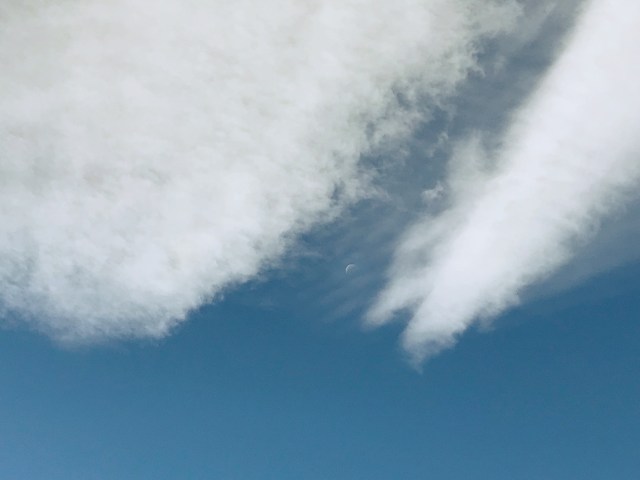
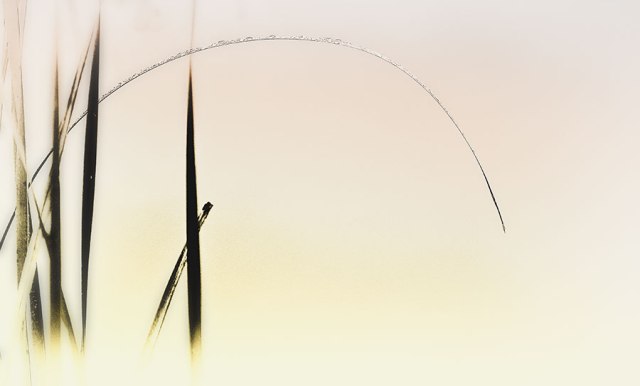
… to hold a moment, how to record something so completely, that all who see [the picture of it] will relive an equivalent of what has been expressed. ~Alfred Stieglitz (cited: http://www.metmuseum.org)
The theory of equivalence was inspired by Wassily Kandinsky’s belief that colors, shapes, and lines reflect the inner, often emotive “vibrations of the soul.” In his cloud photographs, which he termed Equivalents, Stieglitz emphasized pure abstraction, adhering to the modern ideas of equivalence, holding that abstract forms, lines, and colors could represent corresponding inner states, emotions and ideas.
The following are excerpts from Equivalence: The Perennial Trend: Minor White, PSA Journal, Vol. 29, No 7, pp 17-21, 1963 (cited: http://www.johnpaulcaponigro.com)
A change of perspective is a change in state. Jean Piaget reminds us that, “What we see changes what we know. What we know changes what we see.” Perception changes reality… The more conscious the perception the stronger the change. Furthermore, the quality of consciousness one engages perception with influences what is perceived, what is produced, how it is received and the consequences that has. Acting on what one observes, choosing and sustaining one thing / quality amid many others, reinforces that state of being and this is particularly true if during observation one creates something tangible and durable and never more true if multiple related works are created. Often, during the process of manifestation perception continues to change, further extending this process of revelation and transformation.
The visible can be used to reveal the invisible; the external can be used to reveal the internal. ~Alfred Stieglitz
Minor White remarked, “One should photograph things not only for what they are but also for what else they are.”and “Equivalence is a function, not a thing.” He did not mean to suggest that equivalence was merely a rhetorical device. Equivalence is more than a rhetorical device, not a simile that suggests shared commonalities (this is like that), not a metaphor that observes shared qualities through the power of transformation (this is that), but a process inclusive and transcendent of both. Like a simile its power starts with the recognition of shared qualities and like a metaphor its power lies in transformation, but an equivalent transcends both through a heightened state of self-awareness, even to the point of transforming the self through its accompanying effects of clarity and commitment.
Equivalence embraces and elevates the debate over whether photographs are windows (onto the world) or mirrors (into the soul) and whether they are taken (through distant observation, objective to varying degrees) or made (through immediate interaction, subjective to varying degrees), illuminating many more levels of an evolving process. Through equivalence the photographic object created becomes a reflection of both the external things it represents and the internal states of its creator. This reflective capacity is extended to the viewers, who re-experience this shared process in their own ways.
Resonance is a consequence of equivalence. What we create can transform us. We then become co-creators, creating not only things and ideas but selves. What we create can also transform others, triggering cascades of sympathetic vibrations, if we imbue our creations with a persistent resonance, brought on by intensity, clarity and connection (connection to subject, medium, self, and others). Through the experience of art, the powers of perception and transformation can be awakened, in both the ones who create directly and the ones who [perceive] indirectly.
Stieglitz set a shining example for us all. He demonstrated that the full power of our photographs lies not in special subjects or moments but in what we bring to the picture, which can be much more than technical skill, compositional prowess, and cultural awareness. Through photography we can simultaneously bear witness to things / events, affirm our connection / participation with them (even if only as observers, no small thing), and clarify our understanding / interpretation of the confluence of everything that is brought to bear in each moment and the continuing resonances they produce. More than an intellectual interpretation or emotional expression, this is a process of holistic integration.
The photograph can be much more than a material trace of another material; it can even be much more than a trace of light and time; it can also be a trace of spirit, the energetic confluence of body, mind, and emotion, either single or multiple.
White reminds us that this process of self-realization is open to everyone, “With the theory of Equivalence, photographers everywhere are given a way of learning to use the camera in relation to the mind, heart, viscera and spirit of human beings. The perennial trend has barely been started in photography.” Though all photographers do it, not all photographers do it with equal clarity or intensity. Regardless of what level they engage this process, whenever photographers break through to new levels of consciousness the results are transformative for the photographer and the viewer and even the viewed, sometimes subtly and sometimes dramatically is a form of contemplative photography that asks us to see our world in a new way. In some ways it seems very simple, but it is not always easy.
In a famous passage in the Meditations, Descartes speaks of looking from a window and seeing men pass in the street. ‘Yet,’ he reflects, ‘do I see any more than hats and coats which could conceal automations? I judge that they are men.’ …the observer no longer passes through them to see the living person beneath. He no longer sees what is implied. However, the attention of the right hemisphere, concerned as it is with the being in context, permits us to see through them to the reality that lies around and beyond them. It could not make the mistake of seeing the clothes and hats in isolation.
The illusion that, if we can see something clearly, we see it as it really is, is hugely seductive. …We never see anything clearly…What we call seeing a thing clearly, is only seeing enough of it to make out what it is; this point of intelligibility varying in distance for different magnitudes and kinds of things…” Ruskin, in Modern Painters, makes the point that clarity is bought at the price of limitation…He gives the example of an open book and an embroidered handkerchief on a lawn. Viewed from a distance of a quarter of a mile, they are indistinguishable; from closer, we can see which is which, but not read the book or trace the embroidery on the handkerchief: as we go nearer, we ‘can now read the text and trace the embroidery but cannot see the [fibers] of the paper, nor the threads of the stuff’; closer still and we can see the watermarks and the threads, ‘but not the hills and dales in the paper’s surface, nor the fine [fibers] which shoot off from every thread’; until we take a microscope to it, and so on, ad infinitum. At which point do we see it clearly? …Clarity, it seems, describes not a degree of perception but a type of knowledge. To know something clearly is to know it partially only, and to know it, rather than to experience it, in a certain way ~I McGilchrist, The Master and his Emissary (pp181-182).
Do not go upon what has been acquired by repeated hearing, nor upon tradition, nor upon rumor, nor upon scripture, nor upon surmise, nor upon axiom, nor upon specious reasoning, nor upon bias towards a notion pondered over, nor upon another’s seeming ability, nor upon the consideration ‘The monk is our teacher.’
When you yourselves know: ‘These things are bad, blamable, censured by the wise; undertaken and observed, these things lead to harm and ill,’ abandon them.
When you yourselves know: ‘These things are good, blameless, praised by the wise; undertaken and observed, these things lead to benefit and happiness,’ enter on and abide in them. ~ The Buddha (Kalama Sutta)
The Kalama Sutta tells us that the Buddha wanted our truths to be known, not through the words of others, but through personal experiences as well as introspection and intuition.His words suggest that the way in which we comprehend and make sense of this vast and mysterious thing called life brings forth beliefs that have the power to either ease our discontent or intensify our suffering. Yet, to undertake, for one self, the challenge to analyze the mental ground one stands upon is to encounter a time of uncertainty. This uncertainty is like quicksand: its power to imprison will intensify in association with the struggle to escape the entanglements of concepts that formulate the foundation of one’s life, family, culture.
Therefore, to observe, question, and analyze suffering through Buddhist psychology requires an acknowledgment that this endeavor will be influenced by the myths, beliefs, and expectations within my family of origin, how I understood doctrines within my religious upbringing, and the experience and training I have had as a psychotherapist.
Freud noted that suffering comes from three directions: the feebleness of our bodies, the superior power of nature, and more painful to us than that of any other, our relations with others. He also wrote, “In the last analysis, all suffering is nothing else than sensation; it only exists in so far as we feel it, and we feel it in consequence of certain ways in which our organism is regulated.” The few who possess the ability to experience pleasure through special dispositions and gifts do not have “an impenetrable amour against the arrows of future.”
Those who are most likely to have intimate knowledge of what it means to be fettered to suffering are those who present with a history of chemical use, either personal, that of a significant other, or both.The dynamics within dependency resemble the autumn leaves traveling upon the surface of a stream; they are overt manifestations of the undercurrent that demonstrates how each of us seeks pleasure and will, in the long run, endure suffering if there is a thread of hope, no matter how short lived, of experiencing remembered pleasure.As Freud wrote: “The most interesting methods of averting suffering are those which seek to influence our own organism . . . The crudest, but also the most effective method people use to ease their suffering is through “intoxication [to] alter the conditions governing our sensibility so that we become incapable of receiving unpleasureable impulses . . . The service rendered by intoxicating media in the struggle for happiness and in keeping misery at a distance is so highly prized. .. We owe to such media not merely the immediate yield of pleasure, but also a greatly desired degree of independence from the external world.”
This yield of pleasure and degree of independence that Freud identified creates its own attachment, which is compounded by an aversion to both the impermanence of intoxication and a re-engagement with life’s discontent.Suffering intensifies as cravings and intrusive thoughts feed a desire to escape discontent.Therefore, a relentless ruminating and obsessing mind has the power to create as much suffering as physical dependence.
Excerpts from B Koeford, A Meditative Journey with Saldage
Once we establish the discipline of looking and seeing we are free to explore the open dimensions of the phenomenal world. As this orientation becomes more heartfelt, one becomes more attuned to the intimate qualities of contact, communication and natural expression in clear seeing. This brings relaxation and appreciation: the eye is allowed to fall through the world and celebrate this visual communion.
The discipline of looking and seeing cultivates a subtle and profound aesthetic sensibility. While this quality of seeing is genuine and fulfilling there remains a subtle allegiance to an underlying form of contemplative appreciation. The practice of direct perception undercuts this subtle ground and reference point. By completly trusting the unconditional power of the gap of perception one drops reference points and connects with the phenomenal world on its own terms. In direct perception there is no space for doubt or preference. Seeing is believing. With this confidence one enters the play of form and chaos in pure perception. Nothing added; nothing missing: each perception is an image of itself.
A Karr & M Wood (The Practice of Contemplative Photography) identify three mind stages of a contemplative photographer:
Connecting with the flash of perspective
Working with visual discernment
Forming the equivalent of what was seen
Forming the equivalent comes into play when one creates an image that reflects what was seen “—nothing more, nothing less.” It requires an intention to remain with the perception connected with as one engages the shutter. Making “sure the choices [depth of field, exposure, and color balance] you make honestly reflect your perception.”
…you have seen the subject clearly, without conceptual filters or discursiveness. You have rested with the perception in visual discernment, without agitation or photographic thinking.
This phase requires the silencing of composition rules/techniques and restraining the impulse to play around with various camera settings. Yes, easier said than done!
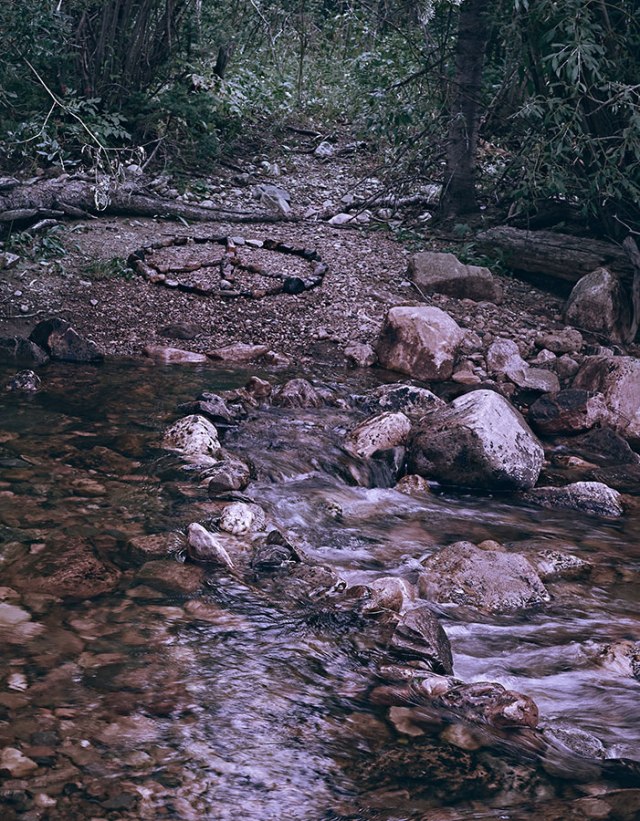
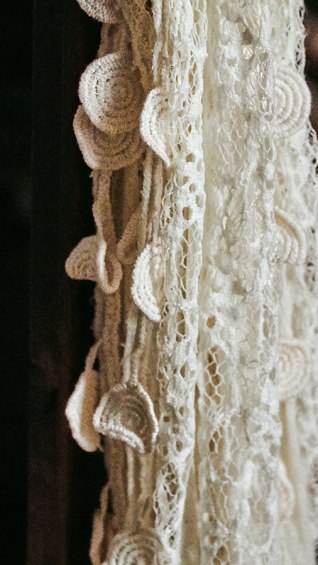
Texture is one of the photo assignments Kerr and Wood invites us to connect with as a means to further our awareness of the “flash of perception.” They noted that when we open ourselves to color the experiences are more sudden and intense than when intentionally photographing texture.
The texture assignment was to:
Establish a firm intention just to look for texture.
Slow down and open yourself to “endless details of the surfaces around you.”
Fill the viewfinder with just the texture that “stopped you.”
Keep in mind that visual patterns are visual while texture is tactile.
As I set out on this exercise, silencing a tendency to pre-identify objects of texture—grass, tree bark, mirrors—was, at first, a bit of a struggle. Then I found that when I opened myself to be with a consciousness of seeing and feeling…as if the surface quality that I visually connected with also invited me to touch, a combining of a visual and tactile moment…the experience tended towards mental qualifications of: silky, bubbly, prickly, nubby, fluffy, grainy, gritty, etc. A busy mind is indeed difficult to silence.
This slideshow requires JavaScript.
I do enjoy the exchanges of ideas and questions as these exchanges help clarify the nuances of Contemplative Photography. Let’s tag with #aphotostudy.
“Man tends to regard the order he lives in as natural. The houses he passes on the his way to work seem more like rocks rising out of the earth than like products of human hands. He considers the work he does in his office or factory as essential to the harmonious functioning of the world. … He respects and envies a minister of state or a bank director, and regards the possession of a considerable amount of money as the main guarantee of peace and security. He cannot believe that one day a rider may appear on a street he knows well, where cats sleep and children play…He is accustomed to satisfying those of his physiological needs which are considered private as discreetly as possible, without realizing that such a pattern of behavior is not common to all human societies. In a word, he behaves a little like Charlie Chaplin in The Gold Rush, bustling about in a shack poised precariously on the edge of a cliff.
His first stroll along a street littered with glass from bomb-shattered windows shakes his fate in the ‘naturalness’ of his world. The wind scatters papers from hastily evacuated offices, papers labeled ‘Confidential’ or ‘Top Secret’ that evoke visions of safes, keys, conferences, couriers, and secretaries. Now the wind blows them through the street for anyone to read; yet no one does, for each man is more urgently concerned with finding a loaf of bread.Strangely enough, the world goes on even though the offices and secret files have lost all meaning. Further down the street, he stops before a house split in half by a bomb, the privacy of people’s homes—the family smells, the warmth of the beehive, life, the furniture preserving the memory of lies and hatreds—cut open to public view. … His walk takes him past a little boy poking a stick into a heap of smoking ruins and whistling a song about the great leader who will preserve the nation against all enemies. The song remains, but the leader of yesterday is already part of the extinct past.
He finds he acquires new habits quickly. Once, had he stumbled upon a corpse on the street, he would have called the police. A crowd would have gathered, and much talk and comment would have ensured. Now he must avoid the dark body lying in the gutter, and refrain from asking unnecessary questions.The man who fired the gun must have had his reasons…. ” ~C Milosz, The Captured Mind







You must be logged in to post a comment.