early morning readings

contemplative photography 5

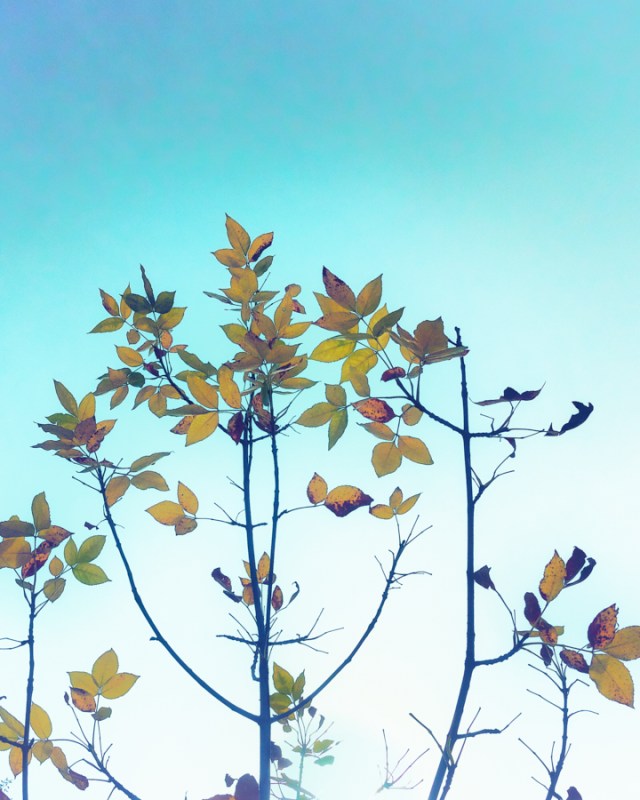
Sony RX100 III  f/4  1/80s  23.9m  250 ISO

“This LeWitt drawing [All Two-Part Combinations of Arcs from Corners and Sides, Wall, Drawing #842, white crayons, black pencil, grid, 14×18 ft.], white lines on a large black field, created a strong presence in the gallery. That presence was beautifully offset by the simplicity of the system it described. Until that show, I believed that conceptual art was about the idea-the concept–and thus that the drawing on the wall was only there to display the idea. I believed this until one day during the show, when I found myself alone in the gallery in front of the wall and my vision was filled with black paint and the pebbly, waxy marks of the white crayon. At that moment the piece seemed to open a door in my mind. Rather than the concept being processed like art in my brain, I felt a sense of integration–my eyes and body were involved, a union between the concept and the materials, neither standing alone. My view transitioned from an analytical appreciation of a system called ‘art’ into an utter, complete presence with an artwork…” ~J F Simon, Jr., Drawing Your Own Path

“Observe the changes that take place in your mind under the light of awareness. Even your breathing has changed and become ‘not-two’ (I don’t want to say ‘one’) with your observing self. This is also true of your thoughts and feelings, which, together with their effects, are suddenly transformed. When you do not try to judge or suppress them, they become intertwined with the observing mind.” ~Thich Nhat Hanh, The Sun My Heart

history is remembrances re-emerging

contemplative photography 6 copy

Intentionally, I set my mind upon the engagement of self with the process of reading the words of another with a knowing that I have accepted an invitation to consider an author’s worldview; that is, to place reality upon a shelf or to open a unique window of understanding.

…distraction, from this engagement as I become aware of a shadow presence – a transparent here-ness tinted with memories of you. It is as if you emerged from the printed page calling forth shared memories.  I feel you sitting silently beside me. Within this silence, I begin to search for words, sentences that covey meanings and insights that awaken the joy that comes from an easing of longing and I hear myself whisper, “Here, a treasured story of thought that reconnects us, reflects a past time of us together, that validates words, ideas—you—and messages, ‘I have heard you within the sharing of love.  I delight in knowing you.  I wish to thank you for simply being…you are the joy that accompanies a gift in transit to being received.’”

…awareness, the words on the page have faded, I have disengaged myself from the invitation to consider the worldview of another as I entered imagined moments with you.  I miss you.  I miss us.

…accepting that what I yearn for can never be for I’m in the autumn of my life while you, my child, have now entered your summer as your children dance within their spring.  Seasons flow one into another—their circular, repeating patterns defined by an unseen guiding hand—births expectations, hope and trust created from past consistencies.

History is remembrances re-emerging like the youthful sprout fragile in its newness, in its responding to life’s call.  Yet, in time this newness will fade and become fragile as one’s autumn yields to their winter.

First posted on September 26, 2013

reflections from a bridge

contemplativephoto-reflection

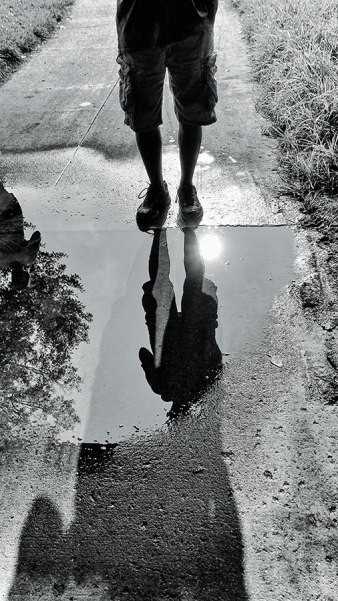
Reflections from a Bridge    Nikon D750   f/4.2   1/400s   45m   100 ISO

I’m in a forest of tall pine trees.  Smooth river rocks and trimmed elephant grass edge a pathway covered with dark red, black, and gray colored gravel stones.  The pine trees release their scent as they sway with the breeze.  The singsong of birds fills the air as they flitter from one branch to another.  Before me I see a clearing illuminated by the rays of the morning sun.  As I step into the clearing, I feel warmth of the sun’s touch and see a house centered within a fallowed field and question, “is this home?”

As I make my way through the fallow field, I find three ancient keys lying within a dust-filled furrow.  Silver is the first key.  A knowing tells me it opens a door to a space of tranquil abiding.  Gold is the second key.  It gives admission to a room of healing serenity.  Diamonds make up the third key.  It unlocks a keepsake of my remembrances.

The awakened groan of the wood planks welcome me as I step onto the weathered porch that surrounds the house.  I find that the silver key fits the lock of an entryway door.  Before I open the door and step over the threshold, I feel compelled to turn around and, with non-judgmental awareness, attend to and then put aside all that I see within and beyond the wheat field.

I step over the threshold and feel an inviting atmosphere of affectionate acceptance that encourages me to wander unencumbered throughout the interior of the house.

I find myself at the bottom of a stairway which I ascend. On the second floor I enter a room lightened by the light of the midday sun entering a picture window painted by the landscape that extends to where the blue ridge of the sky touches the earth’s multi-green jagged horizon.  Opposite to the window is a ceiling-to-floor bookcase lined with books, aged and worn.  The warmth within this room embraces me with stillness, silence, and clarity.  My eyes light upon a small trunk and I know that it is for me.  As I pick up the trunk I find that it is light and fits with ease into the cradle of my arm.

I leave this room and again walk about the house.  I find that the gold key opens a door to a central room of calm solitude.  Stepping into this room I sense the presence of a compassionate being who introduces herself as Sophia, the aged guardian of the innermost things, “my heart hears the wordless tears and fears within your heart and feels the quiver of your heart-filled joys.  You have entered the hearth of your home, an ancient site of healing.”

I sit comfortably on the floor and open the trunk with the third key.  As I explore the contents, I understand that they are mementos of my life’s journey.  My consciousness, mind, and body move in unison with the moment of my breath’s spirit as I hold one keepsake after another. I acknowledge the memories, images, feelings that each memento evokes with the reminder that I am in a space of healing serenity and that I am not alone.

I feel a slight tugging within my heart as dark memories hidden within darker shadows accept the invitation to ride upon the in-breath of the compassionate guardian.   With their departure, my body releases long-held tears.  With my in-breath, I hear her whisper, “This is a time of healing transformation”, and I feel a wondrous golden energy spread throughout my body.

A calling beckons me from beyond this house that feels like home. I hear permission to leave with a chosen remembrance or to place whatever arose back in the trunk.  I step over the threshold; I feel an invitation to return whenever I wish.

contemplativephoto-bench

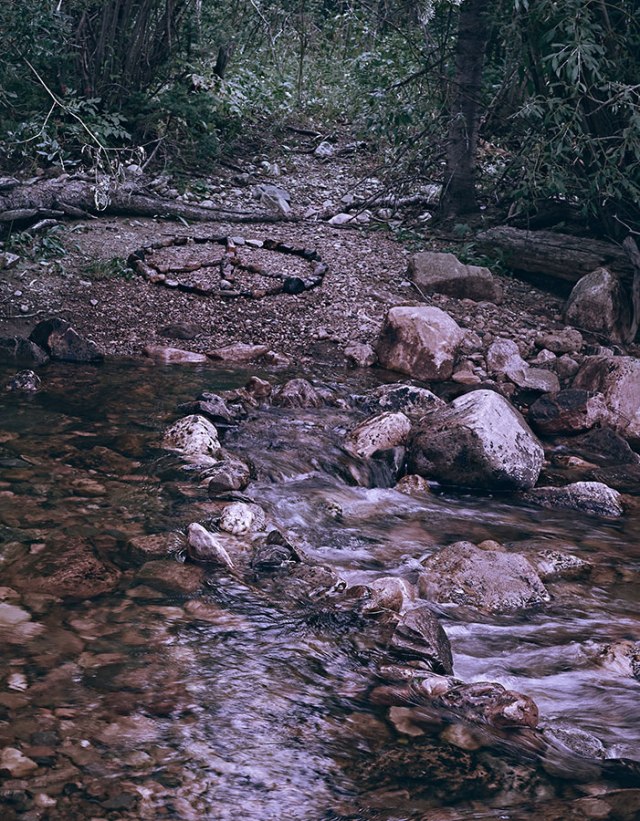
Is this Home?   f/4.3   1/400   45m   100 ISO

Excerpts from B Koeford, A Meditative Journey with Saldage


a photo study: contemplative photography V – things in themselves

conttemplative 7

Seeing begins with respect, but wonder is the fuel which sustains vision.~Steven J Meyers

I believe we all intimately know of that moment…the moment, an early morning moment, that occurs just as we lift a window frame.  That fleeting moment as morning awakens us…before the mind discriminates, defines, labels, associates, and tucks away into memory…the moment of awareness to, awakening to the touching, the greeting..our vulnerability to morning’s sensual presence…That’s magic, the “things in themselves.”

our eye consciousness and ear consciousness can touch the world of suchness without distorting it.  With mind consciousness, we tend to distort…

Thich Nhat Hanh (Understanding the Mind) writes that there are three fields of perception: perception of things-in-themselves, as presentation, and as mere images, and that the way we perceive reality has everything to do with our happiness and suffering.

The perception of things-in-themselves is when we are perceiving directly without distortion or delusions. This is the only one of the three modes of perception that is direct. This way of perceiving is in the stream of…suchness; that is, “reality as it is.”  … Everything—a leaf, a pebble, you, me—comes from suchness. Suchness is the ground of our being, just as water is the ground of being of a wave.  

Are we capable of touching reality-in-itself? … A flower can be the manifestation of the world of suchness, if we perceive it directly.  It all depends on our mode of perception whether we touch the suchness of a flower or only an image of it that our minds have created. Our perceptions rarely reach the mode of things-in-themselves, however.  We usually perceive things in the other two modes, as representations or mere images. 

The first five consciousness-the sense consciousness of eye, ear, nose, tongue, and body—are capable of touching the realm of things-in-themselves, especially when they contact their objects of perception without the participation and intervention of mind consciousness.  When mind consciousness gets involved, however, there will always be some thinking and imagination, and the image brought to it by one of the sense consciousnesses will become distorted. 

We are capable of reaching the field of things-in-themselves, the world of suchness, but because we think and discriminate we don’t usually perceive things as they truly are.  The nature of our mind is obstructed.  This means that we build a world full of illusions for ourselves because of the distorted way we perceive reality.  Meditation is to look deeply in order to arrive at reality—first the reality of ourselves and then the reality of the world.  To get to that reality, we have to let go of the images we create in our consciousness… Our practice is to correct this tendency to discriminate and think dualistically, so that reality will have a chance to reveal itself. (pp 65-71)  

This slideshow requires JavaScript.

Miksang, a Tibetan word, has been translated to ‘Good Eye.’ Miksang photographers write that when we see with/through a Good Eye we see the world as it is for the first time.  This is because this way of seeing is absent of memory and association.  The world is manifesting to us, as it is out of nowhere.

Julie DuBose wrote (Shambhala Times, April 7, 2017, “What is Miksang Really?”) that the basis of Miksang photography

…is the open space of availability in our minds. When our mind and eye connect directly with a visual perception, it is like a flash of lightening arising from this empty open space. Without the voltage, the electric presence of the flash of contact inherent in the image, it is flat and lifeless, somebody’s idea. This is the juice of direct perception. If we can maintain our connection to this raw energy of perception through to our expression of the perception with our camera, then it will be completely expressed in our image. 

There is no halfway, half a flash of perception. The perception and the resulting image either does, or does not, have the living, raw experience of that moment of voltage embedded in it. There is no in between. This is the joy of “fresh” seeing.

A. Karr and M. Wood (The Practice of Contemplative Photography) notes that contemplative photography begins with “the flash of perception.”  

In the flash of perception…there is a space for things to come to you. Experience is definite, because there is no doubt about what you are seeing… Whatever it is, it is here, and there is no doubt involved, no shakiness.  The nature of perception is sharp, with a brilliant, clear quality.  The flash of perception is a moment of seeing that is one-pointed, stable, and free from distraction.  Experience is not diffused or scattered or moving. It is direct and in focus. It is stable because it is not tossed about by winds of thought or emotion. There is a stillness and roundedness as awareness remains with perception.

W. Rowe (Zen and the Magic of Photography) introduces the reader to Roland Barthes’ description of the essence of photography, the “punctum”,a small, distinct point.  

The punctum, “will break (or punctuate) the studium*…photographs that are “in effect punctuated, sometimes even speckled with these sensitive points; precisely, these marks, these wounds, are so many points.”  Punctual rises out of the scene, seeks out the viewer, disturbs the studio, wounds, cuts, pricks, and stings the viewer…also has the power to provide sudden enlightenment… a tiny shock, is usually found in the detail bringing “certain photographs very close to haiku.”

Only the moon

and I, on our meeting-bridge

alone, growing cold ~Teiga (S. Hill, The Sound of Water)

contemplationcolor5web

Torsten Andreas Hoffmann (Photography as Meditation: Tap into the Source of Your Creativity) indicated that within:  

the context of photography and shooting images, the photographer must be at the right place, with the right lens and the right aperture, at exactly the right moment to capture the picture.  Successful images, however, are not guaranteed based solely on having the correct posture and intent. However, by letting go of intent, the stillness of the mind can take over and you can attain oneness with your surroundings. Barthes refers to this concept using the term “satori,” which describes the highest state of enlightenment and comprehension in Zen. I prefer to use the term “Samadhi,” which indicates a state of utmost vigilance and attention. Photographs taken while in this state may achieve the quality of puncture.

As I was pondering my understanding of “the flash of perspective”, as an experience of a shock that is like being awakened from sleep by a loud noise and Barthes’ punctual that “disturbs, wounds, cuts, picks, and stings the viewer to an haiku moment, images of Buddhist masters who drop a book or strike with a stick as a means of wakening wandered into my thoughts.  As a therapist, I came to understand that there is an immediate response to “shock” that may be expressed as denial, laughter, tears, shaking, screaming, or tears that occurs as a way for the body/mind to re-establish a state of equilibrium.  Also, my own personal life experiences have taught me that expected moments of “shock” (as opposed to those horrid moments that come out of the blue) are more likely to be responded to with a more grounded and contemplative state of being. 

“Wounds, cuts, shocks, picks, stings…are not these words of violence incongruent to a contemplative state?  With all this said, I find myself wondering if these “shock” elements identified by contemplative photographers may have, even the smallest tendency, to blur and distract me from those now moments of “things in themselves.”  If so, then how could I open myself to being a photographer who receives and shares the gift that awaits my awareness? To lessen the tendency to shift away from an “awakening?”  What are they ways to cultivate an attitude of receptivity, an openness to what might be given to me?  To engage in a photo walk that is more like meditation or a spiritual discipline than a search or a hunt?  

aloneweb82518

I have come to a place of consideration that one small way in which to become acquainted with underlying attitudes and be in a more graceful receptive place to receive “things in themselves” is to begin to become aware of the words/attitudes that have the potential to define the process by which I photograph. 

I ask myself will I be more able to see with respect, as noted by Steven J Meyers, if I intentionally silence the words “shoot,” “capture,” “frame,” “take,”  “exposed,” “cover,” “take the shot,” in order to open myself to  “receive,” “connect with,” “create,” “be present with,” “wonder,” “surprise,” “reveal.”

And then, will I be more able to open myself to the expression of a temporary enlightenment, in which I see into the life of things.”

*studium…

the intention of the photographer…the elements of an image rather than the sum of the image’s information and meaning.  …the elements of the punctum penetrate the studium—they have the ability to move the viewer in a deep and emotional way.  

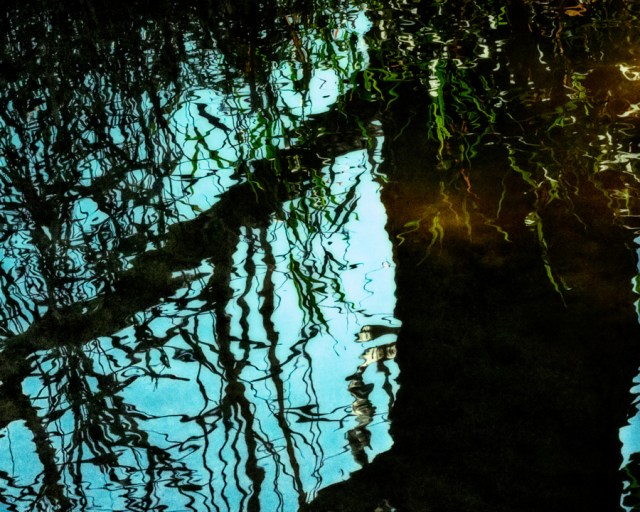
Pond Reflections

contemplative-photographyreflectionsweb91618

They did not die in the hurricane.

They died in pain, at home, of kidney failure unable to access the dialysis clinic for weeks.

They died, gasping for hours near the end, when the oxygen tank they needed to breathe gave out.

They died in the dark and the heat of unsanitary ICU units, of burns or gunshot wounds received before the hurricane that they almost certainly would have survived otherwise.

They died, burning up with fever, of leptospirosis from being in touch with flood waters during the effort to save their neighbors.

They died in fear and confusion after being forced to go off their regular medication.

They died of heat stroke.

They died of diseases of antiquity, in a crisis is of neglect unworthy the greatest, wealthiest and most powerful nation in human history.

They died. But we lived. And we remember.   ~ Eleazar David Melendez

early morning readings II

In this world, time is like a flow of water, occasionally displaced by a bit of debris, a passing breeze.  Now and then, some cosmic disturbance will cause a rivulet of time to turn away from the mainstream, to make connection back stream. When this happens, birds, soil, people caught in the branching tributary find themselves suddenly carried to the past.   ~A Lightman, Einstein’s Dreams

Reality in itself is a stream of life, always moving.  ~Thich Nhat Hanh, The Sun My Heart

Cartier-Bresson’s photograph of children playing in the rubble of war…may become a metaphor or symbol of hope. The image over my desk of a grieving mother and child after an earthquake in Armenia, made by my photographer friend Mark Beach, symbolized for me the sorrow and tragedy that is part of life.  An image I once made of the source of the mighty Susquehanna River–a spring flowing into a bathtub in a field that serves as a water tank for cows, then spilling over to begin a stream–reminds me that the restorative juice “river,” with which I am associated, has many small sources.  ~H Zehr, The Little Book of Contemplative Photography

it is my deepest hope….

It is my deepest hope that you consider how children have been given the message that they need to speak with a trusted adult whenever they have been inappropriately touched by another or impacted by other classifications of child abuse. In fact, our powerlessness as adults to ensure the safety of our children have put the responsibility for address squarely on the shoulders of the victim…the powerless.

As a retired therapist, I find myself recalling how victims of domestic violence and sexual assault would speak, with tears in their eyes, of the need to remain silent as a way of protecting their families. It is incongruent…an injured soul seeking to protect another’s soul.

And, as evident today, when a victim does speak, she faces such scrutiny that serves to message to those who remain silent that to speak is to add to the negation that already tears into their being. Shamed by the initial act and then shamed again through outsiders with their own agenda.

Look to your children…imagine them being silent to protect you. Listen to your public words…imagine them being said to your children, the young ones who will suffer in silence to shield you from harm.