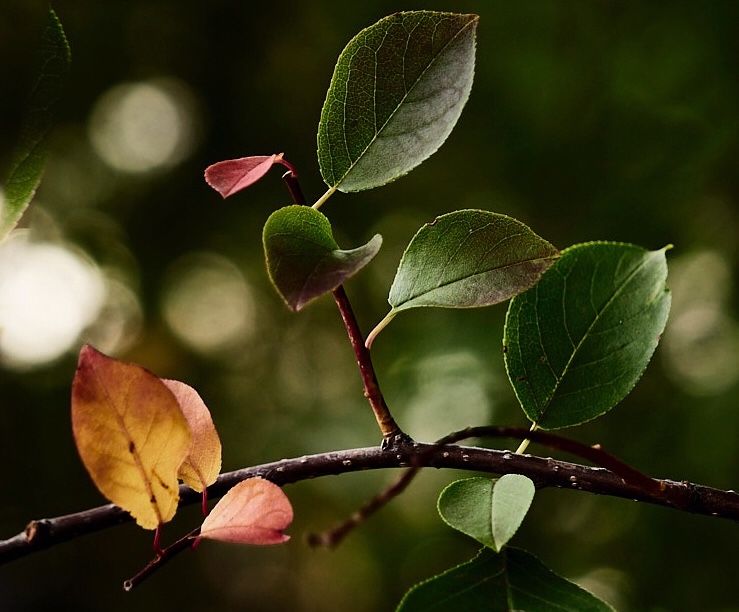
lens-artist: ephemeral

She with a cup of coffee, embraced within her chilled palms, both blanketed by the first light’s silence … her eyes looking, not seeing the eastern horizon’s slow transition from darkness to light. Suddenly, the sky’s canvas painted by the dance of the sun’s rays and clouds broke through her internal musings, “Wait, wait, please don’t move,” she pleaded as she began a search for her camera and trying so desperately, once again, to win her battle with … the moment by moment changes within life, the ephemeral nature of all that is…

across a concealed blue sky

aimless shifting stories...

gathering and dispersing – obscure particles

painting stories … anew,

moment by moment

Thank you Tina for the week’s lens-artist challenge: Ephemeral

life passages … 99

Is my mind elsewhere

Or has it simply not sung?

Hototogisu*

~Ihara Saikaku (1642-1693)**

*Hototogisu, translated as cuckoo, wood thrush and sometimes nightingale.

The bird’s song is a strong but mournful cry.

It is said to die after singing 8,008 times.

It is also known as the “bird of time,”

“messenger of death” and “bird of disappointed love,”

and flies back and forth from this world to the next.

Confucian axiom: If one’s mind is elsewhere, one will look but not see, listen but not hear

**cited in:

The Classic Tradition of Haiku

Edited by:  Faubion Bowers

life’s passages … 60

Who speaks the sound of an echo?

Who paints the image in a mirror?

Where are the spectacles in a dream?

Nowhere at all — that’s the nature of mind!

                                                             ~Tree-Leaf Woman*

*cited:

Women in Praise of the Sacred

Ed: Jane Hirshfield

words of wisdom

“… the wind bids me to leave you.

“Less hasty am I than the wind, yet I must go.

“We wanderers, ever seeking the lonelier way, begin no day where we have ended another day; and no sunrise finds us where sunset left us.

“Even while the earth sleeps we travel.

” We are the seeds of the tenacious plant, and it is in our ripeness and our fullness of heart that we are given to the wind and are scattered.”~Kahlil Gibran*

Paula’s Lost in Translation: Words of Wisdom

*cited: Kahlil Gibran, The Prophet. (Alfred A Knopf 1973)

I have arrived …

Look straight ahead. What’s there?

If you see it as it is

You will never err. ~Bassui Tokusho (cited: Y Hoffmann, Japanese Death Poems)

I would like to share a few words out of Thich Nhat Hanh’s book, No Death, No Fear, that has invited me to contemplate how it feels to be in the present…now…this moment.

“Suppose someone was able to transport you by jet to the [K]ingdom of God or the Pure Land of the Buddha. When you arrive, how would you walk? In such a beautiful place, would you walk under pressure, running and anxious like we do so much of the time? Or would you enjoy every moment of being in paradise? In the [K]ingdom of God, or the Pure Land, people are free and they enjoy every moment. So they do not walk like we do.

I have arrive, I am home
In the here, in the now
I am solid, I am free
In the ultimate, I dwell

The Pure Land is not somewhere else; it is right here, in the present. It is in every cell of our bodies. When we run away from the present, we destroy the [K]ingdom of God. But if we know how to free ourselves from our habit energy of running, then we will have peace and freedom and we will all walk like a Buddha in paradise.

What we carry with us determines in which dimension we dwell. If you carry a lot of sorrow, fear and craving with you, then wherever you go you will always touch the world of suffering and hell. If you carry with you compassion, understanding and freedom, then wherever you go you will touch the ultimate, the [K]ingdom of God.” (pp. 108-109)

As I was reading these words, the above image of a dandelion’s parachutes being within moments of release – of journey’s beginning – came to me as it seems to illustrate how my life has been an series of transitions that required preparation; such as, graduation, marriage, motherhood, retirement, death.  As I read Thich Nhat Hanh’s words, I found an invitation to memorize his “I have arrived, I am home” poem and to practice and recall the feelings it evokes many times a day…even while being within a moment of transition…of release.


who paints the image

Who speaks the sound of an echo?

Who paints the image in a mirror?

Where are the spectacles in a dream?

Nowhere at all — that’s the nature of mind!

                                                             ~Tree-Leaf Woman*

beautywithinaging*cited:

Women in Praise of the Sacred

Ed: Jane Hirshfield


into my heart…

I was alone on a sunny shore

by the forest’s pale blue lake,

in the sky floated a single cloud

and on the water a single isle.

The ripe sweetness of summer dripped

in beads from every tree

and straight into my open heart

a tiny drop ran down.

                                      ~Edith Sodergran*

the red flower

*cited

Women in Praise of the Sacred

Ed: Jane Hirshfield

weekly photo challenge: achievement

On Foot

I had to Walk Through the Solar Systems,

before I found the first thread of my red dress.

Already, I sense myself.

Somewhere in space hangs my heart,

sparks fly from it, shaking the air,

to other reckless hearts.

            (“My self-confidence depends on the fact that I have discovered my dimensions:

It does not become me to make myself less than I am.”)

                                                                                                                           ~Edith Sodergran (1892-1923)

after the first snow (2)

to view additional images or to join in Michelle W’s challenge, “show us a photo that says ‘achievement’ to you” visit: thedailypost 

*cited:

Women in Praise of the Sacred

Ed: Jane Hirshfield


Weekly Photo Challenge: A Day in My Life

Is my mind elsewhere

Or has it simply not sung?

Hototogisu

~Ihara Saikaku (1642-1693)*

Weekly Photo Challenge: A Day in My Life. Another multi-photo challenge! Make sure you include picture captions to explain to people what they’re seeing, and experiment with the tiled galleries.

*Hototogisu, translated as cuckoo, wood thrush and sometimes nightingale.

The bird’s song is a strong but mournful cry.

It is said to die after singing 8,008 times.

It is also known as the “bird of time,”

“messenger of death” and “bird of disappointed love,”

and flies back and forth from this world to the next.

Confucian axiom: If one’s mind is elsewhere, one will look but not see, listen but not hear

cited in:

The Classic Tradition of Haiku

Edited by:  Faubion Bowers